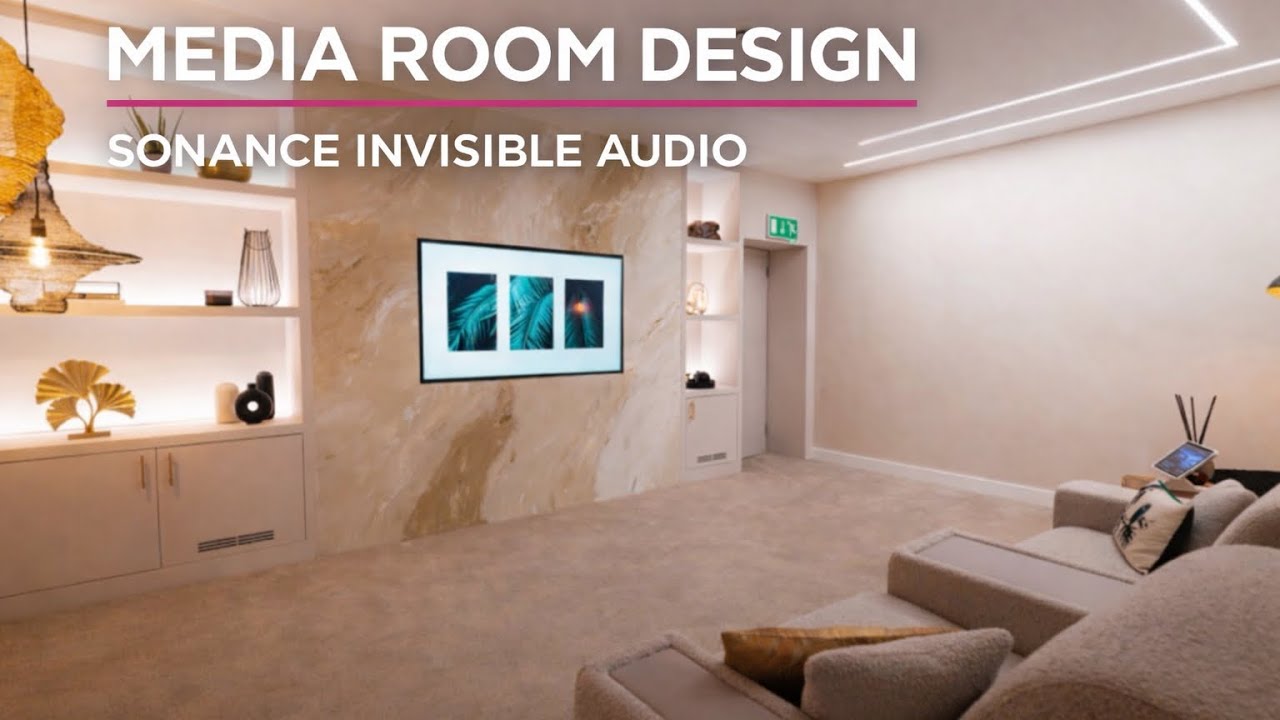
Steinway Lyngdorf's UK demonstration suite sits inside a converted equestrian farm in the Essex countryside. There's a dressage arena outside, a hydrotherapy centre on the same site, and an airfield called Andrew's Field a short drive away — clients with their own helicopters routinely land there and get collected for the day. Inside, on a single wall, sits a quarter-of-a-million-pound audio system — and the people running the showroom are still slightly stunned that they get to do this for a living.
In conversation with Zebra Home Cinema, Simon, the Sales Operations Manager who runs the UK operation alongside his colleague Charlie, walked through the full Steinway Lyngdorf product range, the engineering decisions behind it, and why the brand insists on a closed loop between Steinway speakers and Lyngdorf electronics.
Where the Showroom Sits
Simon and Charlie were handed the keys to the building in August 2022. At the time it had been a call centre — old desks, no walls, no cinema. They unpacked their first delivery from Denmark themselves, propped a system up on a table, ran a calibration, and sat down to listen.
"We propped it up on a table, and we put the subs in the corner, and we did a RoomPerfect calibration, and we sat there, and it was just this moment of like — wow. I I'd been in the industry long enough to hear about them and know that they make these systems that are amazing sounding. But to actually sit and listen to it and really kind of understand it and be blown away by it is why it's so memorable. It was like me and Charlie just looked at each other with this grin on our face, like — I can't believe this is actually real."
The site was chosen as much for its atmosphere as its location. Essex sits within easy reach of London but in genuinely rural surroundings — the equestrian farm setting lets clients detach from a working day rather than fight traffic into a city demonstration. The fact that helicopters land at Andrew's Field a short drive away is, in practice, used by enough clients that it's a real selling point rather than a brochure detail.
A 170-Year Partnership
The central technical claim of the brand is also one of the strangest collaborations in modern audio engineering. Steinway & Sons has been making concert grand pianos since 1853. They are the world's most-specified concert piano — virtually every major concert hall in the world has at least one. Steinway has, in 170 years, refused to put their name on any other product.
With one exception.
In the late 1990s, Peter Lyngdorf developed an amplifier called the TacT Millennium — the world's first fully digital amplifier. Word reached Steinway that listeners were reporting they had never heard a piano sound like that through an audio system before. That conversation produced an exclusive partnership.
"We are the only company in 170 years to partner with Steinway & Sons — but not just partner, physically have Steinway & Sons on the front of the products."
The entire Steinway Lyngdorf product range was built from there. The flagship Model D was developed first, with a single design brief: it had to be the purest possible audio reproduction. No characteristic colouration. The realism of a vocal. The realism of a Steinway grand. Anything less and Steinway & Sons would not let their name on it.
That single rule — no colouration — explains almost every technical decision in the product line.
The Model Range, Mapped to a Piano Range
The entire Steinway Lyngdorf naming convention mirrors Steinway's piano line.
| Speaker | Footprint | Notes |
|---|---|---|
| Model D | Full-range floor-stander, ~2.5m tall | The reference flagship |
| Model C | Floor-stander | Less common, statement piece |
| Model B | Floor-stander, 12 × 12-inch woofers in the pair | Massive SPL, must be away from walls |
| Model A | Floor-stander, AMT tweeter + dual 12-inch | Best value-for-money in the floor-stander range |
| Model O | Smaller floor-stander | Designed for warmer, more intimate listening |
| Model M | Compact floor-stander | Custom-install option |
| Model S | On-wall, smallest in the range | The world's biggest-selling Steinway speaker |
| Model S Soundbar | Three Model S-15s + two 10-inch subwoofers | Launched early 2024 |
Each speaker is engineered for a specific room and a specific listener. The brand is explicit that no model is better than another — they're better for certain situations.
A few that are worth understanding individually.
Model B — Engineered Without Compromise
The Model B is the model Simon describes, with a slight grin, as engineering for engineering's sake.
"We have twelve 12-inch woofers in the pair of floor-standers. So these things can play at absolutely massive SPL levels. And the DSP within the digital amplification just never fails. You will deliver that full-range sound — be it that you're listening at a quiet level, still getting the highs, the mids, the lows — but then if you really want to give it some beans, you don't lose that detail throughout the process."
The Model B is a dipole design and has to be positioned away from walls for that geometry to work. That makes it a poor fit for any room where a floor-stander has to live close to a back wall — which is precisely why the Model A exists.
Model A — When the Room Won't Allow a Dipole
The Model A is the closest the range comes to a single answer for the question I want a flagship-level Steinway floor-stander but my room won't allow a dipole. It uses an AMT (air motion transformer) tweeter for high-frequency clarity and a dual 12-inch woofer arrangement built into the speaker itself.
For a meaningful number of clients, the Model A is the value sweet spot — it delivers the same family voicing as the Model D and Model B in a smaller footprint that doesn't demand a dedicated listening room.
Model O — Small Footprint, Warm Voice
The Model O is designed for smaller rooms — particularly snugs, libraries, and listening rooms where a jazz or classical listener wants the Steinway sound at a more intimate scale. It's engineered to sit close to walls without acoustic compromise — a deliberate design call rather than a placement workaround.
Model S — The World's Biggest-Selling Steinway Speaker
The smallest speaker in the line is also the most-sold. The Model S is an on-wall design with a triangular open baffle inside the cabinet. The tweeter fires onto the baffle and the sound radiates from the sides of the speaker rather than directly forwards.
"It sounds a lot bigger than it is, and it's often quite shocking. It's the demo that you do to someone — they see these small speakers, and they think, 'Oh, it's going to do something.' And then it does what it does, and it's like, 'Wow, how is that physically possible coming from that speaker?'"
The Model S is also the most commonly specified Steinway speaker into multi-channel cinema and media rooms — partly because it's the easiest to integrate aesthetically and partly because the open-baffle radiation pattern works exceptionally well as a height speaker or surround in a Dolby Atmos array.
Model S Soundbar — A Wall of Sound in Bar Form
Launched in early 2024, the Model S Soundbar is, technically, three Model S-15 speakers married into a single bar form-factor with two 10-inch subwoofers built into the cabinet. Calling it a soundbar arguably undersells it.
The brief was to take the Steinway Lyngdorf voicing into media-room and integrated-cinema projects where a floor-stander or in-wall arrangement isn't viable for aesthetic reasons. It can be specified in standard high-gloss black or fully customised with the signature 24-karat gold lacquer finish — the same finish Steinway uses on its concert grand pianos.
Boundary Woofers and RoomPerfect
Two engineering choices appear in every Steinway Lyngdorf installation: subwoofers placed in the corners of the room, and a calibration system called RoomPerfect.
The boundary placement is deliberate.
"We as a manufacturer prefer to have woofers positioned in the corners — the boundaries of rooms — because we gain energy from that. And within our calibration system, RoomPerfect, which is world-renowned as one of the easiest and most accurate calibration tools that can automatically do this for you, it really loves that boundary sound."
The technical reason: a subwoofer in a corner has three reflective surfaces around it (two walls and a floor) reinforcing the low-frequency output. That increases efficiency and shortens impulse times — bass arrives faster and with more energy than the same driver firing into open space.
RoomPerfect is then layered on top to manage what corner placement does to the room's modal behaviour. Most calibration systems try to flatten everything; RoomPerfect's design priority is keeping the speaker's signature sound intact while taking the room's worst behaviours out.
"RoomPerfect just gives us that confidence that the dealer is able to deliver the best that system can sound within the majority of environments. Of course, if it's going into a spherical glass box, then that's the most challenging environment that you could imagine. But within reason, RoomPerfect really does tailor the sound for that listening room to make it as emotional as possible. Calibrating audio is one thing, but taking the emotion out of the sound is another."
This is the engineering pitch for why a calibrated reference system in a real room can outperform an exotic, uncalibrated system in a notionally perfect room. Most listening rooms are domestic — lime-plaster walls, glass, soft furnishings. RoomPerfect's job is to make those rooms sound as close as possible to what the speaker was designed to deliver.
The Closed Ecosystem — and Why It's Closed
One quirk of the Steinway side of the brand is that it's a sealed loop.
"It's illegal to buy third-party amplification and processing for a Steinway system. The electronics are very important — they are the heart of the system. With Steinway, the Steinway electronics are a necessity for the system to perform the way that it should. It's one of the ways in which we are able to guarantee that level of quality."
Lyngdorf's general electronics — the amplifiers and processors sold without Steinway branding — work fine with third-party speakers. The Steinway side does not. Buy a pair of Model B floor-standers and the only legitimate way to drive them is with the matched Lyngdorf electronics.
The rationale is straightforward: the speakers are designed to be driven by specific amplification, with specific DSP, calibrated by RoomPerfect against the specific characteristics of the speaker. Substitute any of those three elements and the resulting performance is no longer Steinway's responsibility — and they won't put their name on it.
The 24-Karat Gold Volume Wheel
A small detail that is, surprisingly, one of the most distinctive parts of the system. The Steinway Lyngdorf remote control includes a 24-karat gold infinite-spinning Swiss-bearing volume wheel.
It's a digital control — not an analogue potentiometer — so the rotation isn't physically resisting anything. The system is digital end-to-end, and increasing the volume increases the voltage applied to the full-range signal without altering its detail. The wheel itself is solid, heavy, and turns indefinitely in either direction.
"It's a cool little feature. The client can sit there on their Friday night, whiskey in hand, give it a little spin, and they're listening to the best audio they can listen to. Heavy is good. Heavy is reliable — you know, if someone breaks into your house, you've got a weapon."
Who Buys One
When Simon is asked who the typical client is, the easy answer would be audiophiles. But after five years working with the brand, he draws the audience differently.
Yes, the natural starting customer is the long-time audiophile — someone with prior reference systems whose ear has been opened by hearing a Steinway demo properly. But a growing share of clients are people who never identified as audiophiles at all. They were invited to a friend's house, sat down, listened, and decided they needed to live with the experience.
"I've worked in this industry for nearly fifteen years now. I've worked with a lot of products, a lot of brands. Everything has its place. But it's the first time that I've sat down and listened to an audio system and it really captures you emotionally. When you hear the crackle in someone's voice, when you hear the clarinet, the keys move as the finger rubs across it, the foot changes on the pedals of the piano — all of that thing that pulls the story the artist wanted to tell through the emotion of it."
That customer profile — people who didn't know they liked speakers until they heard one — is a meaningful share of the showroom's specification. It's also the reason the showroom exists at all. You can't sell this kind of system on a spec sheet. You can only sell it by sitting someone down in a calibrated room and pressing play.
Key Takeaways
- ▪The Steinway Lyngdorf UK showroom is in the Essex countryside on a converted equestrian farm. It sits next to an airfield (Andrew's Field) for clients arriving by helicopter, and the building was acquired by managers Simon and Charlie in August 2022.
- ▪Steinway Lyngdorf is the only brand in Steinway & Sons' 170-year history to be allowed to carry the Steinway name on a product. The partnership originated with Peter Lyngdorf's late-1990s TacT Millennium — the first fully digital amplifier — which was reported to reproduce piano in a way nothing else had.
- ▪The product range mirrors the Steinway piano range: from the smallest on-wall Model S (the world's best-selling Steinway speaker) to the Model D flagship floor-stander. Each model is engineered for a specific room and listening intent rather than a single universal answer.
- ▪The Model B uses 12 × 12-inch woofers across a pair of dipole floor-standers — for high-SPL reference listening in dedicated rooms. The Model A trades the dipole design for a single-cabinet AMT-tweeter format that works closer to walls. The Model O is engineered to sit near boundaries without compromise.
- ▪Subwoofers are deliberately placed in room corners for energy reinforcement and faster impulse times. RoomPerfect calibration is layered on top to manage room modes without stripping the speaker's signature character — the priority is keeping the emotion of the sound intact, not flattening it.
- ▪The Steinway side of the brand is a closed ecosystem. Steinway-branded speakers must be driven by matched Lyngdorf electronics — third-party amplification or processing is not authorised. The Lyngdorf-only side of the brand (without Steinway badging) is fully open and works with third-party speakers.
Frequently Asked Questions
What is Steinway Lyngdorf and how is it related to Steinway & Sons?
Steinway Lyngdorf is the only company in Steinway & Sons' 170-year history to be allowed to carry the Steinway name on a non-piano product. The partnership began in the late 1990s, after Peter Lyngdorf's TacT Millennium — the world's first fully digital amplifier — was reported to reproduce piano sound at a level no other amplifier had achieved. The two companies developed the Model D flagship loudspeaker together as the brand's first product.
Where is the Steinway Lyngdorf UK showroom located?
The UK demonstration suite is in the Essex countryside, on a converted equestrian farm. Visitors can arrive by car or — for clients with their own aircraft — land at Andrew's Field, a small airfield a short drive away, and be collected from there. The showroom was acquired in August 2022 by the brand's UK managers Simon and Charlie and rebuilt from a former call-centre space.
What is the Steinway Lyngdorf Model D?
The Model D is the brand's flagship full-range floor-standing loudspeaker — approximately 2.5 metres tall — and was the first product developed under the Steinway & Sons partnership. It was designed with a single brief: zero characteristic colouration, so it could reproduce a Steinway grand piano with full realism. Every other speaker in the range is voiced from the Model D as a reference.
How does the Model B differ from the Model A?
The Model B is a dipole floor-stander built with twelve 12-inch woofers per pair, designed for very high SPL in dedicated reference rooms — and it must be positioned away from walls for the dipole geometry to work. The Model A delivers similar high-output performance in a single-cabinet design with an AMT (air motion transformer) tweeter and a dual 12-inch woofer per speaker. The Model A works much closer to walls and is, for many clients, the practical choice when the listening room won't accommodate a dipole.
What is RoomPerfect calibration?
RoomPerfect is Lyngdorf's proprietary room-correction system. Unlike most calibration software, which tries to flatten everything in the room, RoomPerfect's design priority is keeping the speaker's signature sound intact while removing the worst of the room's modal and reflective behaviour. It works particularly well with corner-placed subwoofers, which Steinway Lyngdorf prefers for energy reinforcement and faster bass impulse times.
Why does Steinway Lyngdorf require Lyngdorf electronics with Steinway speakers?
Because the speakers are engineered to be driven by specific amplification, with specific DSP, and calibrated by RoomPerfect against the specific characteristics of the speaker. Substitute any of those three elements and the system no longer performs as Steinway's engineers and Steinway & Sons signed off on. The closed loop is the brand's way of guaranteeing the system always sounds as it was intended to. Lyngdorf's own electronics (without Steinway branding) work with third-party speakers; the restriction applies only to Steinway-badged systems.
Who typically buys a Steinway Lyngdorf system?
Two audiences. The first is the long-standing audiophile who has owned reference-level systems before and recognises that Steinway Lyngdorf goes a step further on emotional reproduction. The second — and increasingly the larger — is people who never identified as audiophiles at all but were invited to listen to a system at a friend's house or a showroom and decided they needed to live with the experience. The showroom exists precisely because this kind of system can't be sold on a spec sheet.