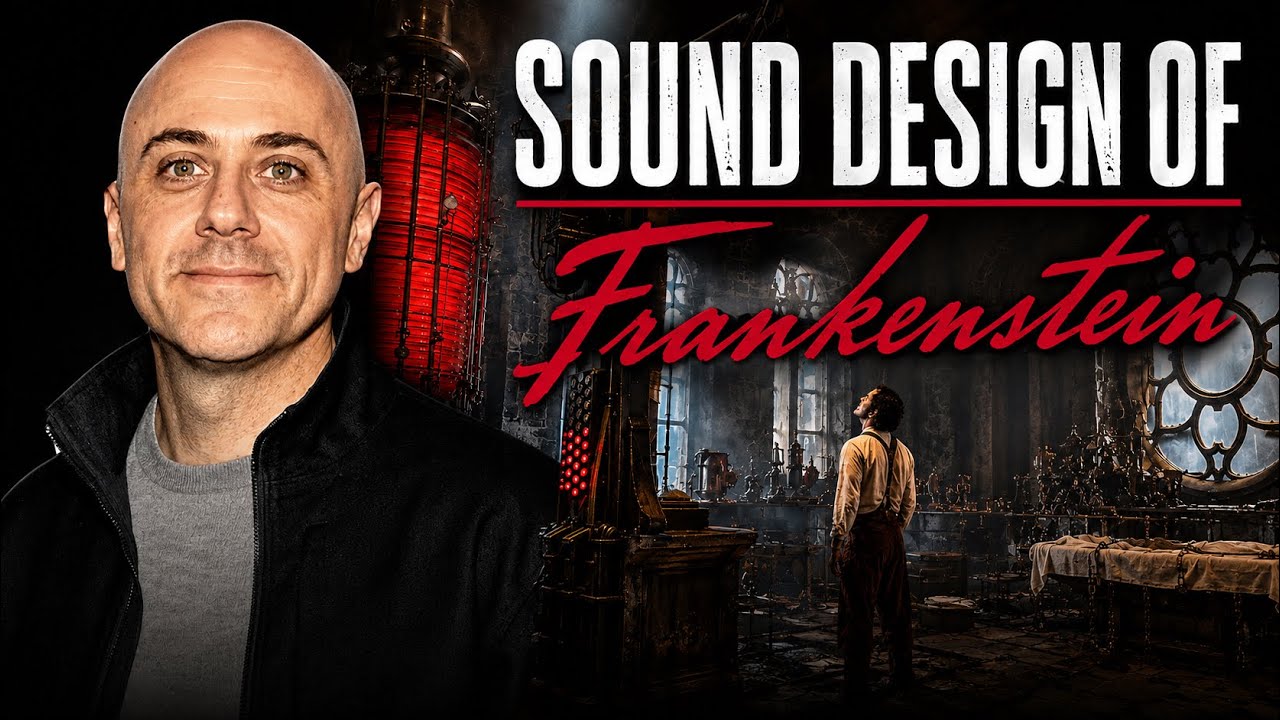
There is a quote pinned to Mike James Gallagher's website that has been there since the day he built it. It comes from Randy Thom, the Skywalker Sound veteran who wrote an essay in the 1990s called Designing a Movie for Sound. Thom's argument was blunt: sound should not be something you bolt on at the end, hiring the sound crew to plop effects over a finished cut. It should be there in pre-production, in the writing, in the storyboards. And buried in that essay is the line that Gallagher read on a plane in the early 2000s and never let go of.
"We should compile some huge compendium of what sound can do in movies, because most of us, especially movie directors, often seem so unaware of how versatile sound is."
"And I remember just being like, that's what I'm doing," Gallagher says.
That compendium is now real. It is called INDEPTH Sound Design, and in a conversation with Zebra Home Cinema, the Los Angeles sound designer behind it explained how a childhood obsession with Nine Inch Nails and Star Wars turned into a career, a mission, and a growing archive of interviews with the people who built the sound of modern cinema.
From Nine Inch Nails to ProTools 5.1
Like most sound designers, Gallagher started with music. He was, and still is, deeply into Nine Inch Nails, and if you go back to those early albums you can hear why. They are as much sound design as they are songs, dirty and lived-in and acoustic in a way that eventually made Trent Reznor's move into film scoring, and his Oscar, feel inevitable. Ben Burtt's work on Star Wars pulled at the same thread. Both had that grubby, real-world texture, and Gallagher resonated with it early.
He played keyboards in an 80s cover band in Louisiana. In the early 2000s he was working at the only ProTools studio in town, learning the software at the tail end of the Mac OS 9 era.
"ProTools 5.1 came out the year that I started, and that was the first time you could do surround sound in ProTools. It would have been ProTools 6, but they named it 5.1 just to sound like surround sound, you know, 5.1 channels."
What happened next is the part most people get wrong when they hear his story. Gallagher did not go straight from music into film sound. He took a long detour through picture. He left Louisiana for New York, then Los Angeles, and the jobs that came were all editorial: assistant picture editor, then media manager at Fox Studios, then head of post-production at a media facility. For the better part of a decade he was doing picture workflow, not sound.
He is adamant that the detour made him, and that the direction matters.
"The best thing that could have happened was studying sound and then getting into video. So many people are not aware of what sound can do, what sound is doing to them, and they have no idea. I was bringing the art of sound into the video world."
People kept having sound problems, and someone would say go grab Mike. He would fix it, and they would be amazed. That reputation moved him up the ranks fast. In 2018 he stopped denying where he came from, started INDEPTH Sound Design, and went full-time as a sound designer the same year.
The Terminator 2 Carousel That Started It All
INDEPTH has a precise origin, and it is not glamorous. Around 2017, Gallagher was head of post at a media company, driving to work, thinking about a new Instagram feature: the carousel, which for the first time let you swipe through several videos in a single post.
That reminded him of a DVD featurette he had watched as a kid. It was a breakdown of a shotgun sound from Terminator 2: Judgment Day, followed by commentary from Gary Rydstrom, the film's sound designer and re-recording mixer. Gallagher had spent years hunting that clip down, first on his own DVD, later on a terrible YouTube rip. And it struck him, right as physical media was dying and everything was sliding onto Netflix and Amazon, that this stuff was about to vanish.
"I found that DVD special feature, I ripped it in the highest quality that I could, and then I re-synced it to the new Blu-ray restoration of Terminator 2. So it was this sound breakdown of this shotgun with visual fidelity we had never seen."
He uploaded it as a carousel. If it hit a thousand followers, he thought, his mind would be blown. That was the birth of INDEPTH.
The whole thing grew out of a specific frustration. When Gallagher finally reached the post-production DVDs for The Lord of the Rings, the sound featurette was only seven minutes long, and he sat there thinking: why isn't this two hours? He would later make a feature-length documentary on the sound design of The Lord of the Rings, cut entirely from those old DVD extras, just to preserve them. Skywalker Sound, he points out, was unusually good at turning its sound people into rock stars. Ben Burtt, Gary Rydstrom, Randy Thom. As a kid he wanted to be them.
Today INDEPTH is that compendium Randy Thom described, built in real time. Gallagher's short reels break into a captivating scene, let it play, then cut to the sound designer explaining how it was done. He has sat across from Mark Mangini, Richard King, Johnny Burn, and others. It is, in effect, a digital museum of how film sound gets made.
Why Hollywood Still Records Everything Fresh
One of the most interesting stretches of the conversation was Gallagher's answer to a layman's question. With decades of digitised sound effects sitting on every hard drive, why still send people out to record wind through the reeds, or Watson Wu pulling triggers on guns with a mic?
Gallagher sits in an unusual spot generationally. Mark Mangini comes from an era before you could summon a million freshly recorded, boutique library sounds; recording fresh is simply what he has always done. Gallagher came up when the libraries were already there. He bought Mangini's library and still uses it. He also works in a world of shrinking budgets, where nobody hands him a year to go collect sounds the way Ben Burtt had on the original Star Wars.
And yet he keeps going out to record. Mangini's analogy stuck with him.
"When you're watching your favourite new film of the past ten years, it's not full of stock footage that was just downloaded from a website. It's all fresh. The cinematographer was paid a lot of money to make these fresh new visuals, so the sound designer should have that freedom too."
There is a practical edge to it as well. Recording exactly what is on screen is often easier than assembling it from a library. Gallagher and his peers, who mostly work on lower-budget jobs, find cars especially hard to cut from a library alone. Meanwhile Richard King and Mark Mangini, working on hundred-million-dollar films, take the actual Porsche or Ferrari out to an airport runway, record precisely what is in the movie, and drop it straight in. Johnny Burn, the sound designer on Poor Things and The Zone of Interest, goes further still. Gallagher does not think Burn uses a single canned effect, recording everything fresh and tailored to the film.
Sound also ages. Cop sirens in New York change. The way people speak in a neighbourhood shifts over the years. To keep a film feeling current, you have to capture the world as it actually sounds now, which is why Gallagher is confident libraries and AI will never fully replace fresh recording.
Mangini, Foley, and the War on "Dry-Ass" Sound
The single idea that has shaped Gallagher's craft most came from an off-camera conversation with Mark Mangini about a scene he had already dissected for INDEPTH: the Sapper Morton Foley in Blade Runner 2049.
It is a quiet moment near the start of the film. Dave Batista, a giant of a man, simply walks through his house. No music. No big steps. And yet the entire room resonates around him, the plates shifting in the cabinets, the silverware in the drawers, the reverb wrapping around you in Atmos. It is completely immersive precisely because it is so restrained.
When Gallagher asked Mangini about it, Mangini explained that he has to specifically ask his Foley team to make it dirtier and more acoustic than they normally would.
"The way Mark puts it, he says he hates dry-ass Foley. And that forever sticks with me."
The point cuts against a lot of formal training. Many beginning supervisors send a film off to Foley, get it back, and that is that. What they get back is often recorded in pristine fidelity, super close-miked, and it fights you when you try to place it in a scene. You end up battling the tippy-tappiness, piling on digital reverb to fake a room that was never captured. Mangini's approach bakes the resonance and the acoustic quality in from the start, because you cannot add it convincingly later.
Gallagher draws the line straight back to his heroes.
"Star Wars has this dirty, lived-in feeling to it, and we're all so influenced by that sound. But then when we make stuff, we bring the mic too close and we want to deaden the room completely. And that's just not the sound that I like, or that I think people like."
The Superpower of Leaving Space
If dirtiness is one half of Gallagher's philosophy, restraint is the other. His comfort film is No Country for Old Men, which he will drop into at any random scene, every time struck by how much the Coens are willing to leave out. Long stretches with no music. Deliberate distance between lines of dialogue. Pure space and texture.
"I can smell that movie. I can feel the heat, the dry Texas atmosphere of that film."
He uses it as a teaching example with directors, urging them not to be afraid of space, because a lot of directors get insecure and reach for music to fill every gap. The pushback against that instinct is what he calls mix focus, and Ready Player One is his favourite demonstration.
There is a race scene near the start with almost no music and very little dialogue, just sound effects over some of the most chaotic visuals ever put on screen. King Kong, a train roaring past the camera, a T-Rex breaking loose. And despite all of it, you only ever hear two or three sounds at a time, weaving in and out of each other. Gallagher credits the confidence Steven Spielberg and Gary Rydstrom have built over decades of working together.
"Why am I not hearing the T-Rex foot stomps after the roar? And it's like, don't worry about that, we're on the car that's past us now. We're on the coins the character is collecting. Once people realise they can do that, it's a superpower."
It works, he explains, because it mirrors how hearing actually functions. In a loud bar, your brain already tunes out everything except the voice in front of you. Good sound design just does what the brain would do anyway. He points to a related trick from The Social Network: every new Harvard location is bustling and loud, and rather than endlessly turning the volume up scene after scene, mixer Michael Semanic starts each one loud and lets it fall away to just the dialogue, so the next location can slam back in at full volume.
Mike James Gallagher's INDEPTH Reference Points
For anyone trying to develop an ear, the scenes Gallagher returns to double as a syllabus. Here are the touchstones he raised, and what each one teaches.
| Film or show | Sound artist referenced | What it demonstrates |
|---|---|---|
| Terminator 2: Judgment Day | Gary Rydstrom | The shotgun breakdown that launched INDEPTH |
| Blade Runner 2049 | Mark Mangini | Dirty, acoustic Foley and full immersion in Atmos |
| Panic Room / Se7en | Ren Klyce | "Psychotic attention to detail"; recording on set at matched mic distances |
| No Country for Old Men | Coen brothers | Space and texture, and the courage to leave sound out |
| Ready Player One | Gary Rydstrom / Steven Spielberg | Mix focus, two or three sounds at a time |
| The Social Network | Michael Semanic / Ren Klyce | Managing loudness across bustling locations |
| The Lord of the Rings | Various | Gallagher's self-made film school, built from DVD extras |
Ren Klyce's method on Panic Room is worth singling out. With access to the actual set, Klyce recorded the sounds he knew were coming in the script at the same mic distances the scenes would be shot, so the effects dropped straight into the film and simply fit. Gallagher loves these old-school techniques, and reaches for them over new plugins because they consistently give the best results.
Why This All Falls Apart on an iPhone
Here is where a sound designer's work meets the living room, and where Gallagher gets a little uncomfortable, because he is guilty of it too. Films get made with enormous care by supremely talented people pouring years into every layer, and then a lot of us watch them on a plane, on a phone, on a television with no soundbar. The least you can do, the argument goes, is listen to it properly.
He does not disagree.
"There's nothing beats moving air. You've got to feel that room moving with you."
You only really understand what you have been missing, he says, once you watch the same content on a proper system. And this is no longer just a cinema question. The big prestige television shows, from Stranger Things to Pluribus to The Boys, are using exactly the same techniques and the same Skywalker-calibre talent, building genuinely cinematic soundtracks that a phone speaker throws in the bin.
His own reference memory makes the case. About a week before he first met Mark Mangini, Gallagher watched Blade Runner 2049 in a friend's Atmos home theatre, and the experience was so memorable it was one of the first things he told Mangini about. That is what a properly calibrated home cinema does. It takes the Foley Mangini fought to keep dirty, the reverb Rydstrom placed with such focus, the space the Coens were brave enough to leave, and lets all of it land the way the people who made it intended. Compress it for earbuds and the resonance in Sapper Morton's kitchen collapses into nothing.
Gallagher's own analogy for the difference is a good one. It is electric vehicles versus a V8 rumble. Both are fast, both get you from A to B, but one of them you feel. You smell the fumes. You have to experience it to appreciate it, and the same is true of a film heard the way it was mixed.
Going Live, and a Master Class With Randy Thom
The most common comment under Gallagher's clips is a plea: where's the full video? Long-form is harder to make than people assume, but his answer for now is a live show, staged with Mark Mangini and other sound designers. He plays his vertical reels on a giant theatre screen, apologises for the vertical format, then uses each clip as a launchpad for a 90-minute conversation packed with exclusive recordings, photos, and stories. He even folds in the comments the videos get, an INDEPTH show about INDEPTH.
They have run it at Sony's Mix Sound for Film, at Cal Lutheran in Thousand Oaks, and are heading to Louisiana, his home state. Much of it is a genuine surprise to Mangini in the moment, because Gallagher preps material his co-host has forgotten they discussed, which makes the reactions real for the audience.
The thread ties all the way back to the beginning. Gallagher has struck up a collaboration with Randy Thom himself, the author of the essay that started everything. The two are developing a live master class built around Designing a Movie for Sound, a fresh, day-long take on the essay Gallagher highlighted on a plane two decades ago, planned for 2027.
"As somebody that has been a huge fan of Randy and the Designing a Movie for Sound essay, I am having a blast developing this with him."
Key Takeaways
- ▪Mike James Gallagher is a Los Angeles sound designer (MPSE) and the founder of INDEPTH Sound Design, a platform devoted to making the invisible art of film sound visible through short clips and interviews with legends like Mark Mangini, Richard King, and Johnny Burn.
- ▪INDEPTH began around 2017 as a preservation project: a Terminator 2 shotgun breakdown, ripped from an old DVD featurette and re-synced to a Blu-ray restoration, uploaded as one of Instagram's new carousels. It grew out of Randy Thom's call to "compile some huge compendium of what sound can do in movies."
- ▪Gallagher's craft rests on two ideas he traces to Star Wars and to Mark Mangini: sound should be dirty, acoustic, and lived-in rather than pristine and close-miked, and it should have the confidence to leave space, with mix focus that plays two or three sounds at a time instead of everything at once.
- ▪Hollywood still records sounds fresh, even in the AI era, because the world keeps changing and bespoke recordings drop into a film more convincingly than any library, just as a film's visuals are shot fresh rather than downloaded as stock.
- ▪All of that craft only reaches you on a system that can reproduce it. A properly calibrated home cinema is what turns the resonance, reverb, and deliberate silence of a modern mix into the immersive experience its makers intended, the difference, in Gallagher's words, between an EV and a V8 rumble.
Frequently Asked Questions
Who is Mike James Gallagher?
Mike James Gallagher is a Los Angeles-based film and television sound designer and a member of the Motion Picture Sound Editors (MPSE). He is best known as the founder of INDEPTH Sound Design, a platform that breaks down famous film sound moments and interviews the sound designers behind them. He came to sound through music, took a decade-long detour through picture editing and post-production, and went full-time as a sound designer in 2018.
What is INDEPTH Sound Design?
INDEPTH Sound Design is the platform Gallagher created to make film sound design visible and appreciated. It started around 2017 as an effort to preserve DVD special features that were disappearing as streaming replaced physical media. Today it publishes short reels that dissect iconic scenes, features interviews with sound designers such as Mark Mangini and Johnny Burn, and has expanded into live theatre shows.
What is Randy Thom's "Designing a Movie for Sound" essay?
Designing a Movie for Sound is an influential essay written by Skywalker Sound designer Randy Thom in the 1990s, originally delivered as a lecture. Its central argument is that sound should be considered from the earliest stages of a film, in the writing, storyboarding, and shooting, rather than added at the end. Gallagher read it in the early 2000s, has sent it to directors ever since, and is developing a live master class based on it with Thom for 2027.
Why do sound designers record new sounds instead of using libraries?
Because fresh, bespoke recordings fit a specific film better than generic library effects, in the same way a film's visuals are shot fresh rather than downloaded as stock footage. Recording exactly what appears on screen, the actual car or the actual location, is often easier and more convincing than assembling a scene from a library. Sounds also evolve over time, so capturing the world as it currently sounds keeps a film feeling current.
What does "dry-ass Foley" mean?
It is Mark Mangini's phrase for Foley recorded too cleanly, super close-miked in pristine fidelity, with the room deadened. Mangini asks his Foley team to record dirtier and more acoustic instead, capturing natural resonance and reverb that cannot be convincingly faked with digital effects later. Gallagher cites the Sapper Morton kitchen scene in Blade Runner 2049 as a masterclass in this warmer, more immersive approach.
Why does a good sound system matter for watching films at home?
Because enormous craft goes into a film's sound, from dirty Foley to precise mixing to deliberate silences, and most of it is lost on a phone, a laptop, or a television with no dedicated audio. Gallagher points out that prestige TV now uses the same cinematic techniques and talent as feature films. A properly calibrated home cinema, ideally with Dolby Atmos, is what lets the resonance and space of a modern mix land the way its creators intended.