The Brief: A Room for Real Life
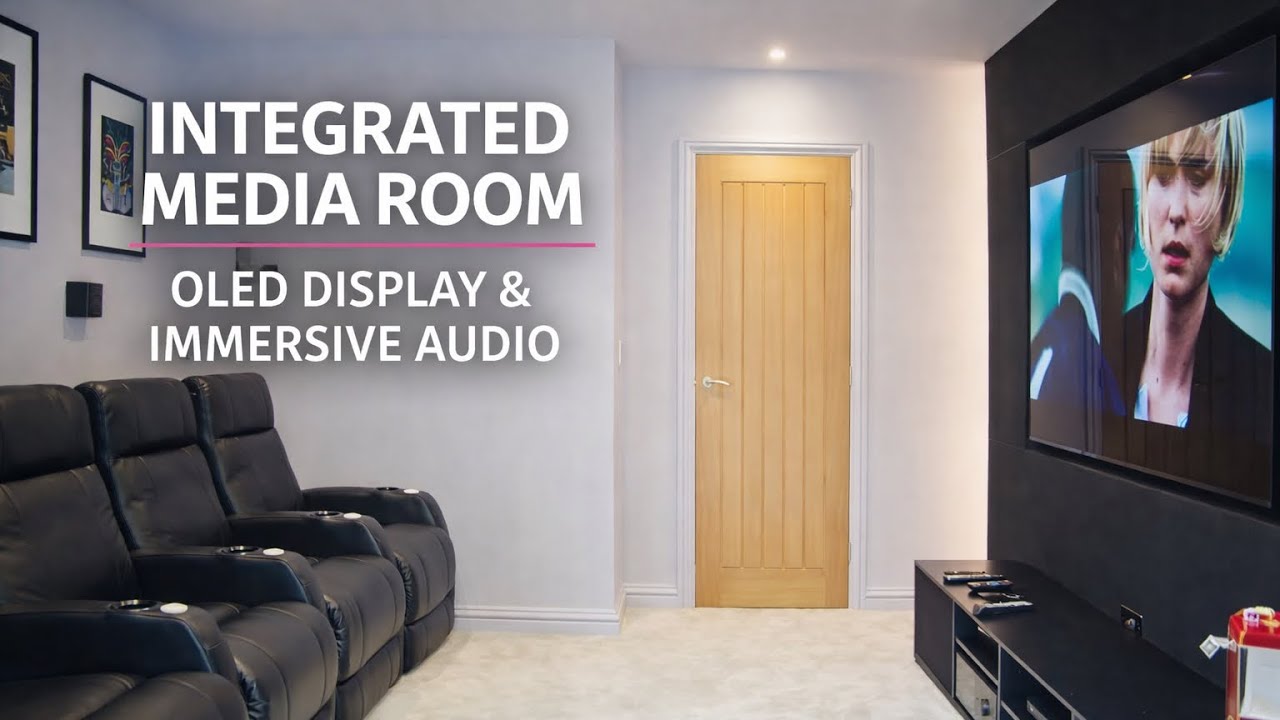
Bradley Isaacs had a clear picture in his mind before he ever called Zebra. He'd bought a new property with a room that felt like it was made for something special — not a dedicated screening vault buried in the basement, but a space right in the heart of the family home. Somewhere the kids could play Xbox after school, where the whole family could settle in for football on a Saturday afternoon, and where he and his wife could unwind with a film in the evening.
That dual brief — daytime versatility and genuine evening performance — is one of the most common briefs Atif at Zebra encounters. And it's one of the most demanding to get right.
"I didn't want it to be too dark. It's not in the basement of the house — it's in the heart of the home. Somewhere you can sit in the day and enjoy a film, and also in the evening." — Bradley Isaacs, homeowner
Why M&K Sound? The Studio Monitoring Advantage
Bradley came to Zebra with a brand already in mind. He'd done his research, and he kept arriving at the same name: Miller & Kreisel.
M&K Sound is a legend in professional audio circles. The brand's speakers have served as reference monitors in some of Hollywood's most celebrated mixing studios for decades. When sound designers are making decisions that affect how millions of people will hear a film, many of them trust M&K. That provenance matters enormously when choosing a home cinema speaker system.
But there's a frustrating catch: M&K is almost impossible to demo in the UK. They don't appear on high street shelves. You won't find them in electronics showrooms. They're a custom-install-only brand, sold through specialist integrators — which is exactly the kind of access Zebra provides.
"I noticed that a lot of studios use M&K speakers. You never see them in-store, so it's very hard to have a demonstration of them and know what they're actually like." — Bradley Isaacs
Bradley managed to get a demo. He listened. He was convinced. And crucially, he noticed something else about M&K: the speakers don't change. They don't get refreshed every 18 months for the sake of marketing cycles. They stay in range because they're designed around acoustic performance, not fashion. For a buyer who values longevity over novelty, that sent a strong signal.
System Specification
| Component | Model | Notes |
|---|---|---|
| Front L/C/R | M&K Sound IW950 (in-wall) | Horizontally-mounted centre for low-profile OLED integration |
| Subwoofers | M&K Sound V10 Plus (×2) | Positioned using REW room analysis |
| Display | OLED TV | Flush-recessed, single-plane integration |
| Gaming | Xbox (via HDMI) | Primary daytime use |
The In-Wall Decision: Keeping the Room a Room
One of the most important design choices in this project was the decision to go fully in-wall on the front soundstage. Bradley was specific: he wanted the entire front wall to read as one seamless, integrated plane — OLED screen flush in a recess, speakers hidden behind, nothing protruding into the space.
That ruled out on-wall or freestanding speakers immediately. On-wall speakers are easier to install and often deliver marginally simpler acoustic calibration, but they break the visual harmony of a room designed to look like a room, not a cinema.
The M&K IW950 in-wall speaker is purpose-built for exactly this application. The key engineering detail: the centre channel can be mounted horizontally, keeping the profile low enough to allow the OLED screen to sit at the correct viewing height without compromise. When the TV is at the right eye level, the centre — the speaker carrying roughly 70% of on-screen dialogue — aligns precisely with the action.
Why Two Subwoofers?
Bradley's room received a pair of M&K V10 Plus subwoofers rather than a single unit. This is a decision grounded in acoustic science, not specification excess.
Bass frequencies in a standard rectangular room create standing waves — pressure nodes where bass builds up or cancels out depending on where you're sitting. A single subwoofer, however good, cannot overcome the physics of room modes. Two subwoofers placed asymmetrically (informed by REW — Room EQ Wizard — measurements) smooth the bass response across multiple seating positions.
The result: whether Bradley's daughter is on the left side of the sofa or his son is sitting dead centre, everyone hears the same tight, extended bass — not a boomy hot spot or an inexplicable dropout.
The Result: A Space the Whole Family Actually Uses
The measure of a great media room isn't what it does on a showroom demo. It's whether the family genuinely gravitates towards it day after day.
Bradley's verdict:
"We love the space. We tend to go in there quite a lot now with the kids. They play the Xbox in there during the day and after school — but mainly for physical media, we go in there and enjoy it. It sounds and looks great."
That last detail matters. Physical media — Blu-ray, 4K Blu-ray — still delivers the highest sustained quality available for home cinema. Kaleidescape aside, nothing streams at the full bitrate of a 4K disc. Bradley reaches for physical media as the preferred format for serious viewing, which tells you something about the system's resolving capability: it's transparent enough that the format difference is audible.
Key Takeaways for Your Own Media Room Project
- ▪In-wall speakers are the right call when visual integration matters — the M&K IW950 proves you don't sacrifice performance for aesthetics
- ▪Two subs always outperform one — REW-guided placement is the difference between "good bass" and "accurate bass across the whole room"
- ▪The best home cinema is one you actually use — designing for daytime flexibility, not just evening performance, is the smarter brief
- ▪Custom-install-only brands require specialist access — if you've never been able to demo M&K, that's the system, not the brand
FAQ: Residential Media Room Design
What's the difference between a media room and a dedicated home cinema?
A dedicated home cinema is a purpose-built space optimised entirely for film watching — blackout, acoustic treatment, no competing uses. A media room is designed as a living space first, with high-performance AV integrated into it. Media rooms are typically more practical for families, easier to justify financially, and usable around the clock.
Can in-wall speakers match the performance of freestanding speakers?
Yes — at the quality level of M&K IW950s, absolutely. In-wall speakers from premium brands are engineered to perform within a wall cavity, with compensated tuning for the back-loaded enclosure. The trade-off is installation effort and less flexibility to reposition, but acoustic performance is comparable to equivalent-grade standmounts.
How many subwoofers do I need for a media room?
For most rooms, two subwoofers dramatically outperform one. The second sub isn't about more volume — it's about more even bass distribution. Asymmetric placement, guided by acoustic measurement software like REW, addresses the room modes that make bass inconsistent across different seats.
Is gaming compatible with a high-quality home cinema system?
Completely. A well-calibrated home cinema system enhances gaming dramatically — positional audio cues, low-frequency impact, and clear dialogue all contribute. HDMI 2.1 on modern displays supports 4K/120Hz gaming without compromise, and consoles like Xbox Series X support Dolby Atmos passthrough for supported titles.
How do I get a demonstration of M&K Sound speakers in the UK?
M&K Sound is a custom-install-only brand in the UK — you won't find them in any retail store. Your route to a demo is through a specialist AV integrator like Zebra Home Cinema, who can arrange a private demonstration at their showroom or via a similar reference installation.
Frequently Asked Questions
Can a single media room serve both gaming and film?
Yes — and well, if it's specified with both use cases in mind from the start. The key compromises are around screen size and viewing distance (gamers usually sit closer than film viewers), input lag (which has to be designed out of the signal chain), and audio routing (gaming audio is often more directional and dynamic than film mixes).
What changes in a gaming-capable media room?
Three main differences. First, the display chain prioritises low input lag — typically a fast-response OLED or laser projector with a video processor that doesn't add a frame of latency. Second, the audio system is specified for sustained dynamic content, not just film peaks. Third, the seating layout often supports closer viewing distances than a traditional film-first cinema.
What equipment works best for both?
A fast OLED display or modern laser projector for the picture, a multi-channel immersive processor with a low-latency mode, and speakers chosen for clarity at high SPL across long sessions. Console placement and cable routing also matter more than in a film-only room — gamers need quick access to game switching and controller charging.
How does this differ from a dedicated cinema?
A dedicated cinema can prioritise picture and sound for a single use case (film) and optimise every dimension of the room around it. A dual-purpose media room accepts compromises in both directions — but if the brief is honest from the start, those compromises can be small enough that neither use case feels secondary.