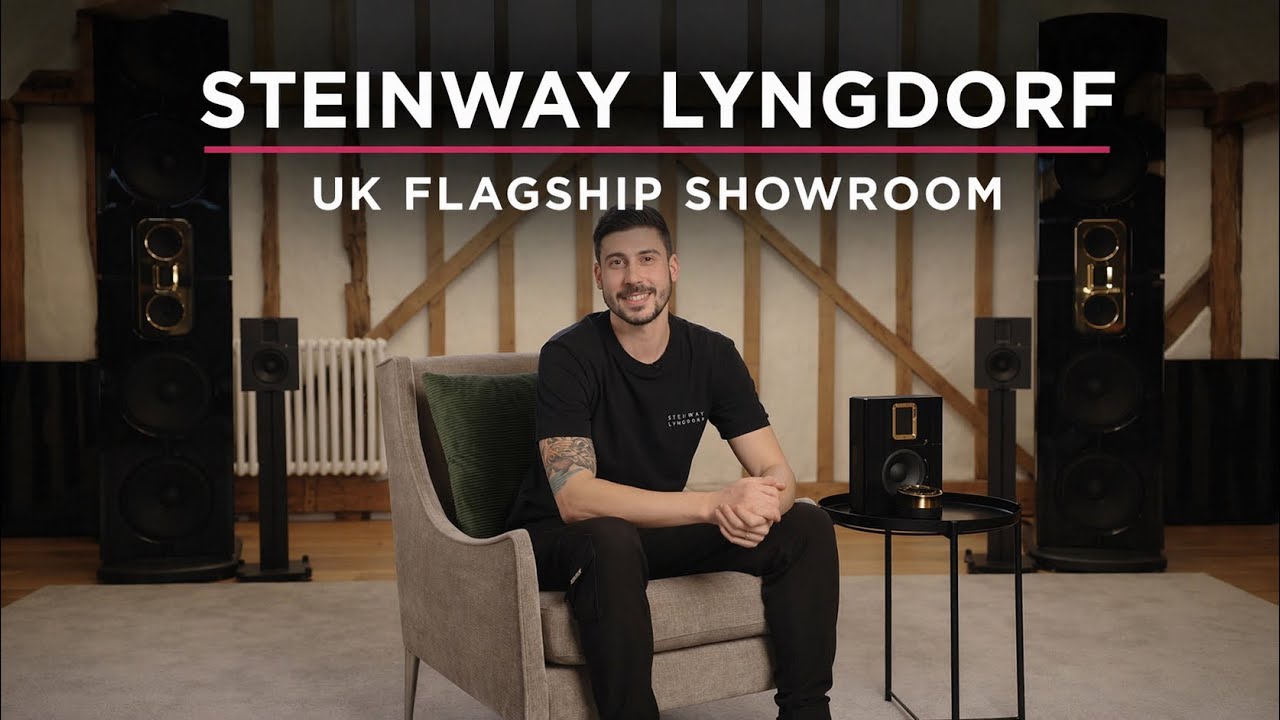
Colin Pink has mixed sound for Hyde Park, the Brit Awards, the MTV Awards, the 2012 London Olympics, and — for the better part of fifteen years — every Hans Zimmer Live world tour. He got his start because someone needed a phone to ring during a school play. He accepted an invitation to visit Steinway Lyngdorf on his day off while in London to mix Bocelli at Hyde Park and review Katherine Jenkins. This is what it looks like when the person responsible for the sound of the world's largest music events sits down and listens to the best residential audio system available.
The Path to Hans Zimmer: From School Theatre to the World's Biggest Stages
Colin's career origin story is one of those moments that's almost too neat in hindsight. At school, he happened to be walking past the theatre space when a teacher came out looking for someone good at electronics. They needed a phone to ring for a production. Colin could help. He went in, made the phone ring, and just kept going back.
From school theatre, he studied at the Guildhall School of Music and Drama (technical theatre). His first professional decade was at the National Theatre in London, where Trevor Nunn's tenure meant a heavy diet of large-scale musical theatre with full orchestras. That experience — mixing orchestras, dealing with scale and dynamics — set the course for the rest of his career.
The route to Hans Zimmer came through the Classical Brit Awards at the Albert Hall. Zimmer was being given an award and performed a twenty-minute medley. After the show, Zimmer was discussing whether to do his own concert tour with Harvey Goldsmith. In short form: "The classical Brit sounded good. I had fun. Can I use that audio team?" Colin got the call. He didn't take long to say yes.
"I got the phone call: do you want to go and help out mixing Hans Zimmer? I didn't have to think that long about it. It was a definite yes."
The Live Sound Engineer's Perspective on Audio Quality
What makes Colin's visit to Steinway Lyngdorf interesting is the specific quality of his listening experience. He's spent years calibrating his ears against the sonic reference of a full live orchestra, solo vocalists, and some of the most complex band configurations in contemporary live sound. When he sits down in a residential audio demonstration room, his frame of reference is not the hi-fi world's standard of comparison — it's real events, reproduced live.
The Steinway Lyngdorf system's defining quality — its ability to reproduce the spatial character and dynamic truthfulness of a live event — is the specific thing that connects with someone like Colin. The system doesn't just sound good in abstract terms. It sounds like a real event, which for a live sound engineer is a meaningful and specific claim.
From Bocelli at Hyde Park to Steinway Lyngdorf in Worcestershire
The context of Colin's visit adds a dimension to the listening experience. He's in London to mix an event at Hyde Park — Bocelli, Katherine Jenkins, Hans Zimmer — and takes time on his day off to come and hear what a residential system sounds like.
The juxtaposition is informative. The system he'll have been working with at Hyde Park uses L-Acoustics line arrays designed to cover tens of thousands of people over hundreds of metres. The Steinway Lyngdorf system is designed to deliver the same music — or better — at a listening distance of a few metres, in a room, with the acoustic intimacy that an outdoor PA system fundamentally cannot offer.
"Some viewers may find the following scenes disturbing — a well-dressed rack of equipment and properly labelled cables."
The Socks Are Famous
Colin Pink's socks are, apparently, among the most recognisable things about him on the Hans Zimmer Instagram. When Atif introduces him, the socks get a mention before the technical credentials. For a world-class live sound engineer, this seems like a reasonable legacy.
What Live Sound Engineers Listen For
When a professional live sound engineer evaluates a residential system, their criteria are different from a home listener's. They're listening for:
- ▪Separation — can they hear individual instruments within a complex mix, or does everything blur together?
- ▪Dynamics — does the system handle the contrast between quiet and loud without compressing or distorting?
- ▪Spatial accuracy — does the system place sounds in a three-dimensional space that corresponds to the mix intent?
- ▪Naturalness — does it sound like real instruments in a real space, or like recorded sound?
These are the same questions a mixing engineer asks about the PA system before a show. When a residential system passes these tests for someone who spends their professional life calibrating their hearing against live events, it tells you something real about the system's capability.
Key Takeaways
- ▪Colin Pink began his career by making a telephone ring for a school play and built one of the most distinguished careers in live sound through 35+ years of focused work
- ▪His path to Hans Zimmer was through a chance conversation at the Classical Brit Awards — a reminder that professional opportunity often comes from being excellent at the work immediately in front of you
- ▪The Steinway Lyngdorf visit during a break from mixing Bocelli at Hyde Park gives a specific context to his listening — he has a rare calibration point from working with live orchestras and international artists at scale
Frequently Asked Questions
Who is Colin Pink and what has he mixed?
Colin Pink is a British live sound engineer whose credits include the Brit Awards, MTV Awards, the 2012 London Olympics opening ceremony, tours with Terence Trent D'Arby, Guns N' Roses, and numerous other major acts, plus over a decade of Hans Zimmer Live world tours. He worked for ten years at the National Theatre before moving into large-scale live touring and event production.
What does a Hans Zimmer Live mixing engineer actually do?
A mixing engineer in this context is responsible for the real-time balance of all audio elements during the live show — orchestra, rock band, soloists, electronics, playback tracks, and environmental sound design. For a show of Hans Zimmer Live's scale, this involves mixing a full orchestra plus an extended band of world soloists through a large-format PA system, managing the spatial placement of sound elements across the venue, and maintaining the sonic vision across dozens of performances in different venues with different acoustic properties.
How does professional live sound experience change how you evaluate a residential audio system?
A professional live sound engineer's hearing is calibrated against real events — live orchestras, acoustic instruments in real spaces, the dynamic contrast of a full concert performance. When they evaluate a residential system, they're testing it against a very specific internal reference. Systems that sound impressive to a general listener (high volume, strong bass, wide soundstage) may fail a professional's test for naturalness and spatial accuracy. Systems that genuinely replicate the presence and dynamic character of live performance — like Steinway Lyngdorf — are the ones that impress people with this level of experience.
What is the Classical Brit Awards and why does it matter for live audio?
The Classical Brit Awards is an annual ceremony at the Royal Albert Hall celebrating achievements in classical music. For live sound engineers, it's a technically demanding event that requires mixing classical musicians at a level of acoustic accuracy that mainstream pop/rock events don't demand. Classical music's wide dynamic range, the complexity of orchestral textures, and the audience's familiarity with the live sound of the instruments make it a stringent test of a mixing engineer's capabilities.