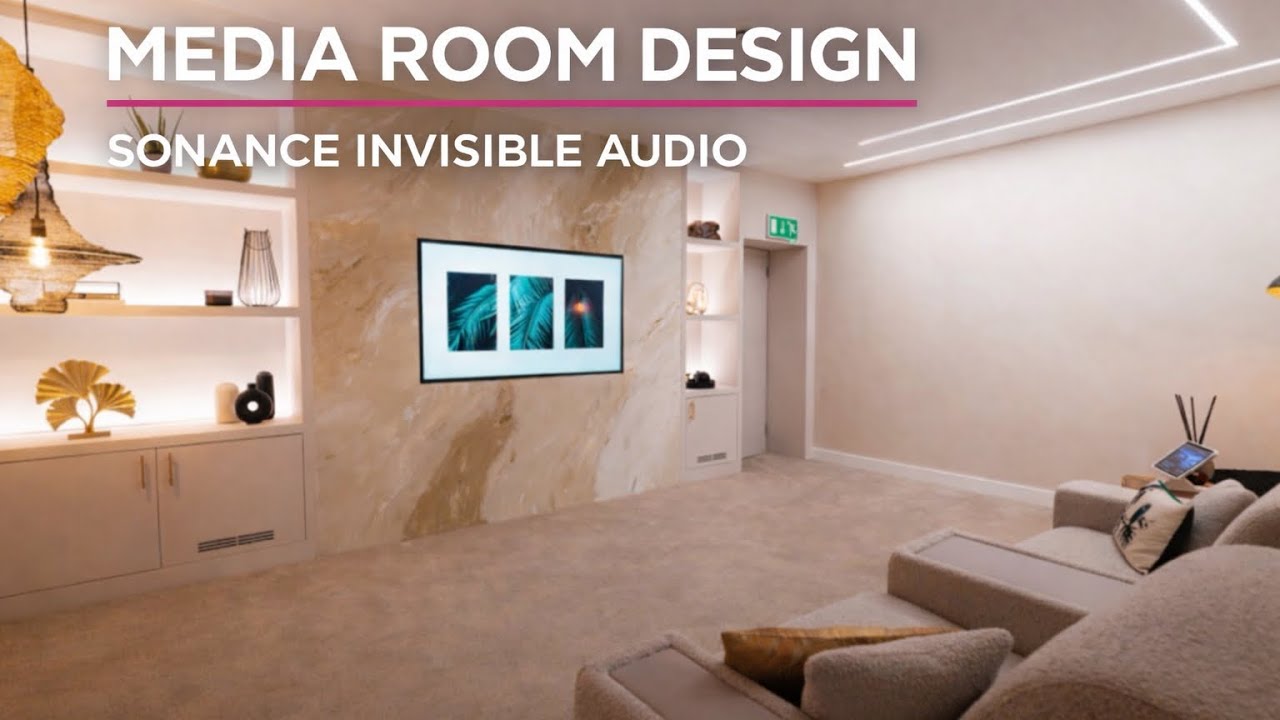
The walls are skimmed. The ceiling insulation is in. The in-wall speakers are locked into their final positions. The screen frame is ready to go up. This is the finalisation phase of a cinema build — the stage where the months of structural work start to become a real cinema room. Atif and the Vertis Integration installation team walk through the critical decisions being made right now.
Speaker Positioning: From Rough-In to Final Lock
Getting speaker positions right in a home cinema is a calibration exercise that happens at the construction stage, not after. Once plasterboard is on the walls, speaker positions are fixed. Moving them later means cutting out sections of finished wall — expensive and disruptive.
At this installation, the speaker layout follows the standard Dolby Atmos cinema geometry:
| Channel | Position | Notes |
|---|---|---|
| Left, Centre, Right | Front wall, behind screen | In-wall, equidistant from centre |
| Surround Left, Right | Side walls at ear level | In-wall, 90–110° off-axis from seating |
| Rear Centres | Rear wall | In-wall |
| Height (Atmos) | Ceiling | 4 × in-ceiling — three remain to be installed |
| Subwoofers | Front corners | Pending — in position before carpeting |
With the LCR, surrounds, and rear centres all locked in, the remaining work is completing the four ceiling Atmos channels (one installed, three to go) and placing the subwoofers. The subwoofer positioning follows the standard approach: front corners, where room geometry reinforces bass output and helps smooth frequency distribution across the seating positions.
Speaker Grilles: Why You Cannot Just Paint Them
Every in-wall speaker in this installation comes with a white paintable grille. This is standard practice — the grille is designed to be painted to match the wall colour, making the speaker nearly invisible in a finished room. But there's a technique to it that most people get wrong.
You cannot apply paint directly to the grille fabric with a brush. The paint fills the grille's microscopic perforations, sealing them shut and turning an acoustically transparent grille into a solid barrier. The correct method:
- 1.Spray paint only — aerosol or HVLP gun, never a brush or roller
- 2.Multiple thin coats — one heavy coat is worse than three light ones
- 3.Hold the can at distance — 30–40cm away, light passes to build colour gradually
This is a small detail with a real consequence. A sealed grille acts as an acoustic resistor — it attenuates the speaker's output and changes its frequency response. For a system that will be professionally calibrated after installation, a partially sealed grille introduces an error that calibration can partially compensate for but cannot fully correct.
The Acoustically Transparent Screen: A Deliberate Compromise
The projection screen in this installation is an acoustically transparent (AT) screen — a screen fabric with tiny perforations that allow sound to pass through. This is the configuration used in commercial cinemas: the speakers are behind the screen, so the sound arrives from exactly the same direction as the picture. The LCR audio is perfectly synchronised in space with the on-screen action.
But an AT screen is a compromise between video performance and audio performance. It is not a free lunch.
"This is a slight compromise between video performance and audio performance. Getting the screen correct is where you want to invest — a good acoustic transparent screen with the right projector setup avoids the issues associated with transparent screens."
The perforations that allow sound to pass through also introduce a fine, regular pattern into the screen surface. When a projector illuminates this pattern, a moiré interference pattern can become visible — a shimmering, grid-like artefact superimposed on the image. The severity depends on:
- ▪Projector resolution — higher native resolution makes the pattern less visible
- ▪Screen perforation pattern — woven versus micro-perforated screens have different moiré characteristics
- ▪Throw distance — longer throws reduce the perceived size of the pattern
- ▪Viewing distance — from the seating position, the pattern should be below the angular resolution of the human eye
With a quality AT screen (Stewart Filmscreen, Screen Research, Elite Screens' AT range) and a native 4K projector at a standard throw distance, the moiré artefact is not perceptible from the seating position. This is the setup in this installation — investment in a quality AT screen eliminates the problems that a cheap AT screen would introduce.
Screen width versus speaker width. The screen's left and right edges extend beyond the left and right speakers. This is intentional: it ensures the widest possible soundstage behind the screen, with the stereo field extending to the screen's edges rather than being constrained between the speaker positions.
The Screen Frame: Felt Edge and AT Fabric
The screen specified here is an AT screen with a felt edge border — a 3mm felt border around the perimeter of the screen fabric. The felt edge absorbs light scatter at the screen's edges, preventing bright reflections that would otherwise reduce perceived contrast. It also provides a clean, defined termination to the screen surface that looks professional in the finished room.
Screen fabric for AT applications uses a micro-woven or micro-perforated material that balances optical performance (gain, grey level, colour accuracy) with acoustic transparency. For this installation, the fabric is ready to install as soon as the subwoofers are positioned and the carpet is down.
The Sequence to Completion
The remaining steps in this build:
- 1.Complete the four in-ceiling Atmos speaker installations (three remaining)
- 2.Place the subwoofers in front corners, confirm positions before fixing
- 3.Carpeting throughout (week of filming)
- 4.Mount the AT screen on the prepared frame
- 5.Electronics rack installation and cable dressing
- 6.Audio calibration and video calibration
Key Takeaways
- ▪Speaker positions in a home cinema are finalised at the construction phase — moving them post-plasterboard requires destructive remediation
- ▪AT speaker grilles must be spray-painted in thin coats; brush painting seals the perforations and degrades acoustic performance
- ▪An acoustically transparent screen is a deliberate compromise between video and audio performance — with a quality AT fabric and a native 4K projector, the trade-off is imperceptible at the seating position
- ▪Screen width should extend beyond the LCR speaker positions to maximise the soundstage width
- ▪Subwoofer placement (front corners) follows room loading principles and must be confirmed before carpeting
Frequently Asked Questions
What is an acoustically transparent (AT) screen?
An acoustically transparent screen is a projection screen fabric with thousands of tiny perforations or a micro-woven construction that allows sound to pass through it with minimal attenuation. This allows speakers to be positioned behind the screen, placing LCR audio exactly where it appears on-screen. It is the standard configuration for commercial cinemas and is used in dedicated home cinema installations where the priority is spatial audio-visual synchronisation.
Does an acoustically transparent screen affect picture quality?
A quality AT screen introduces a small gain reduction (0.1–0.3 in gain factor) and, in some configurations, a risk of moiré interference patterns when used with certain projectors. With a quality AT fabric (from manufacturers such as Stewart Filmscreen or Screen Research) and a native 4K or high-quality pixel-shifted projector, these effects are imperceptible from the correct viewing distance. Budget AT screens can have visible perforations or moiré artefacts — the screen is not an area to economise if you're investing in quality image.
How should in-wall speaker grilles be painted?
Use aerosol spray paint or an HVLP spray gun. Hold the can approximately 30–40cm from the grille and apply multiple very light coats, allowing each coat to dry before the next. Never use a brush or roller — the bristles or nap force paint into the grille perforations, sealing them and degrading acoustic performance. The goal is colour coverage while leaving the perforations fully open.
Why do subwoofers go in the corners of a cinema room?
Corner loading uses the room's geometry to reinforce the subwoofer's output. When a driver radiates into a corner, the three converging surfaces (floor and two walls) act as acoustic boundaries that reflect the sound energy back into the room rather than letting it dissipate. This increases the effective output by 9–12 dB compared to placing the subwoofer in free space — the same output level requires significantly less amplifier power. Diagonal corner placement (front and rear corners) also helps smooth the frequency response across the room.
When is the best time to finalise speaker positions in a cinema build?
Speaker positions should be planned at the very beginning of the project and confirmed before first fix electrical. In practice, the ideal workflow is: room acoustics and seating position calculated → speaker positions derived from seating geometry → positions marked on structural drawings → cable routes installed before plasterboard → speaker positions cut and mounted before skim coat. Any changes after plastering require cutting into finished walls.