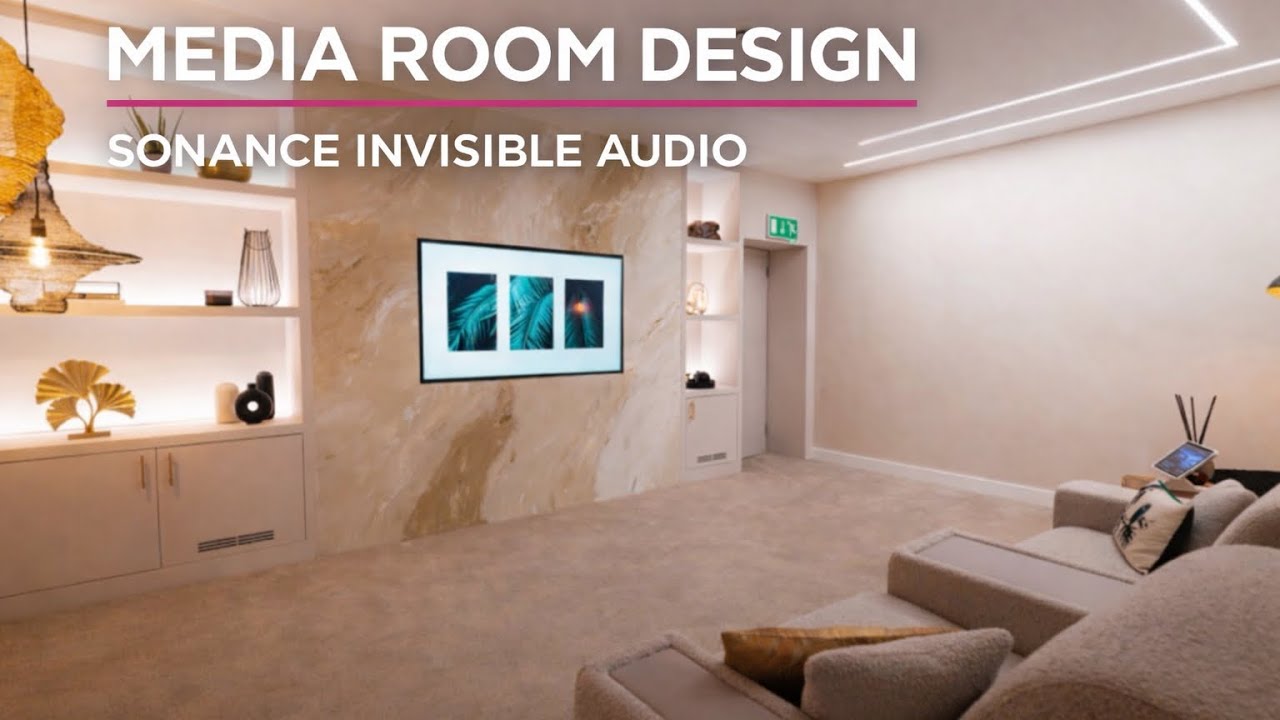
First fix cabling is the foundation everything else builds on. Get it wrong and the finish — the acoustics, the calibration, the commissioning — can't fully correct for it. Get it right and the rest of the installation has a clean platform to work from. In this pre-Christmas site visit, Atif and his team are laying cables through a new build cinema room, and the details — the cable types, the routing decisions, the plywood backer technique — are exactly the kind of thing that doesn't make it into product reviews but makes an enormous difference to the finished system.
What First Fix Means in a Cinema Installation
First fix is the stage where all cables are run through the structure before the walls are closed. This is the only opportunity to route cables through wall cavities, under floors, and across ceiling voids without cutting into finished surfaces.
At this installation, the first-fix scope includes:
| Cable Type | Use | Specification |
|---|---|---|
| Optical HDMI | Projector signal from source to ceiling | Active fibre, long run |
| Speaker cable | All speaker runs | 14 AWG (2 gauge) |
| RG6 coaxial | Subwoofer signal | Standard 75-ohm coaxial |
| Network (Cat6) | Control system and streaming | Via existing infrastructure |
The projector receives its signal via active optical HDMI — not standard copper HDMI. For the lengths involved in a ceiling-mounted projector installation (typically 5–15 metres), active fibre HDMI is significantly more reliable than passive copper, which degrades at longer runs and can produce subtle image degradation (dropped frames, colour errors) that's difficult to trace once walls are closed.
The Anthem Amplifier and Speaker Cable Specification
The power amplifier is an Anthem — a Canadian brand known in both home cinema and high-end two-channel audio for clean, accurate amplification with low noise floors. Anthem's AVM series processors and MCA series power amplifiers are commonly specified in installations where reference-level accuracy matters more than budget constraints.
14 AWG speaker cable (described as "14, two gauge" in the transcript) is the appropriate specification for residential cinema speaker runs up to approximately 30 metres. Heavier gauge (12 AWG or 10 AWG) is appropriate for longer runs or very high-current applications, but for typical cinema rooms, 14 AWG provides the right balance of conductor resistance and installation practicality.
The subwoofer runs use RG6 coaxial cable — the same cable used for satellite television distribution. RG6 provides adequate shielding for the relatively low-frequency subwoofer signal without the expense or installation complexity of premium audio cable.
The Plywood Backer: Why It Matters
One of the most important installation details in this walkthrough is the plywood backer for in-wall speaker mounting.
Atif demonstrates a 12mm plywood sheet installed behind the speaker position, secured to the structural frame rather than to the plasterboard. The speaker mounts to this ply rather than to the plasterboard.
"Rather than using the plasterboard as the brace for the speakers, put some ply in. This is just some 12mm ply, and the speaker mounts to that. So if there's going to be any vibration, it's gone completely — because this has all been taken out of the structure."
The physics: a speaker in operation exerts force on its mounting surface with every cone excursion. Plasterboard is flexible — it moves in response to that force, creating a resonance that adds unwanted colouration to the speaker's output. The plywood backer eliminates this by providing a rigid mounting point that doesn't flex under speaker load.
This is a first-fix detail — the ply goes in now, before plastering. It cannot be added later without cutting into finished walls.
Cable Routing: The Long Way Is Often the Right Way
The cable routing for this installation goes around the outside of the structural frames rather than through them — running high and dropping to each speaker position. This approach:
- 1.Avoids drilling through structural members — drilling through studs and joists weakens them and can require Building Regulations notification in some configurations
- 2.Maintains clear cable paths — a cable running along the frame's edge is easier to trace and service than one threaded through multiple drilled holes
- 3.Reduces installation time — routing around rather than through is faster when the geometry allows it
- 4.Creates accessible runs — if a cable fails later, a routed cable is easier to replace than one buried in drilled holes
The routing decision depends on the room's geometry — sometimes threading through is unavoidable. But where the option exists, running along the frame exterior is the better practice.
Pre-Christmas Installation: The Joy of First Fix
The video notes the setting: a wet and cold December morning, pre-Christmas. First fix day means drilling, pulling cables, getting dirty. It's the unglamorous work that nobody sees in the finished cinema but that determines whether the finished system works properly.
Atif's helper, referred to as "Aphty," describes his contribution as "ten minutes." The honest self-assessment of anyone who's done a full day of pulling cables through new build cavities in December.
Key Takeaways
- ▪Active optical HDMI (not copper) is the correct specification for projector signal runs over 5 metres — passive copper HDMI degrades at longer runs in ways that are difficult to diagnose post-installation
- ▪14 AWG speaker cable is appropriate for residential cinema runs up to approximately 30 metres; RG6 coaxial handles subwoofer signal adequately
- ▪Plywood backers for in-wall speakers provide a rigid mounting surface that eliminates the resonance contribution of plasterboard under speaker load
- ▪Cable routing around structural frames rather than through them is faster, easier to trace, and less structurally impactful
- ▪First fix is the only opportunity to route cables cleanly — post-plaster remediation is expensive and destructive
Frequently Asked Questions
Why use active optical HDMI instead of standard HDMI for a projector installation?
Standard passive copper HDMI degrades over distance. The maximum reliable length for 4K/HDR signal via passive copper HDMI is approximately 5 metres; beyond this, signal attenuation can cause dropped frames, colour space errors, or complete signal loss. Active optical HDMI (also called AOC or Active Optical Cable) carries the signal on optical fibres with active electronics at each end, maintaining full signal integrity at lengths up to 50 metres or more. For a ceiling-mounted projector receiving signal from a rack several metres away, active optical is the reliable specification.
What AWG speaker cable do I need for a home cinema?
14 AWG (14 American Wire Gauge, approximately 2.5mm² cross-sectional area) is suitable for runs up to approximately 30 metres with typical 8-ohm speakers. For runs over 30 metres, or for 4-ohm speakers, move to 12 AWG (approximately 4mm²). For subwoofer signal (low-level, line-level signal rather than speaker-level), use RG6 coaxial or dedicated audio coaxial rather than speaker cable — the signal type is fundamentally different.
Can a speaker be mounted directly into plasterboard?
A speaker can be physically installed in plasterboard, but it's not the recommended approach for anything other than very light background music speakers. Plasterboard flexes under speaker load, creating resonance that adds audible colouration to the speaker's output. For cinema and high-quality audio applications, a plywood backer (12–18mm, fixed to structural framing) provides a rigid, non-resonant mounting surface that eliminates this problem.
What is an Anthem amplifier and why is it used in high-end cinema installations?
Anthem is a Canadian audio manufacturer producing AV processors and power amplifiers used in both home cinema and high-end two-channel audio applications. Their amplifiers are known for clean power delivery with low distortion and low noise floor, and their AVM processors include Anthem Room Correction (ARC) — a proprietary room correction system. In home cinema installation, Anthem is positioned between consumer-grade equipment (Denon, Marantz) and the extreme high end (Trinnov, StormAudio).
When does first-fix cabling happen in a cinema build timeline?
First fix occurs after the structure is up (walls framed and insulated, ceiling joists in place) but before plasterboard goes on the walls and ceiling. This is the only access window for running cables through the structural cavities cleanly. First fix must include every cable type that will be hidden in the structure: speaker cable, HDMI, subwoofer signal, network (Cat6), control system cabling, power circuits for in-wall equipment, and conduit for any future cable additions.