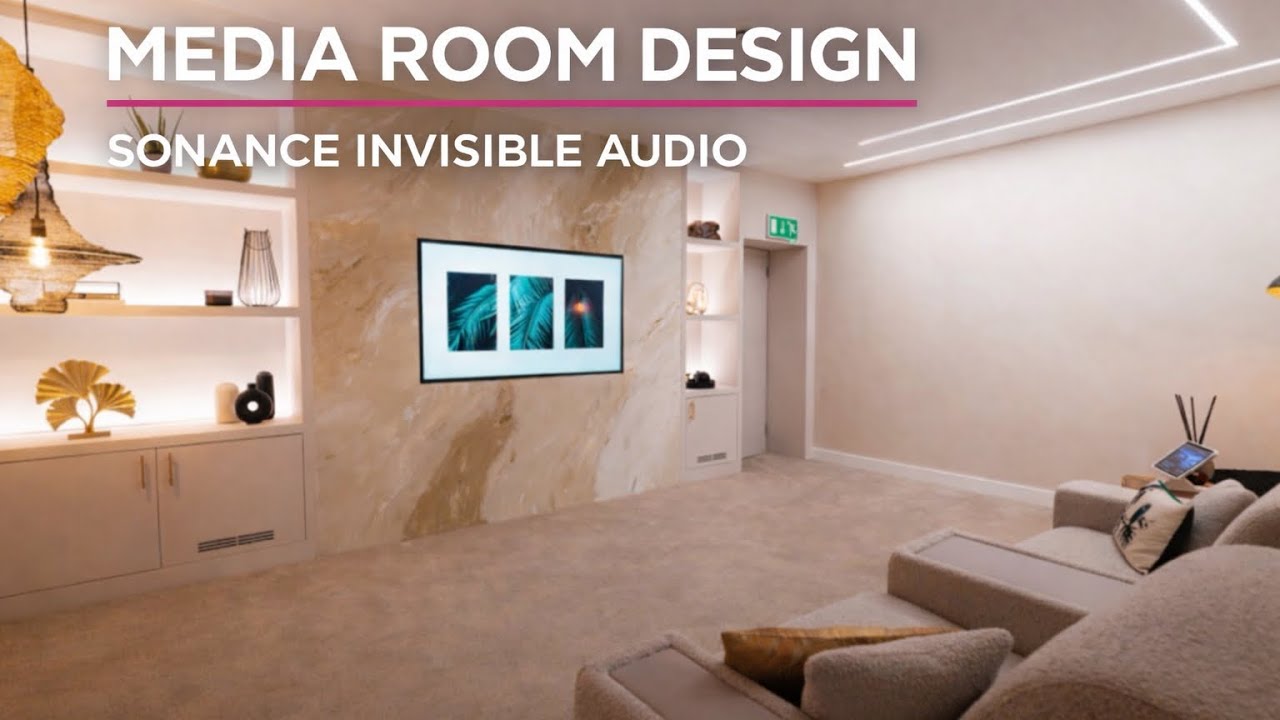
Inside a garage cinema conversion mid-build, the real decisions aren't about which amplifier to choose or what colour to paint the walls. They're about wall stacks, floating floors, and measuring speaker positions from the exact height a reclining head will occupy. Atif visits the site during one of the most critical build phases — and the construction team walk through exactly what they're doing and why.
The Wall Construction Stack: Six Layers Between You and the Neighbours
The wall build at this garage conversion follows a specification designed to achieve maximum sound isolation within the constraints of a domestic build budget. Working from the outside inward, the full stack is:
| Layer | Material | Purpose |
|---|---|---|
| 1 | 12.5mm Fireline board | Fire protection (Building Regs compliance) |
| 2 | 25mm foil-backed insulation | Thermal + first acoustic break |
| 3 | 12.5mm structural ply | Rigidity + in-wall speaker mount substrate |
| 4 | 75mm RW3 Rockwool acoustic slab | Primary sound absorption layer |
| 5 | 15mm acoustic plasterboard | Mass + decoupling |
| 6 | 15mm acoustic plasterboard | Second mass layer |
The double plasterboard finish is significant. Two separate layers of plasterboard — particularly when one or both are mounted on resilient channels or bars rather than fixed directly to studs — provides substantially better sound transmission loss than a single board. Each layer adds mass; the separation adds a decoupling effect. Together, they target the specific frequency range where single-skin walls fail: the low-mid bass energy that transmits most efficiently through solid structures.
The Floating Room: Full Structural Isolation
Beyond the wall build, the entire room is constructed as a floating structure — the inner walls, floor, and ceiling are built so that they make no rigid structural contact with the surrounding garage shell.
A floating room creates an air gap between the inner and outer structures. Sound energy trying to escape must cross that gap, losing energy at each transition. Without a floating structure, sound transmits directly through any rigid connection between the inner wall and the outer wall — a single metal screw bridging the gap can be enough to undermine tens of thousands of pounds of acoustic construction.
"We've built the room so it's actually floating — it's not touching any wall. It's totally isolated from the rest of the house, which hopefully will keep the sound in a tight confined space."
The ceiling treatment mirrors the wall specification: acoustic RW3 mineral wool, followed by two layers of 15mm acoustic plasterboard. With bedrooms above the garage, the ceiling isolation is as critical as the wall isolation.
Subwoofer Integration: Enclosed and Isolated Boxes
The subwoofer specification includes in-built corner positioning — a well-established technique that uses the room's corner geometry to reinforce bass output while also helping distribute low frequencies more evenly across the seating positions.
The subwoofers aren't simply placed in the corners, however. They're recessed into built enclosures within the wall structure, with the enclosures themselves soundproofed. The rationale: at the sound pressure levels a quality home cinema subwoofer operates at, the enclosure's rear panel faces directly into the wall construction. Without isolation of the enclosure itself, the subwoofer's rearward radiation bypasses all of the careful wall isolation work and transmits energy directly into the structure.
The Projector Hatch: Access Without Compromise
The projector will be mounted in a dedicated projector enclosure at the ceiling, accessed via a hatch. The enclosure will be insulated with acoustic soundboards to prevent sound from the cinema room weeping upward into the bedrooms above via the projector aperture — one of the most commonly overlooked acoustic leakage paths in garage cinema builds.
The hatch allows future access for bulb changes, maintenance, and calibration adjustments without requiring destructive access to the ceiling structure.
Speaker Positioning: Why Ear Level Is the Starting Point
The critical measurement for every speaker position in this cinema is taken from the seating position at ear level — specifically, the ear height of a viewer reclining in the seat, not sitting upright. The distinction matters: in a fully reclined cinema chair, ear height drops by approximately 150–200mm compared to the upright position. A speaker installed at 1.0m height for an upright listener is now at shoulder level for a reclined viewer. The high-frequency dispersion — which is the most directional component of any loudspeaker — misses the listener.
The speaker layout follows ITU-R BS.775 cinema geometry:
- ▪LCR (left, centre, right): Behind the acoustically transparent screen, equidistant from centre
- ▪Surround left/right: At ear level from the seating position, 90–110° off-axis
- ▪Rear surrounds: Raised slightly for the second tier of seating, maintaining ear-level alignment
- ▪Height channels (Atmos/DTS-X): Positioned in front of the seating position, away from the walls, to project sound from above without excessive early reflections
The ceiling height channels are placed slightly forward of the seating position rather than directly overhead. This placement creates a better upward arrival angle — sound appears to come from a space above and slightly ahead, replicating how Atmos mixing engineers intend height information to be perceived.
Two-Tier Seating and Rear Speaker Elevation
The room is specified for two rows of seating. The rear row is raised on a platform — standard tiered-seating geometry ensures the rear viewers aren't looking over the heads of front-row viewers.
The rear surround speakers adjust accordingly. A speaker mounted at the same height as the front surround speakers would now be below ear level for rear-row viewers on the raised platform. The rear speakers are installed at a slightly higher position and angled downward, maintaining the ear-level alignment for every seating position across both rows.
Key Takeaways
- ▪A six-layer wall construction stack (fire board, foil insulation, ply, RW3 Rockwool, double acoustic plasterboard) addresses both Building Regulations requirements and achieves meaningful acoustic isolation
- ▪A floating room — no rigid structural connection between inner and outer structures — is the only reliable way to prevent structural flanking transmission of bass energy
- ▪Subwoofer enclosures must themselves be acoustically isolated, not just placed in isolated corners
- ▪All speaker positions are calculated from ear level at the reclining seating position, not the upright position
- ▪In two-tier seating layouts, rear surround speakers require height adjustment to maintain ear-level alignment with the raised rear row
Frequently Asked Questions
What is the difference between acoustic insulation and thermal insulation?
Thermal insulation (such as fibreglass batts or PIR foam boards) is designed to slow heat transfer — it has relatively little mass and is not particularly effective at blocking sound. Acoustic insulation (such as Rockwool RW3 mineral wool slabs) has higher density and is specifically engineered to absorb and attenuate sound energy within its fibres. For home cinema walls, acoustic mineral wool is the correct choice; thermal insulation provides incidental acoustic benefit but is not a substitute.
Why does room-within-a-room construction matter if I already have thick walls?
Mass helps — a thick, heavy wall transmits less sound than a thin light one. But structural flanking bypasses mass entirely. If any rigid connection exists between the cinema room structure and the surrounding building fabric (screws through both layers, a shared joist, a solid floor connection), low-frequency bass energy travels through the rigid path rather than through the air. Room-within-a-room construction eliminates these rigid connections, ensuring that bass must cross air gaps rather than travel through solids.
Do I need acoustic plasterboard or is standard plasterboard acceptable?
Acoustic plasterboard has higher density (typically 12.5kg/m² vs 8–9kg/m² for standard board), which increases the sound transmission loss of the partition. For a home cinema, the difference between two layers of acoustic plasterboard and two layers of standard plasterboard is measurable — typically 3–5 dB in the critical 63–250Hz bass range. At reference cinema levels, 3–5 dB is a meaningful improvement. Use acoustic plasterboard wherever the goal is sound isolation.
How do I calculate the right speaker height for cinema seating?
Sit or recline in the actual seating position (or the intended seating position if the seats aren't installed yet) and measure the height of your ear from the floor. This is your reference height. The LCR speakers should be at this height or very close. Surround speakers should be at the same height. Height (Atmos) channels typically go higher — 1.8–2.4m from the floor — positioned to project sound from above the listening position.
Is a two-tier seating layout always worth the additional construction cost?
For rooms with more than four to six seats, a tiered layout is almost always the right choice. Without elevation, rear-row viewers have restricted sightlines to the lower portion of the screen (particularly in wider rooms), and rear speakers cannot achieve consistent ear-level alignment for both rows. The construction cost — a raised platform with integrated electrical for the rear row — is modest relative to the overall project cost and significantly improves the experience for rear-row viewers.