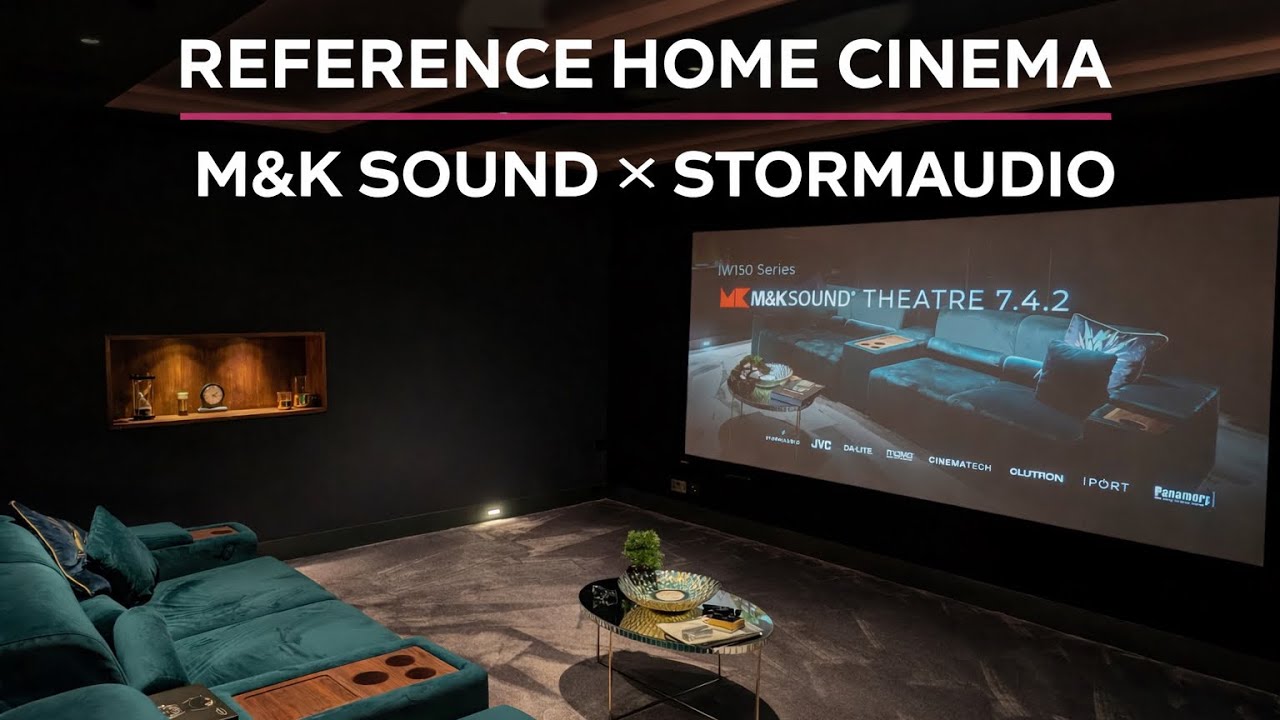
There are home cinemas. And then there is what Habitech have built in their UK flagship showroom. Featuring Wisdom Audio line-source loudspeakers, a Christie 4K RGB laser projector running at 15,000 lumens, a MadVR Envy Extreme, and Movia seating with prices reaching £50,000 for a front row — this is the benchmark against which everything else is measured. Atif got a full behind-the-scenes tour.
Why a £400,000 Showroom Exists
The first thing Habitech will tell you is that this room wasn't built to generate revenue directly. It was built because you can't sell a £400,000–£500,000 home cinema to someone who has never sat in one.
The problem with reference-level home cinema is that the price tags are genuinely difficult to justify without the experience. Unlike a Rolex or a Ferrari — products where the luxury is culturally understood even without ownership — a reference cinema room is almost completely outside the experiential reference frame of most wealthy buyers.
"You need to sit in that seat and be wowed to really understand why this room is worth the price tag that is associated with it."
So Habitech built the best room they could — not as a sale, but as proof. When a client walks in, smells the curated fragrance Sophie has specified, sinks into a Movia Dallas in the middle row, and watches a Christie laser projector deliver a perfectly calibrated HDR image at 4.5 metres wide — the conversation changes.
The Wisdom Audio Line Source System
The loudspeaker specification is built entirely around Wisdom Audio, an American brand producing line-source transducers for high-end commercial and residential cinema.
What is a line source? Instead of a point source (a single cone driver radiating in all directions), a line source radiates along a vertical axis. The result is a much more even distribution of sound across different listening heights — critical in a multi-row home cinema where ears at different seat heights need identical frequency response.
The Habitech flagship uses:
| Position | Model | Notes |
|---|---|---|
| LCR (left, centre, right) | Wisdom Audio Sage Line 3 | Behind the projection screen |
| All surrounds & heights | Wisdom Audio Insight LAI | In-wall line array format |
| DSP amplification | Wisdom Audio proprietary | All-digital signal path |
The rear surrounds are installed at a slightly greater height than the front speakers and angled downward. This isn't arbitrary — it's an engineering decision to ensure the vertical dispersion of each speaker covers all three tiers of seating, from the reclining Milano front-row daybeds to the elevated rear tier.
Christie 4K RGB Laser: 15,000 Lumens at 45%
The projection system is built around a Christie 4K RGB laser, one of the most capable projectors available for residential cinema installation.
The critical specification: 15,000 lumens — but calibrated and running at 45% for daily use.
This counterintuitive approach is how reference-level HDR performance is achieved. The projector's calibrator, Julian, set the brightness to 45% because at full output, the 4.5-metre screen at 9 metres throw is simply too bright for comfortable viewing. More importantly, running below maximum output provides luminance headroom — the reserve capacity to deliver sharp, clean peaks for bright HDR scenes without the projector being pushed to its limits.
"This thing is dialed back. Julian has it running about 45%. It's a 15,000-lumen projector. In a dark room at 100% light output, you basically need sunglasses."
The projector runs without an anamorphic lens. On a Christie with the right optics specification, the lens geometry handles scope content natively — another example of how careful front-end planning eliminates the need for add-on solutions.
MadVR Envy Extreme: The Calibration Engine
Sitting between sources and the Christie is a MadVR Envy Extreme — widely regarded as the finest video processor available for residential use.
The Envy handles tone mapping, scaling, noise reduction, and frame interpolation. For the calibration team, it provides a precise and repeatable canvas: Julian performs his video calibration through the Envy, ensuring that whatever the projector is capable of, it's being driven correctly.
The combination of Envy Extreme + Christie laser is one of the most sought-after pairings in reference cinema specification. The projector provides the light. The Envy ensures every photon is deployed as the director intended.
Storm Audio Evo: All-Digital Processing
The audio signal chain runs through a Storm Audio all-digital Evo immersive audio processor. The notable design point: it communicates over the network, eliminating the traditional maze of XLR interconnects that has historically been one of the more unreliable elements of complex cinema installations.
With Wisdom Audio's DSP amplifiers handling power delivery — also networked and addressable — the entire signal chain from processor to loudspeaker is digital and network-controlled. Channel count, routing, and calibration data can all be managed and updated remotely.
Movia Seating: Three Configurations, One Showroom
Habitech represents Movia in the UK, and the flagship theatre showcases three different seat models at different price points to demonstrate the range.
| Row | Model | Configuration | Approximate Price |
|---|---|---|---|
| Front | Movia Milano | Daybed / full recline | ~£50,000 |
| Middle | Movia Dallas | Classic leather cinema seat | ~£33,000 |
| Rear | Standard configuration | 5-seat wider layout | ~£27,000 |
The Dallas — a black leather seat that looks like a classic cinema chair — is the one that consistently surprises clients. It looks familiar. It doesn't look like a £33,000 seat. Then people sit in it and understand. The Milano front-row daybeds extend far further than they appear from standing, turning into full lie-flat positions.
Every seat includes motorised reclining, dimmable and colour-tuneable LED lighting in the cup holders, wireless charging in the armrests, and Control4 integration. Seat positions can be recalled as memory presets — the same logic as a memory seat in a luxury car.
The Projector Brightness Problem Nobody Plans For
One of the most consistent mistakes in home cinema specification is under-specifying projector brightness for large-format HDR viewing. As the Habitech team explain, the gap between a projector that technically works and one that delivers reference HDR performance is enormous — and it's almost always measured in lumens.
At large throw distances, light drops off. Screens absorb a percentage of the light based on their gain. HDR content demands high peak luminance for specular highlights. A projector operating at its maximum output with no headroom cannot deliver clean, accurate HDR — it clips highlights and loses dynamic range.
The Christie at 15,000 lumens with the screen at 9 metres throw and 45% calibrated output has approximately 8,250 lumens of headroom available for peak HDR moments. That headroom is the difference between an HDR image that genuinely impresses and one that feels flat.
Key Takeaways
- ▪Habitech's flagship showroom exists specifically to make the price tag of reference cinema understandable — you cannot sell what people haven't experienced
- ▪Wisdom Audio line-source speakers are specified at different heights and angles per tier to ensure uniform frequency response at every seat position in a multi-row cinema
- ▪Running a 15,000-lumen projector at 45% is not waste — it's the technique that enables proper HDR headroom on a large-format screen
- ▪MadVR Envy Extreme + Christie 4K RGB laser is the benchmark pairing for reference residential video
- ▪Movia seating is fully bespoke: fabric, motors, lighting, and cup holder specifications are all client-selectable
Frequently Asked Questions
What makes Wisdom Audio line-source speakers different from conventional cinema loudspeakers?
Wisdom Audio's line-source design radiates sound along a vertical column rather than from a single point. This creates a much more even sound field across different listening heights — essential in a tiered cinema room where the front row is lower than the back. Every seat gets the same frequency response rather than having the ideal listening zone biased toward one row.
Why is the Christie 4K laser projector only running at 45% brightness?
Because reference HDR performance requires luminance headroom. At full output on a 4.5-metre screen, the image would be uncomfortably bright. By calibrating to 45%, the projector has reserve capacity to deliver accurate, clean luminance peaks when HDR content requires them, without the image looking washed out during normal scenes. The headroom is the point, not the absolute brightness number.
What is the MadVR Envy Extreme and why does it matter?
The Envy Extreme is an external video processor that handles scaling, HDR tone mapping, and image optimisation between your sources and your projector. In a reference cinema, it gives the calibrator a precise, controllable platform for video calibration and ensures the projector is driven with optimal signal quality regardless of source.
How much does a reference home cinema like this actually cost?
The Habitech flagship is positioned at £400,000–£500,000. For a private installation, costs vary significantly based on room size, acoustic treatment, projector choice, and seating specification. The Movia seating alone ranges from approximately £27,000 for a five-seat rear row to £50,000 for a three-seat Milano daybed front row. The projector, processing, and loudspeaker system are separate.
Is a reference-level cinema possible without Wisdom Audio and Christie?
Yes — there are excellent alternatives at various price points. However, the specific combination of Wisdom Audio line source, Christie RGB laser, and MadVR Envy Extreme represents the current benchmark for multi-row dedicated cinema rooms. Stepping down in any of the three areas changes the performance envelope, though it remains possible to build excellent cinemas at lower cost by making considered trade-offs in each category.