Habitech's Most Popular Room — Seven Years Running
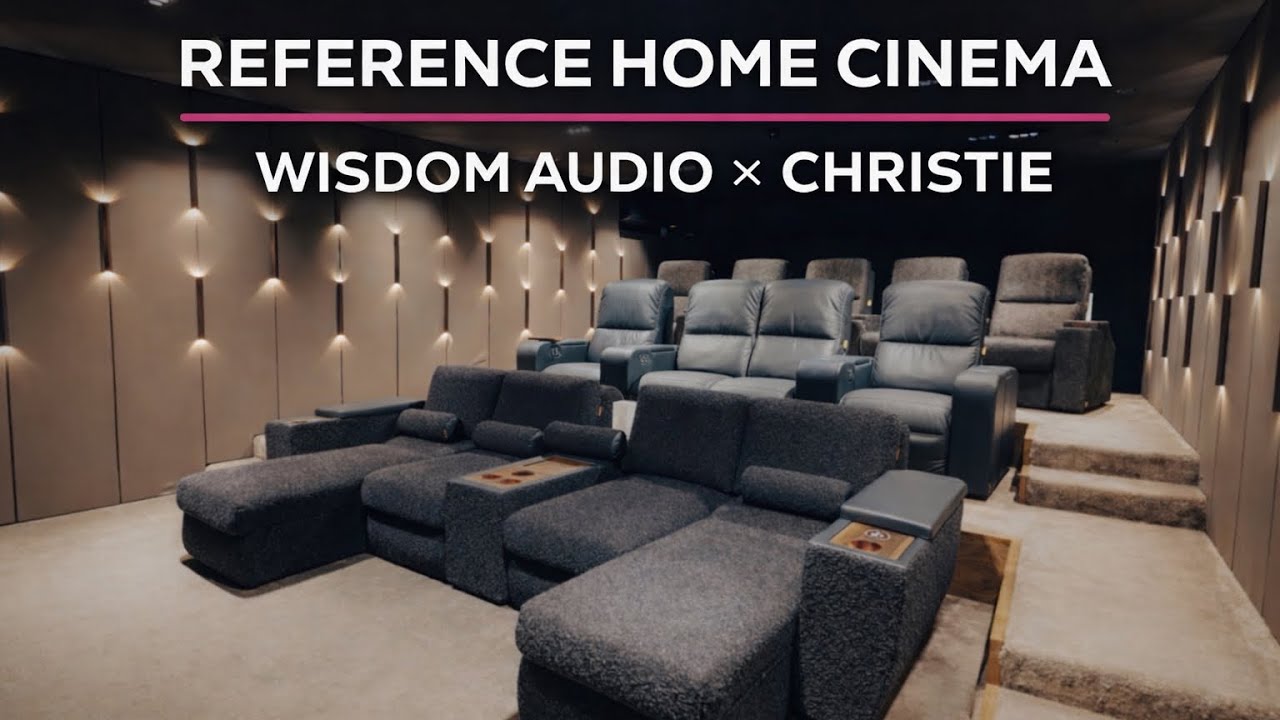
Some rooms don't need to change. Habitech's reference home cinema suite at their UK showroom has been demonstrating M&K Sound, StormAudio, and JVC projection for nearly seven years in the same configuration — and it's consistently the room that visitors want to recreate.
"This room still is what people want. They come through the showroom and they go, 'I want this room.'"
That longevity isn't inertia. It's validation. A room that clients keep choosing, year after year, over newer and more expensive alternatives, is a room that gets the fundamentals right. Atif visited with Imran to experience the IW500 speakers — available here for the first time in Europe — and the reaction, as you'll see, was visceral.
The Acoustic Philosophy: 70% Reflection, 30% Absorption
Before a single specification is discussed, the acoustic approach at Habitech's reference room challenges the most common mistake in home cinema construction: over-treating.
The room's walls are overwhelmingly hard and reflective. Nearly every surface returns sound. That is a deliberate, physics-based decision.
"So there's some diffusion around the speakers, but nearly everything in here is reflective because we don't want the room to be too dead. If you go too far either side of that very fine line down the middle, you don't have a very nice space. It's either too echoey or too dead — and if it's too dead, it'll feel like you've got a head cold."
The 70/30 rule — 70% reflection, 30% absorption — is the balance that keeps a room acoustically alive while controlling the specific reflections that harm clarity. The principle holds because acoustics is physics: every panel placement has a mathematically correct rationale, and installing treatment without understanding that rationale actively damages the room.
"If you've got someone who can't tell you where that panel goes, where and why, don't use that panel."
System Specification
| Component | Specification | Notes |
|---|---|---|
| Front LCR | M&K Sound IW150 (in-wall) | Planned upgrade to IW500 |
| Height / Surround | M&K Sound IW150A | Full 150 family throughout |
| In-wall subs | M&K Sound C15S × 2 | Built into front L/R walls |
| In-room subs | M&K Sound X12 Plus × 2 | Alternative for clients avoiding wall buildout |
| Processor / Amp | StormAudio ISR Fusion 20 | 16ch × 150W class D, 3U |
| Projector | JVC NZ800 | 8K e-shift, high contrast |
| Lens | Panamorph Alpha anamorphic | Zero barrel distortion |
| Screen format | CinemaScope 2.35:1 | |
| Seating | Muvia (German) | Fully custom, £25K+ configuration |
| All-in room cost | ~£100,000 | ~£75-80K equipment + labour/build |
The StormAudio ISR Fusion 20: The Component That Changed Everything
The StormAudio ISR Fusion 20 is the heart of this system — and it's the component that prompted Atif to buy one for his own home.
Most high-end home cinema installations use separate components: a dedicated processor, separate power amplifiers, potentially a separate DAC. Each component in that chain does its job well, but the chain is long, and every additional stage adds something. The Fusion 20 collapses that chain into a single 3U unit: 16-channel amplification at 150 watts per channel of class D power, with processing kept physically isolated from the amplification section to prevent interference.
For spaces where rack real estate is scarce — and plant rooms are getting smaller — this matters enormously. But the performance case is even stronger than the form factor case.
"I went from a very normal, what would be considered an audiophile amplifier and separate streamer to just running everything on a Storm and an Apple TV. And the Storm, uncalibrated, sounds better than my previous setup calibrated. Just out of the box. Insane."
The bridged subwoofer outputs are a distinguishing detail: in bridged mode, the Fusion 20 delivers 500 watts to drive M&K's C15S in-wall subwoofers. No other receiver-class product does this. For a room like this — high-performance, with serious bass requirements — that capability removes a compromise that would otherwise require additional amplifier hardware.
The JVC NZ800 and Panamorph Alpha Lens
JVC's NZ800 is one of the finest projectors available for reference home cinema. Its 8K e-shift processing and D-ILA imager deliver contrast levels that distinguish it from DLP-based alternatives, particularly in dark scenes where the quality of blacks determines perceived image depth.
The Panamorph Alpha anamorphic lens addresses a specific problem with CinemaScope projection: conventional anamorphic lenses distort the image at the corners, creating the barrel effect familiar from wide-format photography. The Alpha eliminates this entirely — delivering the full width and brightness of anamorphic projection without requiring any post-correction software.
Combined with a CinemaScope screen format and a throw distance calibrated for the room, the result is a projection setup that Habitech describes as uncompromised.
The M&K IW500: The Upgrade Coming
The existing IW150 system is being upgraded to M&K Sound's IW500 — a larger, more capable in-wall speaker that Habitech is bringing to this room alongside the new 300 series surround and Atmos speakers. The IW500 was only available here at the time of this visit — the first installation in Europe.
Atif and Imran's reaction on hearing the system playing through the IW500s in the context of this room:
"I watched that last night. It did not sound anything like that at all. Oh my word. Amazing cinematic experience. For me, that's serious cinema at home."
The gap between the same content heard at home on a standard system versus a reference installation is not subtle. This is the point of showroom visits: understanding what the recording actually contains, rather than what an under-performing system permits you to hear.
Project Cost: What £100K Actually Buys
For a room of this specification, the all-in cost is approximately £100,000. Broken down:
- ▪~£75-80K: Equipment (speakers, processor, amplification, projector, lens, screen)
- ▪~£20-25K: Labour, acoustic treatment, build materials
- ▪Seating: Additional, starting from around £25K for the Muvia configuration shown here
The seating cost is genuinely variable — from a well-chosen sofa to fully bespoke hand-crafted Italian cinema furniture. Muvia, a German manufacturer, works to any brief: custom fabrics, motorised headrests, family crests, and configurations not in their standard range are all achievable.
Key Takeaways
- ▪Over-treating a room acoustically is a real problem — the 70/30 reflection/absorption rule keeps a room sounding natural
- ▪The StormAudio ISR Fusion 20 collapses separates into one box without sacrifice — 16 channels, bridged sub outputs, processing isolation in 3U
- ▪Anamorphic projection without barrel distortion is now achievable — Panamorph Alpha changed what's possible
- ▪The only way to understand what's possible is a properly configured demo — gap between standard and reference is fundamental, not marginal
FAQ: Reference Home Cinema Installations
What is a reference home cinema?
A reference home cinema is a system calibrated to reproduce content as the original recording engineers intended — not enhanced, coloured, or limited by the playback equipment. Reference-level systems are used as the benchmark against which all other playback is compared. They're built around professional-grade components, proper acoustic environments, and precise calibration.
How much does a £100K home cinema include?
At the £75-80K equipment level demonstrated here, the system includes M&K Sound in-wall speakers and subwoofers, a StormAudio ISR Fusion 20 processor/amplifier, JVC NZ800 projector, Panamorph anamorphic lens, and CinemaScope screen. Labour, acoustic treatment, and build materials add approximately £20-25K. Custom cinema seating is additional.
What is the StormAudio ISR Fusion 20?
The ISR Fusion 20 is StormAudio's integrated processor and amplifier — 16 channels of class D amplification at 150W per channel, with processing circuitry physically isolated from the amplification to prevent interference. In bridged mode, it delivers 500W to subwoofer channels. It is designed for installations where rack space is at a premium but performance cannot be compromised.
Why is acoustic treatment important in a home cinema?
Untreated rooms create uneven frequency response, early reflections that smear dialogue, and low-frequency standing waves that produce inconsistent bass. Acoustic treatment addresses these problems — but over-treating a room kills the natural ambience and results in a dead, closed-in sound. The goal is controlled acoustics, not total absorption.
What is the Panamorph Alpha lens?
The Panamorph Alpha is an anamorphic lens designed to work with projectors to fill a 2.35:1 CinemaScope screen without the barrel distortion that traditional anamorphic lenses produce. It allows the full brightness and resolution of the projector to reach the screen in the correct aspect ratio, without any geometric correction required in software.
Frequently Asked Questions
What loudspeakers does the Habitech M&K reference cinema use?
The room is built around an M&K Sound flagship in-wall system — typically MX series mains for left/centre/right, MP-series in-walls for surrounds, and dedicated subwoofers for low-frequency reinforcement. M&K is one of the few residential speaker brands also installed in Dolby-certified mixing stages, which is why it's specified into rooms that need to reproduce what the content was authored on.
Why pair StormAudio with M&K Sound?
StormAudio's all-digital immersive processors (the ISP and ISR Fusion families) deliver Dolby Atmos, IMAX Enhanced, and Auro-3D decoding with channel counts that match flagship multi-row cinemas. They communicate over IP and integrate cleanly with M&K's amplification and Habitech's calibration workflow — keeping the entire signal chain network-controlled rather than relying on long XLR runs.
Why JVC projection in a reference home cinema?
JVC's D-ILA laser projectors are class-leading for native contrast and black-level performance — the two image qualities that matter most in a dedicated dark room. The current-generation NZ-series laser units pair well with large-format screens at long throw distances, and their colour accuracy after professional calibration sets the benchmark in residential projection.
What does a Habitech-spec reference cinema cost?
Reference-level installations at this specification typically range from £150,000 to £450,000 in the UK, depending on screen size, seating, structural acoustic treatment, and projection choice. Equipment is one component — the room itself (acoustic isolation, riser construction, lighting integration) often accounts for 30–40% of total project cost.
Why is M&K Sound used in professional mixing stages?
M&K's house voicing is unusually neutral and its bass response is tightly controlled, which makes it a trustworthy reference for engineers mixing immersive content. When a domestic cinema is specified with M&K speakers, the playback environment aligns with the rooms the film or series was mixed in — meaning the audience hears closer to what the post-production team approved.