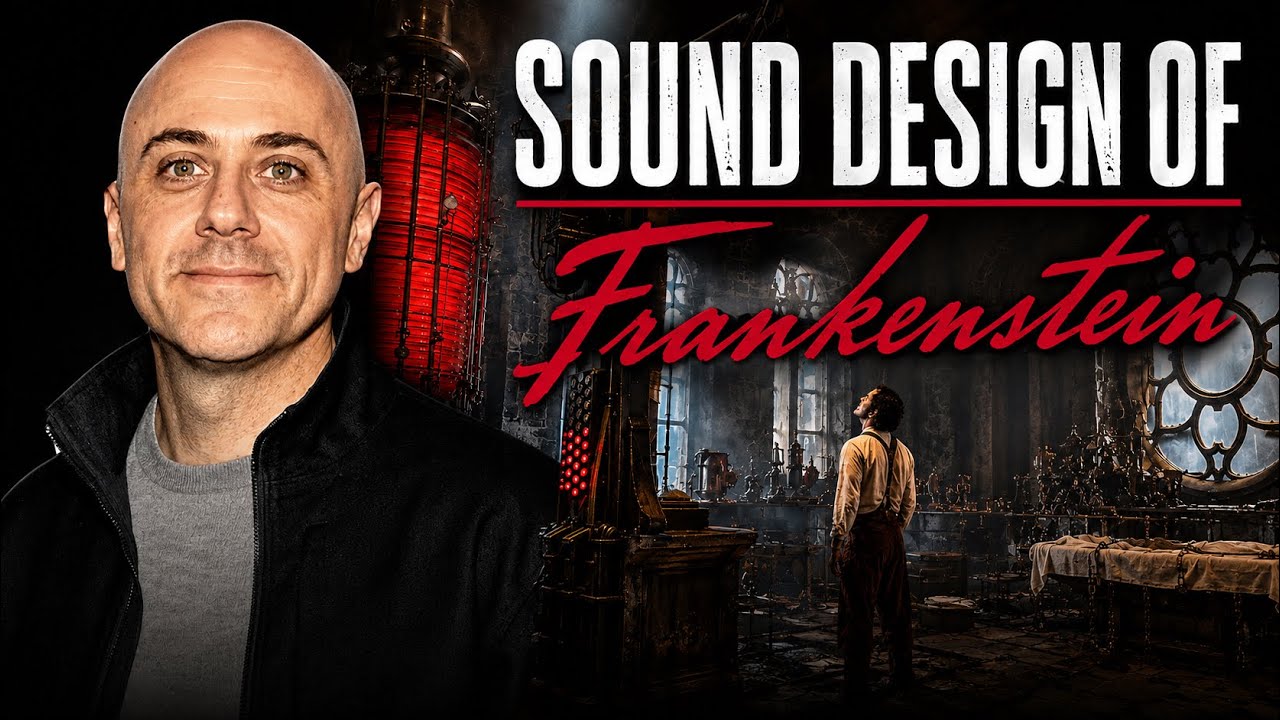
It was 39°C in the San Fernando Valley the afternoon Patrick Hogan sat down with Zebra Home Cinema for this interview. In a few hours he would leave his umbrella-shaded backyard, put on something more formal, and head into downtown Los Angeles for the premiere of Cobra Kai Season 5 — which was dropping on Netflix two days later. The premiere was being held outdoors, which meant some of the tickets had been released to fans. They sold out in five minutes.
Hogan is a multiple Emmy-nominated supervising sound editor and an independent filmmaker in his own right. He has been with Cobra Kai since the beginning. Alongside the day-job sound work, he writes and directs his own films — his 2021 short Killing Time has won multiple festival awards. In this conversation he walked through the technical reality of ADR (the post-production rerecording of dialogue that audiences generally don't notice is there), the story behind Killing Time, and what the Cobra Kai team was about to unleash in Season 5.
Starting in Film and Ending Up in Sound
Hogan came into sound sideways. Most sound professionals arrive from music — as instrumentalists, recording engineers, or live-sound technicians who found their way into film post. Hogan's path was different.
He was born into the Star Wars generation — one of the kids who dragged his parents to the first Star Wars film. Theatrical productions through high school. A radio DJ job in the same period that taught him to cut basic audio — bumpers and promos for the radio station. Then film school in Los Angeles, intending to become a director.
"In film school, I kind of fell into the sound department. Before I even graduated, I was getting paid offers to do sound on projects. I thought, wow, I haven't even graduated yet. I'm making money. This is pretty nice."
He has never given up filmmaking. His sound-editing career finances and supports the independent shorts he directs between jobs — where he gets final say and can exercise the muscles his paying work doesn't always reach.
That dual identity matters for his sound work. When he's sitting across from a director, producer, or editor, he speaks their language — because he is one.
"I think it helps me as a sound editor, because since I've been on the opposite side of the table, when I'm talking to my clients, I kind of know where they're coming from. I think I get to what they need faster."
He worked out of an office three doors down from Mark Mangini — the two-time Oscar winner for Mad Max: Fury Road and Dune, widely regarded as one of the most articulate practitioners of sound design working today. Mangini, in Hogan's framing, is "the Spielberg of sound editorial." The proximity shaped Hogan's craft in ways he is still conscious of.
What ADR Actually Is (And Why It's Harder Than It Looks)
Hogan gave the clearest explanation of Automated Dialogue Replacement (ADR) we've heard. The term is a misnomer — nothing about it is automated. It's also historically called looping, because of how it was done before digital.
"They would take the piece of the scene they needed to rerecord. They would literally loop that piece of film and play it in the projector. The actor could sit in front of the stage and see that looped film playing — Here's looking at you kid. Here's looking at you kid. Here's looking at you kid. — and then they'd start recording on a new piece of film. Then on the flatbed they'd line up the new line against the original. That's why it's called looping."
Today it's all hard drives, but the discipline is identical. ADR is defined as any dialogue recorded after principal photography, either to fix a technical problem in the original recording or to add or change a line that the edit requires.
The most common reasons for ADR:
- 1.Technical interference. A jet plane flies overhead during a period-piece scene. A train runs behind one camera angle but not the reverse. Wind machines during action sequences. Drones — which have become increasingly loud and ubiquitous — generate a high-pitched whine that's unremovable from any location recording. Any of these forces a rerecord.
- 2.New dialogue. During editing, the story reveals a missing piece of information. A character explains something on a reaction shot, or over the shoulder, or while picking up a glass. The new line is written, recorded in ADR, and added.
- 3.Accent adjustments. On international co-productions, actors frequently play characters of a different nationality than their own. Even with dialect coaches, occasional words trip them up. ADR lets the performance be corrected line by line.
- 4.Performance adjustments. Sometimes the director realises later that a line needed a different register. ADR is the mechanism for changing it.
What the audience doesn't realise: if ADR is done properly, they can't tell it's there. If done badly, they can feel it without being able to say why.
The Match Problem — Microphones, Distance, Timbre, Performance
The hard part of ADR is that it has to match.
Hogan broke this down into four layers:
Microphone match. Production sound is captured on shotgun or hypercardioid mics on set, plus lavalier mics clipped to the actor's clothing and often transmitted wirelessly. ADR stages have to replicate that exact capture chain. Formosa Group's ADR stages use the same shotgun mics boomed at the same distance as they would be on set, plus a lav transmitted via wireless pack to match the digital signal path exactly.
"A lav mic out here is going to sound very different from when it's sitting on your chest. That signal path, when it gets digitised through a wireless system, sounds a little bit different than when it goes through a hardwire."
Distance and room match. If the actor was interior on set, the mic catches a small amount of room reflection. The ADR stage recreates this by asking the actor to stand slightly further back from the mic. If the scene was exterior, the actor comes closer to the mic, so the dry ADR sound can be matched to the dry exterior original.
Timbre match. The human voice changes through the day. Vocal cords warm up and wear out. Morning voice and end-of-day voice are measurably different in pitch and resonance. If the actor was shouting in preceding scenes, their voice carries hoarseness into the scene being ADR'd. If they ADR fresh four weeks later at 8 am with coffee in hand, none of that physical reality is present. Good ADR takes into account where in the production day — and production schedule — the actor's voice was when the original line was captured.
Performance match. The hardest of the four. The actor has to match the emotional register of their original performance exactly.
"Sometimes the actor comes in and they're in a perfectly air-conditioned room, they had a Starbucks, they're rested. But on set they were filming a scene where they were dying in the snow at night after a 14-hour day. They were cold, tired, defeated. We have to work with them — sometimes run them through multiple takes to wear them out so they reach the same exhaustion as the original."
The industry joke Hogan offered: if there was a performance button on the mixing console, whoever invented it would be a billionaire. There isn't one. The fix is always the actor doing the work.
Killing Time — Making a Short Film During the Pandemic
Hogan's short film Killing Time is a COVID-era production that looks nothing like one. It was shot during the peak of the pandemic lockdowns easing, with strict SAG rules in place: actors who were unmasked had to stay six feet apart. No crowded scenes. Minimal cast. Minimal background.
Hogan had an earlier script — a film noir about a couple — that was impossible under those rules. So he reworked it for the conditions.
- ▪Setting changed from public streets and stores to a single confined house interior.
- ▪Cast simplified from couple to mother and daughter — a biologically distanced relationship where a daughter poking her head in the door and yelling at her mum (never close enough for an onscreen hug) reads as entirely natural.
- ▪Tone shifted from noir to a horror homage — Halloween specifically. The lone-in-the-house trope justifies exactly the kind of isolation the shooting rules required.
- ▪Voiceover removed, replaced with a grandfather character who delivered the exposition that noir's voiceover would have carried.
The production resources were friends and equipment:
- ▪The DP was the director-husband of the lead actress
- ▪The house on screen is the actual home of the grandfather character
- ▪Crew were friends who happened to have time
- ▪Total budget: minimal — "no budget, just friends"
The sound mix was handled by Frank Marrone and Rob Carr — Hogan's mixing colleagues on the Roswell, New Mexico series he was simultaneously mixing on. Frank took the dialogue home on a day off and pre-dubbed it. On another off-day, the three of them mixed the film end-to-end on the Roswell stage in a single day. The result — particularly the bass, as Zebra Home Cinema's reviewer noted on the Blu-ray — punches far above the production's weight class.
Why Cinema Short Films Still Deserve 2.39:1
Killing Time was shot in 2.39:1 CinemaScope — the widescreen aspect ratio of most theatrical features. This was a deliberate framing choice for a short that most viewers would watch on domestic screens.
"We wanted to give it that theatrical feel. Widescreen cinema psychologically makes you feel like you're seeing an event. The idea was — let's make a short film that could easily look like any 10-to-15 minute portion of a big-budget theatrical film."
Hogan's earlier short Virtually — shot pre-pandemic with a different cinematographer — used the same framing logic. The consistent framing principle: when you make something with the grammar of cinema, you earn the audience's attention. Short films framed like standard internet video get treated as internet video. Short films framed like theatrical work get treated as theatrical work.
Hogan was explicit about who this effort is really for.
"A lot of people are going to watch stuff on an iPad that's set to a very dim level, playing through the one mono speaker. We could mix and colour the film for that. But we decided that, you know, we always do the work to the highest level. So the people who do take the time and money to view it that way, we'll get that. We don't want to shortchange them. The details are there for those people who really want to get the best experience."
A reference home cinema owner watching Killing Time on a 2.39:1 projector screen with dual 12-inch subwoofers gets exactly what Hogan and his colleagues hid in the mix. Most audiences won't notice it. The ones who do are the ones the work was made for.
How Cobra Kai Modernises Without Losing the Karate Kid Grammar
Cobra Kai's underlying creative challenge: the original Karate Kid films were 1984 productions. The sonic grammar of 1984 martial-arts cinema is distinct — the specific impact sounds, the punctuation style, the dynamic range. Cobra Kai's audience includes both original Karate Kid fans who want the show to feel like the 80s films, and new viewers who expect contemporary immersive-audio production.
Hogan's approach is to honour the original sonic language while modernising the execution.
"We listen to the Karate Kid movies and we use that as the basis for what we do in the sound — the same way they use it for the basis for the show. But we also recognise that was 1984, and we're now thirty-some years past that. So while we pay homage to the sound design, we do modernise it."
The team also benefits from Cobra Kai's legacy casting. The series brings back characters from the original films (Chozen, Mike Barnes, etc.), and audio cues that call back to Karate Kid 2 and 3 are woven through Season 5's sound design as treats for the fans who recognise them.
One specific observation Hogan offered about Chozen: actor Yuji Okumoto, who played him as a "one-note villain" in Karate Kid 2, gets a deeply expanded arc in Cobra Kai Season 5. The part now has comedy, emotional range, and physical presence. In Hogan's words: he's going to make you laugh. He's going to make you cry.
Inside Season 5's New Sonic Techniques
Without spoilers, the Season 5 sound additions Hogan was willing to hint at:
- 1.Metallic "shing" sounds. Cobra Kai is primarily about bare-handed martial arts, but Season 5 escalates. Some of the fighting this season features implements that make very specific metallic sounds. Bladed, sharp, and new to the show.
- 2.Multiple concurrent fights. Previous seasons occasionally had large-scale confrontations; Season 5 has scenes where multiple distinct fights occur simultaneously across different locations, requiring the sound design to hold separate sonic identities for each fight while the edit cuts between them.
- 3.New senseis with real martial-arts credentials. Several of the new characters this season are played by actual trained martial artists — including at least one high-end MMA fighter. That affects what the sound team can do on the stage: when the on-screen performer is genuinely executing the technique, the sound design can support rather than conceal.
Hogan flagged the production context: Cobra Kai is not a big-budget show by prime-time standards. It started on YouTube Premium with a shoestring budget and even now, on Netflix, works with resources that most action-forward dramas do not have. Everything the show achieves on screen is the product of disciplined, creative execution rather than enormous money.
"It's kind of like the budget of Saved by the Bell but with the action of some huge 80s Sylvester Stallone or Jean-Claude Van Damme action movie rolled into it."
The Season 3 Dee Snider Cameo — Why It Sounded Real
One of the best pieces of sound craft on the show was actually in Season 3 — Dee Snider's on-screen cameo. Hogan was involved in that decision from before the scene was filmed.
The pet peeve Hogan and the team wanted to avoid: the generic on-screen-concert trick where a scene supposedly depicts a live performance but the audio is clearly the album recording with a bit of reverb layered on top. It's immediately unconvincing.
Dee Snider sent the production his personal archive of live recordings of the two songs under consideration. Hogan reviewed five or six different live versions of each song — sourced from gigs ranging from intimate clubs to 40,000-capacity stadiums. He listened specifically for:
- ▪Which recording had the right intimate-club ambience
- ▪Which had available stems (separated vocals, guitar, drums, crowd)
- ▪Which could be mixed to sound authentically like the venue in the scene
The selected live recording was then used as the playback track on set — Dee and the other actors performed along to the actual live track. That same track, properly mixed by Hogan's team on the stage, is what you hear in the finished scene. The result is a performance that reads as real because, in a specific sense, it is.
This is the kind of craft detail that distinguishes Cobra Kai from most TV productions. The sound isn't invented in post. It's pre-planned in concert with the production, and the results are visible (or rather, audible) on screen.
The Season 4 Speed-Ramping Problem
The speed-ramping technique that Cobra Kai Season 4 introduced — starting a shot at normal speed, accelerating into slow motion, then returning to normal — is visually striking but technically non-trivial from a sound perspective.
The cinematographic method: the entire shot is filmed at 3x slow motion. In slow-motion playback, the footage is full-resolution. In normal playback, the footage plays back 3x faster than it was captured. The sound engineers had to work with this mismatch before the footage was shot.
Hogan was consulted ahead of filming. He ran tests to verify that when the footage was played back at regular speed (3x faster than its native capture), the on-set sound remained in sync and useable. On the mixing stage, the team paid particular attention to ensuring sync was maintained across the speed transitions.
This is the advantage of having a sound supervisor involved in pre-production rather than only post. Technical issues that would otherwise appear mid-mix get identified and designed around before a camera rolls.
Key Takeaways
- ▪Patrick Hogan is a multiple Emmy-nominated supervising sound editor on Cobra Kai (Netflix), The Umbrella Academy, Fire Country (CBS), Reservation Dogs, and many other shows, and a writer-director of independent short films including Killing Time and Virtually. He came into sound from a filmmaking background rather than a musical one — giving him an unusual ability to speak the language of directors and producers.
- ▪ADR (Automated Dialogue Replacement) is not automated. It is post-production rerecording of dialogue to fix technical problems (jet planes, trains, drones, wind machines), add new dialogue required by the edit, correct accents, or adjust performances. The four match problems an ADR session has to solve are: microphone, distance and room, timbre, and performance. Performance is the hardest and can't be fixed on a console.
- ▪Killing Time was a COVID-era short, rewritten from a pre-pandemic noir script to comply with SAG distancing rules — reframed as a mother-and-daughter Halloween-homage thriller and shot with friends in the grandfather's real house. Frank Marrone and Rob Carr mixed the sound in a single day on the stage they were already using for Hogan's main show Roswell, New Mexico.
- ▪Short films earn cinematic respect by using cinematic framing. Hogan shot Killing Time in 2.39:1 CinemaScope so that any 10–15 minute excerpt could plausibly sit inside a theatrical feature.
- ▪Cobra Kai approaches its sound design by honouring the 1984 Karate Kid grammar while modernising the execution. Season 5 introduces metallic blade sounds, simultaneously-cut multiple fights, and new senseis with real martial-arts credentials including an MMA fighter.
- ▪The Season 3 Dee Snider cameo sounded authentic because the production used Snider's archive of actual live recordings as the set playback track. That track was then mixed on the stage for the finished scene — meaning the audience is listening to a real live performance, not a retrofitted album track with reverb.
- ▪Speed-ramping — the slow-mo-and-back technique introduced in Season 4 — requires pre-production sound consultation because the footage is captured at 3x slow motion throughout, which affects sync when played back at regular speed.
Frequently Asked Questions
What is ADR in film and television?
ADR — Automated Dialogue Replacement — is the post-production rerecording of dialogue after principal photography. It is used to fix technical problems (jet planes, trains, drones, or wind-machine noise over the original on-set audio), to add new dialogue required by the edit, to correct accents on international co-productions, or to adjust performance. It is also historically called looping, from the pre-digital method of literally looping a piece of film in a projector so the actor could rerecord against it.
Why is ADR hard to get right?
Because it has to match the original on-set recording on four separate dimensions: the microphone and signal path used, the distance and room acoustics, the actor's vocal timbre at the original time of day, and the emotional performance. The first three can be engineered on a well-equipped ADR stage. The fourth — performance — has to be coached from the actor. There is no console button for emotional register.
Who is the supervising sound editor on Cobra Kai?
Patrick Hogan is the supervising sound editor on Netflix's Cobra Kai, and has been since the show's first season. He also supervises sound on The Umbrella Academy (Netflix), Fire Country (CBS), and Reservation Dogs. He works out of Formosa Group in Los Angeles.
How was Patrick Hogan's short film Killing Time made?
Killing Time was shot during the COVID-19 pandemic under strict SAG distancing rules. Hogan reworked a pre-pandemic noir script about a couple into a mother-and-daughter Halloween-homage thriller so the cast could realistically stay six feet apart without the scenes looking unnatural. It was shot in the grandfather character's real house with friends-and-family crew, a zero-budget production schedule, and mixed in one day by Frank Marrone and Rob Carr on the Roswell, New Mexico mixing stage during an off-day.
What makes Cobra Kai's sound design different from other TV action shows?
Several things. The show works inside a very tight budget by prime-time standards, which forces creative rather than expensive execution. It is deliberately calibrated against the 1984 Karate Kid sonic grammar while modernising the production. Season 5 adds multiple concurrent fights, bladed-weapon metallic sounds, and new characters played by real martial artists. The show's pre-production sound consultation — Patrick Hogan is involved before filming on techniques like speed-ramping and the Dee Snider concert cameo — results in effects that reach the final mix without the usual post-production compromises.
Why did the Dee Snider cameo in Cobra Kai Season 3 sound so authentic?
Because the production used Dee Snider's personal archive of actual live performance recordings as the set playback track. Hogan reviewed five to six different live versions of each song from different venues (clubs and stadiums of varying sizes) and selected the one that best matched the scene's intimate-club setting. The actors performed to that live track on set, and the track was then mixed for the finished scene — so the audience hears a real live performance rather than a studio track dressed up with reverb.
What is speed-ramping and why does it affect sound design?
Speed-ramping is a cinematic technique where the footage starts at normal speed, transitions into slow motion, then returns to normal — often during an action beat. To achieve it, the entire shot is filmed at three times slow motion, which means the "normal speed" sections are actually played back three times faster than they were captured. For sound, this breaks the usual one-to-one sync between capture and playback. Patrick Hogan was consulted before Cobra Kai Season 4 began filming with this technique, and ran tests to verify the on-set sound remained useable at the altered playback speed.