A Speaker Unlike Any Other
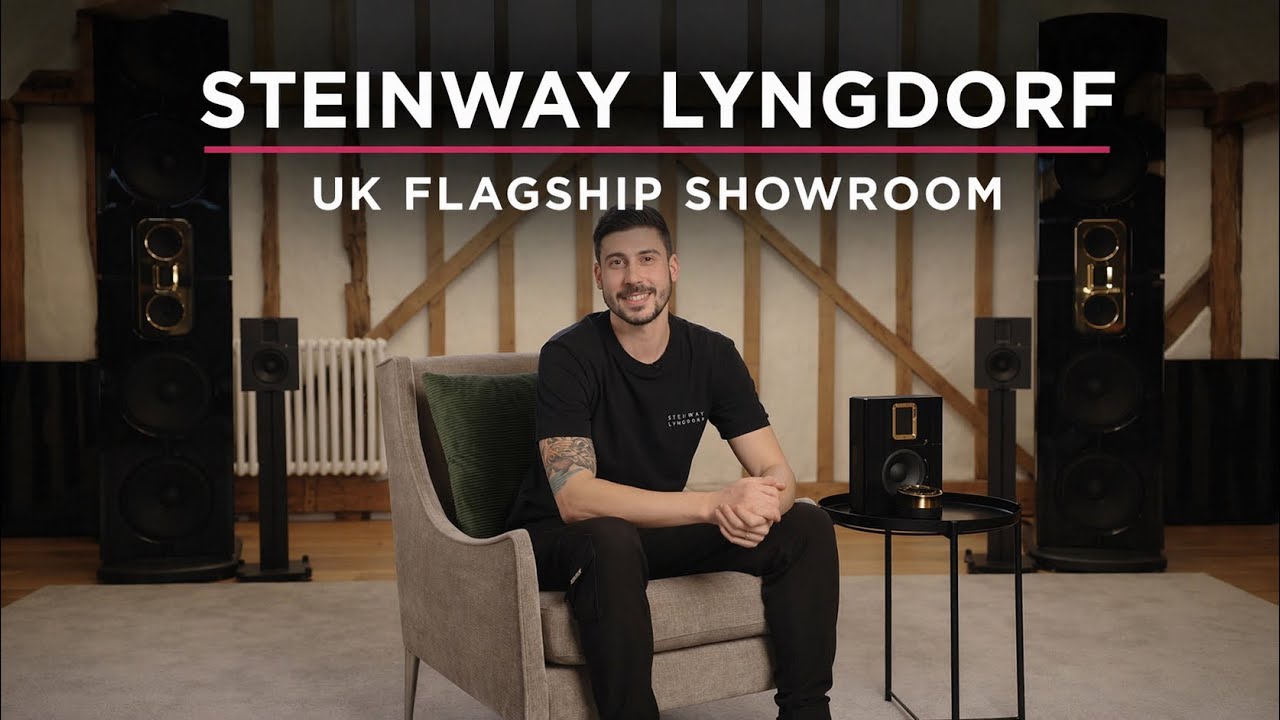
There are loudspeakers, and then there is the Steinway Lyngdorf LS Concert Series. At two and a half metres tall, it is one of the most physically commanding loudspeakers ever engineered for domestic environments. But its presence in a room is felt before you can explain why — and the explanation, once you understand it, changes how you think about reproduced sound entirely.
"When you hear music on this, it doesn't sound like a speaker firing at you. It sounds like a live event right in front of you."
That claim sounds like marketing until you stand in front of one. Then it sounds like a description.
The Open Baffle Principle: Why There's No Box
The first thing you notice about the LS Concert Series is what's missing: a cabinet.
Every conventional loudspeaker — from a £200 bookshelf speaker to a £50,000 floorstander — is built around an enclosure. Drivers are mounted in a sealed or ported box, and that box performs a function: it controls the air movement behind the cone. Without it, the rear wave would cancel the front wave at low frequencies.
But the enclosure creates its own problem. As the driver moves, the air inside the box compresses and resists — it physically slows the cone's movement. Cabinet walls vibrate. Put your fingertips on any conventional speaker playing at volume and you can feel it resonating. That resonance is distortion.
The LS Concert Series eliminates the cabinet entirely. It is a free-standing dipole — an open baffle speaker that lets drivers move without resistance, and that radiates sound equally from front and back.
What Dipole Radiation Actually Means
When a piano is played in a concert hall, sound doesn't project from one point towards the audience. It radiates in all directions, reflects off walls and ceiling, and reaches the listener as a combination of direct and reflected energy. That's what gives live music its three-dimensional quality — the sense that sound exists in space rather than emanating from a point source.
A dipole speaker replicates this. Sound leaves the front of the driver and the back, wraps around the room, and arrives at the listener with the spatial complexity of a real acoustic event. The room becomes part of the instrument.
"Imagine listening to someone playing the piano. You're not just hearing sound coming towards you. The sound from the piano is coming out in all directions, and you're getting reflections from the room."
Engineering Specification
| Specification | LS Concert Series |
|---|---|
| Height | 2.5 metres |
| Configuration | Free-standing dipole (open baffle) |
| Tweeter array | Air Motion Transformer (AMT) — 2 per module, 10 modules per column |
| Effective SPL range | Maintains reference levels at 60+ metres |
| Cabinet | None |
| Sold as | Complete system only (speakers + electronics integrated) |
| D-to-A conversions | One (vs. 3+ in conventional separates) |
| Preamp stage | None — signal path eliminated |
Scale Without Distortion
Most high-end hi-fi speakers achieve reference listening levels at three to four metres. At greater distances, the sound pressure level drops and the dynamics compress. In large rooms — great halls, commercial screening rooms, properties with double-height reception spaces — this becomes an engineering constraint that separates good audio from genuinely reference audio.
The LS Concert Series maintains its acoustic performance at sixty metres. That's not a typo. The combination of the open baffle design, the AMT tweeter array, and the sheer driver count means the system scales to spaces most loudspeakers cannot address.
The AMT Tweeter Stack: Why Driver Count Matters
The LS Concert Series employs Air Motion Transformer tweeters — a driver design that moves air through a folded ribbon membrane rather than a conventional cone. AMT drivers have exceptional transient response and low distortion at high SPLs.
Each column of the LS Concert Series contains ten modules, each with two AMT tweeters. That's twenty tweeter-equivalent drivers per column. At extreme volume levels, each driver is barely moving — because the work is shared across so many. The result: virtually zero high-frequency distortion even at live concert levels.
Why It Can Only Be Sold as a Complete System
This is the detail that surprises most audiophiles encountering Steinway Lyngdorf for the first time: you cannot buy the LS Concert Series speakers alone.
The reason is architectural, not commercial.
A standard high-end audio chain involves multiple components: source, preamplifier, digital-to-analogue converter, power amplifier. Each stage introduces noise and distortion. By the time audio reaches the drivers, it has passed through three or more D-to-A conversions and at least one preamp stage.
Steinway Lyngdorf integrates the entire signal path. The system performs a single D-to-A conversion. There is no preamp. The speakers are purpose-designed to work with the electronics, and the electronics are purpose-designed to drive those specific drivers — including the brand's proprietary RoomPerfect room correction technology.
The practical result: when you sit in front of a Steinway Lyngdorf system, the background is completely silent. Not just quiet — silent. There is no noise floor to speak of. What you hear is only the recording.
The Listening Test: Music as the Standard
A revealing way to evaluate any home cinema system is to strip it back to stereo and play well-recorded music. A surround processor doing its job can paper over many sins with multichannel content. Two-channel music is unforgiving.
Specialists who demonstrate the LS Concert Series regularly issue this challenge: bring a recording of an instrument you know well — a piano, a violin, a string quartet — and play it back. Then compare it to any other system at any price.
The claim made by everyone who has conducted this test seriously: musicians placed in front of an LS Concert Series playing a recording of their own instrument say it sounds like the live performance. Not an excellent reproduction — the live performance.
That is the standard the LS Concert Series is engineered to meet.
Key Takeaways
- ▪Open baffle eliminates cabinet distortion — drivers start and stop faster, and nothing resonates
- ▪Dipole radiation creates genuine three-dimensional soundfields — not stereo simulation, but actual spatial reproduction
- ▪AMT tweeter arrays enable concert-level SPLs without distortion — achievable at 60+ metres
- ▪System integration is fundamental to performance — fewer conversions, no preamp, one coherent design
- ▪Music is the real test of a home cinema system — and nothing else passes it like this
FAQ: Steinway Lyngdorf LS Concert Series
Who is the Steinway Lyngdorf LS Concert Series designed for?
The LS Concert Series is designed for large-scale domestic and commercial applications — substantial reception rooms, double-height spaces, private cinemas, and environments where both music listening and home cinema need to perform at the absolute highest level. It is not a starter product; it represents the pinnacle of what Steinway Lyngdorf builds.
Can the LS Concert Series be used for home cinema as well as music?
Yes — and this is central to the Steinway Lyngdorf philosophy. The system is equally capable with film content, and the studio-monitor accuracy that makes it extraordinary for music translates directly into home cinema performance. Dialogue clarity, dynamic range, and spatial imaging are all exceptional.
Why does Steinway Lyngdorf only sell complete systems?
Because the speakers are engineered to work with the brand's own electronics as a single coherent system. Separating the components introduces additional conversion stages and preamp noise that degrade performance. The integrated approach achieves a single D-to-A conversion with no preamp — a fundamentally cleaner signal path than any separates combination.
What is RoomPerfect, and why does it matter?
RoomPerfect is Steinway Lyngdorf's proprietary room correction technology. It analyses the acoustic behaviour of your specific room and applies mathematically precise corrections to ensure the speaker performs as designed regardless of room geometry, furnishings, or surface treatments. It is one reason the same speaker sounds correct in very different rooms.
How do I arrange a demonstration of the Steinway Lyngdorf LS Concert Series in the UK?
Steinway Lyngdorf is a custom-install-only brand with limited UK representation. Demonstrations are by appointment through authorised specialists. Zebra Home Cinema maintains a Steinway Lyngdorf reference system and can arrange private listening sessions for serious enquirers.
Frequently Asked Questions
What is the Steinway Lyngdorf LS Concert Series?
The LS Concert Series is Steinway Lyngdorf's range of large-scale reference loudspeakers designed for full-room playback in dedicated listening spaces and high-end home cinemas. They are physically larger than the consumer-tier models in the line and are engineered for very high SPL with no loss of dynamic detail.
Who is the LS Concert Series for?
Clients with dedicated listening rooms or large home cinemas where the space and budget can support reference-level large-format speakers. Typical applications include flagship two-channel music rooms, multi-row cinema installations where the front L/C/R needs to fill a large screen, and serious sound stages.
How does the LS Concert Series differ from the Model D?
The Model D is Steinway Lyngdorf's flagship floor-stander, designed for high-end domestic rooms. The LS Concert Series scales the engineering up — larger drivers, higher amplification, designed for spaces that demand sustained reference output across a wider listening area. Both share the same digital-amplification and RoomPerfect calibration architecture.
What rooms suit a Concert Series installation?
Dedicated rooms over roughly 50 m² with controlled acoustics and the structural mass to support sustained high-output playback. The brand's authorised installers work with the architect or AV integrator to specify placement, calibration, and amplification requirements before the room is finished.