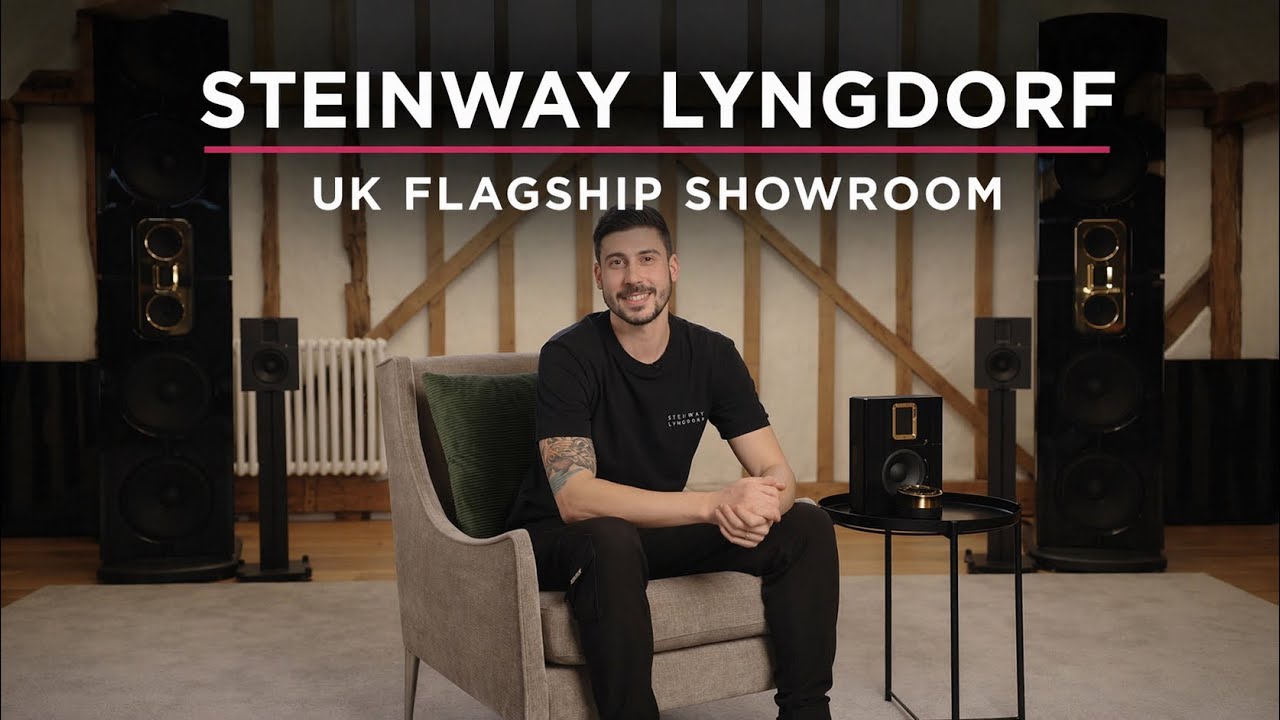
Ask most people what the most important part of a film score is and they'll mention the dialogue or the explosions. Ask someone who has spent years listening to reference audio systems and they'll tell you it's the music. The orchestra swell that makes a scene land. The piano motif that carries the emotion. And according to the team behind Steinway Lyngdorf, most home cinema systems — no matter how expensive — don't faithfully reproduce it.
The S-15 is Steinway Lyngdorf's entry-level loudspeaker. It's compact, it looks unassuming, and in combination with Steinway Lyngdorf electronics, the claim is that it outperforms anything else available.
Why Music Is the Real Test for a Cinema System
There's a test that cuts through the marketing noise in any home cinema demonstration. Forget the action sequences. Forget the deep bass drops and the LFE that rattles your chest. Bring a well-recorded stereo music track — a string quartet, a solo piano, a jazz trio recorded live — and play it through the system you're considering.
Most systems fail it. The strings lose their texture and become smeared. The piano sounds like a piano-shaped approximation rather than the real instrument. The spatial imaging that live music creates — the sense of performers in a real space — collapses into a vague sound cloud between two speakers.
"Home theatre systems can't faithfully reproduce music. They're not accurate enough. Strip it back to stereo, play a bit of music, and you'll find these big fancy home theatres just don't sound natural."
The Steinway Lyngdorf philosophy starts from the premise that if a system can reproduce music accurately — if a Steinway concert grand played through it is indistinguishable from the live instrument, as per the brand's founding validation — then cinematic sound is achievable as a consequence. Accuracy first. Everything else follows.
The S-15: Specifications and Design
The S-15 is Steinway Lyngdorf's compact reference speaker, the most accessible entry point into the system. Its physical dimensions are modest — it looks, at first glance, like a small bookshelf loudspeaker. The engineering behind it is anything but.
| Specification | S-15 Detail |
|---|---|
| Sensitivity | 95.5 dB (1W/1m) |
| Amplification | Active — 400W Equibit amplifier per channel |
| Cabinet material | Solid aluminium billet |
| Type | Active, fully integrated |
| Room correction | Lyngdorf RoomPerfect included |
High sensitivity, active design. The 95.5 dB efficiency rating means the S-15 converts amplifier power into acoustic output more efficiently than most passive speakers (typically 85–88 dB). Combined with 400 watts of active amplification per channel, the S-15 can produce significantly higher output levels than much larger passive floor-standing speakers — while the active electronics ensure the amplifier and driver are perfectly matched.
Solid aluminium cabinet. A conventional speaker cabinet is a wooden box. Wood resonates — you can feel it vibrating if you place your hand on the cabinet during loud playback. That vibration is energy that should have been converted to sound being dissipated as cabinet resonance instead, adding colouration and smear to the output.
The S-15's cabinet is machined from a single billet of aluminium. It is, in the words of its demonstrators, "like picking up a pavement slab" — extremely inert, with no resonant frequency in the audio band. The result is that the driver generates only the sound it was instructed to produce, with no cabinet artefacts contaminating the output.
The Electronics: Removing Conversion Noise
One of the recurring themes in Steinway Lyngdorf's product philosophy is signal path simplicity. Conventional speaker systems involve multiple conversion stages: the source signal passes through a preamp, then a power amplifier, then a crossover network, before reaching the driver. Each stage adds noise and distortion.
Steinway Lyngdorf's active architecture eliminates the passive crossover entirely. The signal processing, crossover, room correction, and amplification are all handled in the digital domain, with a single conversion to analogue at the final amplifier stage. The practical result: the system is completely silent when playing no music. No hiss, no hum, no floor noise. In the demonstration room, you can verify this simply by listening. Most high-end passive systems reveal a noise floor in a silent room.
The Music Recommendation Test
The S-15 demonstration at Gecko Home Cinema — the UK's Steinway Lyngdorf specialist — involves a specific approach: play music you know. Not unfamiliar audiophile recordings chosen to flatter the equipment. Your music. The kind you listen to regularly and know how it should sound.
For attendees who are professional musicians or recording engineers, this is where the system separates itself. The example in this video involves a client who composed a piece of music, hired the London Philharmonia Orchestra to record it, mixed it himself, and then heard the Steinway Lyngdorf playback reveal detail he hadn't encountered during the mixing session. What he heard had been in the recording the whole time. His monitoring system hadn't shown it to him.
For home cinema purposes, the implication is clear: if the system can reveal that level of musical detail, the dynamic range and spatial accuracy of a well-mixed Atmos track becomes genuinely accessible.
Who Is the S-15 For?
The S-15 is positioned as Steinway Lyngdorf's entry-level loudspeaker, but "entry-level" in this context means entry into a reference-tier system. It is appropriate for:
- ▪Smaller cinema rooms where a full-size floor-standing speaker would be acoustically and aesthetically inappropriate
- ▪Surround and height channel applications in larger systems using Steinway Lyngdorf Model D or P-100s as the primary speakers
- ▪High-end two-channel and music systems where accuracy across the full frequency range is the priority
- ▪Clients who want Steinway Lyngdorf performance in a more compact physical footprint
The S-15's small size combined with 95.5 dB efficiency means it can anchor a cinema system in rooms where larger loudspeakers would overwhelm the space.
Key Takeaways
- ▪The S-15 is Steinway Lyngdorf's compact reference loudspeaker — small form factor, aluminium cabinet, active 400W amplification per channel
- ▪The real-world test for any cinema system is music playback: it reveals whether a system is accurate or merely impressive on action sequences
- ▪Solid aluminium construction eliminates cabinet resonance that wooden speakers introduce as colouration
- ▪The active, fully integrated design removes passive crossover noise and multiple conversion stages — the system is silent at rest
- ▪At 95.5 dB efficiency with active amplification, the S-15 produces higher output levels than significantly larger passive speakers
Frequently Asked Questions
What makes an active loudspeaker better than a passive one?
An active loudspeaker has its own dedicated amplification built in or closely matched to each driver. The benefits include: perfectly matched amplifier-to-driver impedance (improving efficiency and accuracy), elimination of the passive crossover network (which adds colouration and phase errors), and the ability to apply digital signal processing to each driver individually. Passive speakers with separate amplifiers involve more conversion stages and more opportunity for noise and distortion to enter the signal path.
Why does the aluminium cabinet matter so much?
All cabinets vibrate to some degree. When a cabinet vibrates, it radiates sound — sound that wasn't in the original signal, which constitutes distortion. Aluminium has a very high stiffness-to-mass ratio and is not resonant in the audio frequency band in the form used here. The effect on the listener is reduced colouration and better transient clarity, particularly on complex musical content where cabinet resonance would smear the imaging.
Is the Steinway Lyngdorf S-15 a good choice for a two-channel music system?
Yes — and it is arguably the more natural use case. The S-15 was developed from the same acoustic philosophy as the Model D (which had to pass a live concert piano test). For two-channel music systems where accuracy and resolution are the priority, it is one of the most capable compact loudspeakers available. The integrated RoomPerfect room correction also makes it significantly more tolerant of real-world room acoustics than most passive alternatives.
What is the RoomPerfect room correction system?
RoomPerfect is Lyngdorf's proprietary room correction technology, developed specifically for real domestic listening environments. It measures the room-speaker system's response from multiple microphone positions, computes a correction profile, and applies digital filtering to compensate for room-induced frequency response anomalies. It is considered one of the most effective room correction systems available and is integrated into all Steinway Lyngdorf electronics.
Where can I audition the Steinway Lyngdorf S-15 in the UK?
Gecko Home Cinema is the UK's Steinway Lyngdorf specialist and demonstration facility. They host the only Model D demonstration in the UK and carry the full Steinway Lyngdorf range. An appointment is recommended.