Steinway & Sons has been making concert grand pianos for over 170 years. More than 90% of professional concert pianists insist on a Steinway when they perform. The brand means something in music that few others can claim. So when speaker manufacturers came calling — dozens of them over the decades, wanting to license the Steinway name for audio products — the company said no. Every time. Until Peter Lyngdorf showed up with a recording.
Why Steinway Refused Every Collaboration — Until Lyngdorf
Steinway's rejection of audio partnerships wasn't commercial stubbornness. It was a standard. They said they would not put their name to an audio system until one existed that could perfectly reproduce a Steinway piano.
The piano is one of the most demanding acoustic tests any audio system can face. A concert Steinway produces sound from 88 strings across a frequency range from 27.5Hz to 4.186kHz, with overtone energy extending far beyond. The attack of a hammer on string, the resonance of the soundboard, the room interaction — a piano played live in a concert hall creates a specific, reference-quality acoustic experience that professional musicians and their tuners know with extraordinary intimacy.
Steinway's piano technicians — the people who tune concert grands before every major performance and can detect tuning drift of less than a hertz — were the gatekeepers. If they couldn't distinguish the recording from the live instrument, the collaboration was possible. If they could, no amount of commercial appeal would change the answer.
Peter Lyngdorf's Approach
Peter Lyngdorf of Lyngdorf Audio — a Danish electronics engineer who had built one of the most technically rigorous amplifier and signal processing companies in high-end audio — approached Steinway approximately 15 years ago. His claim: he could reproduce the Steinway piano convincingly enough to satisfy their technicians.
He wasn't pitching a product. He was presenting a proof. The demonstration system — not yet refined to commercial form — was played for the people who tune and play Steinway instruments for a living.
They said it was indistinguishable from the live piano.
More remarkably, they could identify which piano it was from the recording. Steinway grand pianos are manufactured in two facilities — Hamburg, Germany and New York, USA — and there are subtle tonal differences between the two workshops. The technicians identified the recording as a Hamburg-built instrument.
"The people that tune the pianos could say: no, that one's from New York. The tonal variance between Hamburg and New York instruments — they heard it on the system."
The collaboration was agreed. Steinway Lyngdorf was born.
The Model D: The First Product
The first Steinway Lyngdorf loudspeaker system was the Model D — named after the concert grand, the Steinway Model D, the largest piano Steinway manufactures and the instrument used in the majority of professional concert performances.
The Model D is a full-range, active, room-corrected speaker system designed to perform in a real room rather than an anechoic chamber. Lyngdorf's RoomPerfect room correction technology — one of the most sophisticated available — analyses the room's acoustic signature and applies corrections to ensure the speaker-room system performs accurately regardless of the acoustic environment it's placed in.
The Demonstration That Proves the Point
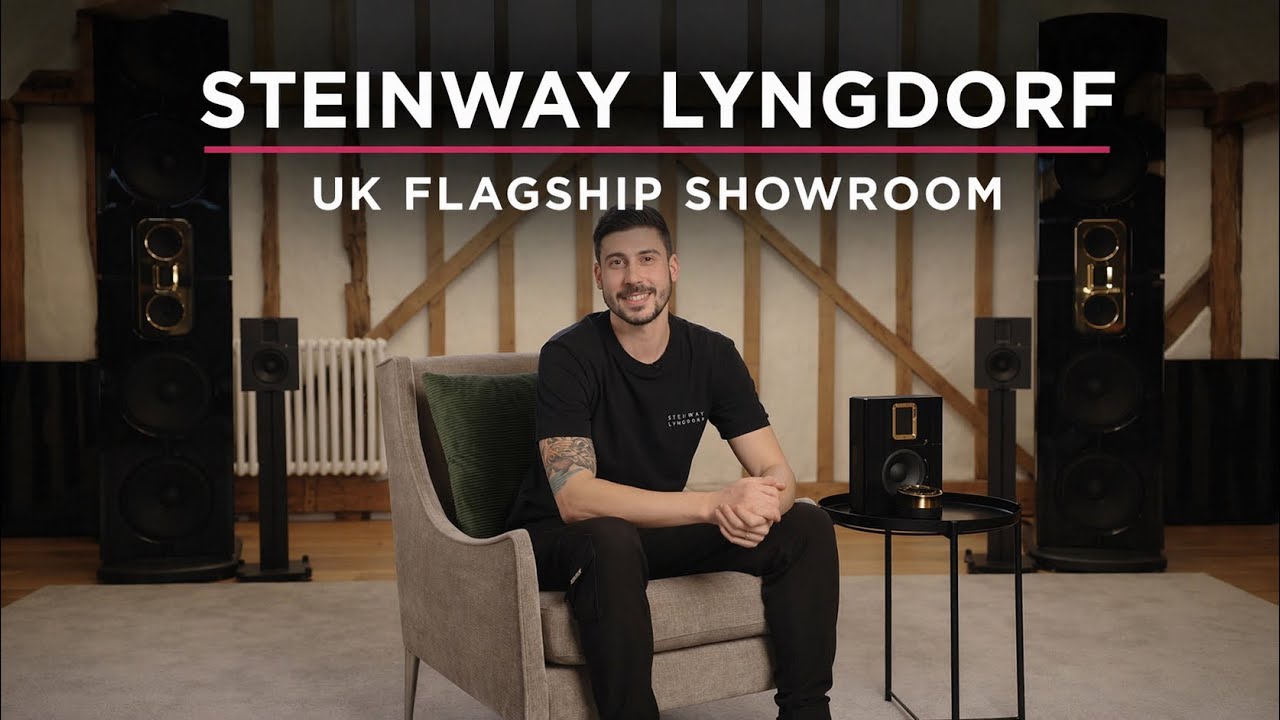
The Gecko Home Cinema showroom hosts the only Steinway Lyngdorf Model D demonstration facility in the UK. Atif visited for an exclusive listen, and the demo involved a recording with an unusual provenance.
A client had composed a piece of music, performed the piano part himself, hired the London Philharmonia Orchestra to record his score, conducted the session, and mixed the result in a professional studio. He came to the Model D demonstration to hear his own work.
He heard things he hadn't heard during the mix.
"He said he was hearing things on this system that he didn't hear in the studio when he was mixing it. And this is someone who can play concert piano and is a professional mixing engineer."
This isn't an anecdote about volume or clarity. It's about resolution — the ability to retrieve information that was in the recording but wasn't audible on the monitoring system it was mixed on. For audio engineers and musicians at the top of their discipline, this is the most compelling evidence a system can offer.
What Steinway Lyngdorf Actually Costs
The Model D is positioned at the extreme end of the high-end audio market. A full Steinway Lyngdorf system — comprising the floor-standing speakers, active bass modules, electronics, and room correction processing — is typically quoted in the range of £100,000 to £150,000 and above for a complete installation, depending on configuration and room treatment requirements.
This places it firmly in the same category as other ultra-premium audio brands: Wilson Audio, Magico, YG Acoustics, and Focal Grande Utopia. What distinguishes Steinway Lyngdorf is the combination of the Steinway heritage validation, the integrated room correction (most competing brands require separate processing), and the brand recognition that the Steinway name carries outside the audiophile world.
| Aspect | Steinway Lyngdorf Position |
|---|---|
| Core technology | Active loudspeakers with integrated room correction (RoomPerfect) |
| Origin | Collaboration between Steinway & Sons (USA/Germany) and Lyngdorf Audio (Denmark) |
| First product | Model D, named after the Steinway concert grand |
| Validation standard | Piano tuners must not be able to distinguish recording from live instrument |
| UK demo | Gecko Home Cinema — only Model D demo facility in the UK |
Key Takeaways
- ▪Steinway & Sons refused every audio licensing request for decades until Peter Lyngdorf demonstrated a system that passed their piano technicians' blind listening test
- ▪The technicians not only failed to distinguish the recording from the live instrument — they could identify the manufacturing location of the specific piano
- ▪The Model D was the first product from the collaboration, named after the concert grand that professional pianists use most
- ▪Steinway Lyngdorf integrates RoomPerfect room correction as standard — the system is designed to perform accurately in real rooms, not only in ideal acoustic conditions
- ▪The Gecko Home Cinema showroom hosts the only Model D demonstration space in the UK
Frequently Asked Questions
What is RoomPerfect and why is it significant in Steinway Lyngdorf systems?
RoomPerfect is Lyngdorf's proprietary room correction system, developed over many years and considered one of the most technically rigorous available. It measures the room's acoustic response from multiple positions, computes a correction profile for the speaker-room system, and applies digital filtering to compensate for room resonances and acoustic anomalies. The result is a system calibrated to its specific room rather than performing optimally only in ideal conditions — critical for real-world installations in domestic spaces.
Why is the piano considered such a demanding test for a speaker system?
A concert grand piano covers an unusually wide frequency range (approximately 27.5Hz to over 4kHz), generates complex harmonic structures from each note, and produces transient attacks (hammer on string) that are extremely demanding for speaker dynamic linearity. Professional pianists and tuners develop highly refined pitch sensitivity through years of training. A speaker system that convinces them constitutes genuine acoustic accuracy rather than merely flattering coloration.
How does Steinway Lyngdorf differ from other high-end speaker brands?
Most high-end speaker brands produce passive loudspeakers driven by separate amplifiers. Steinway Lyngdorf systems are active — each driver has its own dedicated amplification and signal processing — and include RoomPerfect room correction as an integrated component. The closest analogues in the market are companies like Kii Audio or Dutch & Dutch, though at a very different price point. The Steinway & Sons heritage validation also differentiates the brand in a way that no competitor can replicate.
Can a Steinway Lyngdorf system work in a normal living room?
Yes — this is one of the system's design objectives. RoomPerfect was developed specifically because most loudspeakers perform best in acoustically treated rooms, and most clients don't have acoustically treated rooms. The system measures and corrects for the actual acoustic environment, making it more tolerant of typical domestic room acoustics than most competing high-end speaker systems.
Where can I hear a Steinway Lyngdorf Model D in the UK?
Gecko Home Cinema is the UK's only authorised Steinway Lyngdorf Model D demonstration facility. A listening appointment is required.