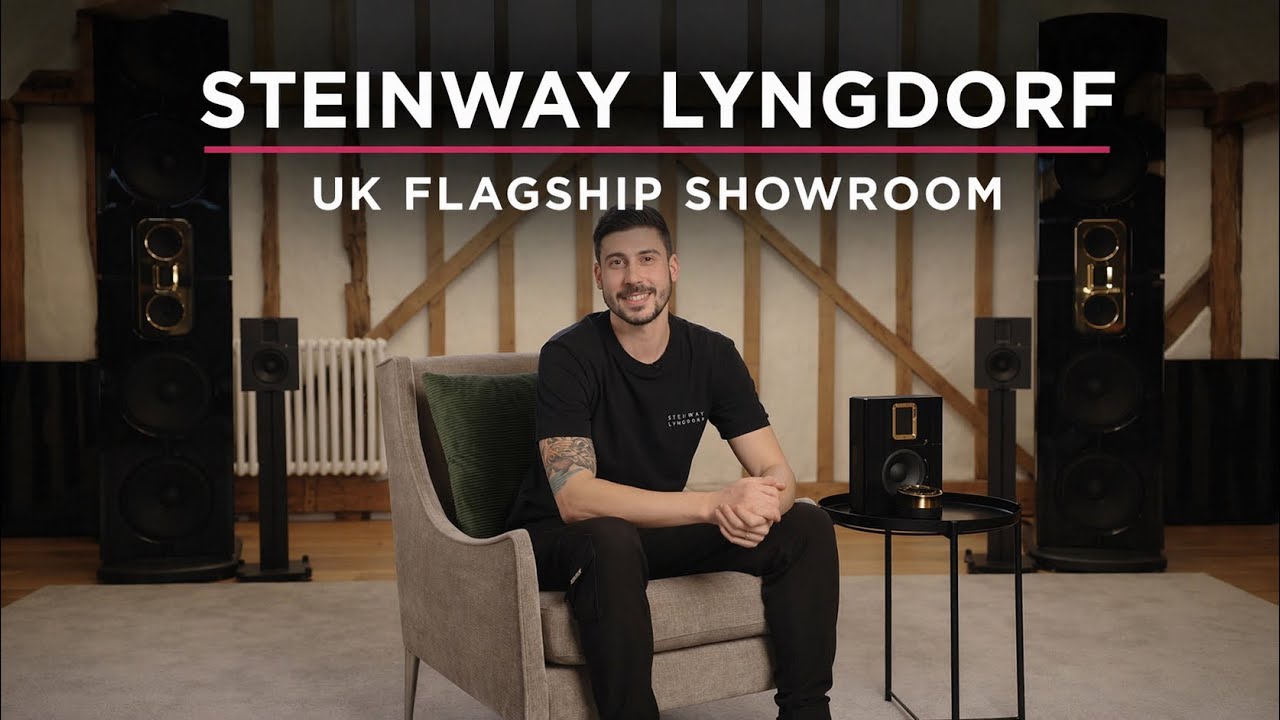
At Steinway Hall London, on a warm spring evening, Zebra Home Cinema was invited to attend an unusual concert. The pianist was Vincent Corver — a Royal Academy-trained concert pianist, Steinway & Sons artist, and Steinway Lyngdorf dealer. Joining him on stage were four elements rather than three: Vincent himself at a live Steinway grand piano; a Steinway Spirio self-playing piano performing a pre-recorded Vincent part alongside him; a pair of Steinway Lyngdorf Model D reference speakers streaming an orchestral backing track; and above it all, a Samsung The Wall micro-LED display carrying the visual layer.
Corver calls the format the Four Elements. In attendance were Peter Lyngdorf himself — the founder of Steinway Lyngdorf — and the CEO for Steinway & Sons UK. It was Vincent's first London concert in two years, and his homecoming to a city where he'd studied at the Royal Academy of Music in 2004.
What the Four Elements Are
Vincent's concept for the evening was to build a performance that deliberately recruited multiple complementary media into a single experience, rather than having the piano carry the whole thing.
The four elements:
- 1.The live pianist — Vincent, playing a Steinway grand piano in real time.
- 2.The Spirio — Steinway's self-playing piano, performing a pre-recorded Vincent part so he was effectively in dialogue with himself.
- 3.The speakers — a pair of Steinway Lyngdorf Model D reference loudspeakers delivering an orchestral backing track.
- 4.The visuals — a Samsung The Wall micro-LED display providing the cinematic image layer.
The result was a concert that sat somewhere between a classical recital, a film score performance, and an immersive gallery installation. Vincent was improvising against a fixed timeline — the Spirio, the orchestra track, and the visuals ran as a pre-composed foundation, and Vincent reacted to what he saw and heard on top.
"When I play the piano, I really want to have a dialogue, a communication with what you see on the screen."
The Spirio and Spirio R — The Piano That Plays Against Itself
Steinway's Spirio is a modern self-playing acoustic grand piano — a flagship instrument equipped with concealed actuators that can reproduce, note by note, a previously-captured performance. Every dynamic, pedal depression, and subtle timing shift of the original pianist is preserved. From the front of the hall, a Spirio playing a recording is acoustically identical to a pianist seated at the instrument.
The Spirio R is the recording-enabled variant — it can both play back recordings and capture new ones of its own performances in the same high-fidelity format.
For an artist like Vincent, this unlocks a specific creative possibility: recording your own part in advance and performing a different part live against it. The audience hears two coherent piano lines in a unified acoustic space, delivered by the same instrument family but by one physical pianist.
Historically, a pianist wanting to perform against their own earlier playing had to use a recorded audio layer — a compromise of fidelity and musicality. The Spirio eliminates the compromise.
Samsung The Wall — A Million Micro-LEDs Behind the Piano
The display layer of the Four Elements concert was a Samsung The Wall — a modular micro-LED display technology that represents one of the current technical benchmarks in professional and high-end residential imaging.
Micro-LED displays work fundamentally differently from conventional LCD or OLED televisions. Each pixel is a self-emitting micro-LED — millions of individual light-emitting diodes at micron-scale, each independently addressable. This produces:
- ▪Perfect blacks — each pixel can be individually switched off
- ▪Extreme contrast — because the light source is the pixel itself
- ▪No burn-in — micro-LEDs don't degrade the way OLED pixels do
- ▪Scaling modularity — The Wall can be configured to almost any size by adding panels
- ▪Extreme brightness — far higher peak luminance than OLED, making it suitable for brightly-lit rooms
For a live concert backdrop, the combination of black-level purity and modular scaling lets micro-LED serve as an imaging layer genuinely competitive with reference projection — without the fragility and environmental constraints projection introduces.
Samsung positions The Wall as the "future of display." In this concert, it was positioned as a new instrument alongside the piano.
Steinway Lyngdorf Model D — The Speaker That Weighs a Piano
The audio layer of the concert was carried by a pair of Steinway Lyngdorf Model D reference loudspeakers. Peter Lyngdorf, standing next to one of them during the introductions, noted the speaker's mass bluntly.
"A system like this weighs the same as a Steinway grand piano."
The Model D is Steinway Lyngdorf's flagship reference speaker — a modular system used in reference concert halls, mastering rooms, and the highest end of residential installations. Its weight is a byproduct of the cabinet engineering, the number of drivers, and the rigorous construction required to achieve concert-scale sound in a speaker that must sit inside a room rather than inside a dedicated concert space.
Crucial to the performance: the speakers were calibrated for the Steinway Hall London room using Steinway Lyngdorf's DSP-based Room Perfect technology. This is the same room correction that defines the brand's reference philosophy — adjusting the speaker's output to compensate for the acoustic signature of the specific space rather than forcing the room to conform to an idealised standard.
The practical effect at the concert: the orchestral backing track streamed through the Model Ds sat in the same acoustic space as Vincent's live piano. Audience members didn't experience piano + speakers as two separate things — they experienced a single integrated performance.
Why Film Concerts Aren't New (And What This Version Adds)
The concept of a pianist performing alongside a projected image is older than most people realise. Vincent pointed out that cinematic piano concerts were well-established by the late 19th and early 20th centuries — silent films in cinemas across Europe and North America were routinely accompanied by a live pianist improvising a score beneath the screen. Modern "film concerts" in arenas, where orchestras perform a full film score live to the projected picture, are a direct descendant of that tradition.
What the Four Elements format adds is the pianist playing against themselves, and the visuals as a response-layer rather than a fixed film. The Spirio allows the pianist to establish a compositional counterpoint with their own previous part. The micro-LED display allows the visuals to be cued and modulated precisely. The speakers carry the orchestration that would otherwise require an actual orchestra on stage.
For Vincent, the improvisational element is critical:
"The great thing about improvisation is that you can tailor it exclusively to the moment. The scene is always different. People really get into the moment, especially when they have the visuals and the music. They seem to have a deeper understanding of the music because they don't have to create the interpretation in their own mind."
Vincent, Peter Lyngdorf, and Steinway as a Family Business
One of the quieter themes of the event was the sense of Steinway as family — not just the brand name, but the extended network of people who live and work within the Steinway and Steinway Lyngdorf orbit.
Vincent's relationship with Peter Lyngdorf is clearly affectionate — Vincent described Peter as "like an uncle to me. The most warm-hearted person I know." Peter had travelled specifically to attend the London event, alongside the CEO for Steinway & Sons UK. A company that brings its founder to a concert in a partner's hall — even when the concert is modest in scale — signals a relationship between artist, brand, and dealer that's close to genuinely familial.
For Vincent's career arc — from Royal Academy to Harrods to Lucerne to Qatar to Zurich — that Steinway family connection has been the anchor. The London concert was partly a performance and partly a homecoming to the institution.
Key Takeaways
- ▪Vincent Corver's "Four Elements" concert at Steinway Hall London combined four complementary performance layers: a live pianist, a Steinway Spirio self-playing piano, Steinway Lyngdorf Model D speakers streaming an orchestral backing track, and a Samsung The Wall micro-LED display providing the visual layer.
- ▪The Steinway Spirio and Spirio R are modern self-playing acoustic grand pianos that can reproduce a previously-captured performance note-for-note — letting a pianist perform with themselves in a way that wasn't possible with audio-only playback.
- ▪Samsung The Wall is a professional-grade micro-LED modular display with perfect blacks, extreme contrast, extreme peak brightness, and no burn-in risk — a display technology that scales to almost any size and is increasingly used in serious residential reference rooms.
- ▪A single Steinway Lyngdorf Model D reference loudspeaker has the physical mass of a grand piano. The system is Steinway Lyngdorf's flagship reference speaker, designed with Room Perfect DSP correction for calibrated installation inside real residential rooms rather than idealised acoustic spaces.
- ▪The concept of film concerts (live piano to projected picture) is roughly 120 years old — dating back to silent cinema. The Four Elements format extends it with the pianist performing against themselves via Spirio, and with modulable visuals replacing a fixed film strip.
- ▪Peter Lyngdorf attended the London event alongside the Steinway & Sons UK CEO — a small but meaningful signal of how closely Vincent's career is interleaved with the Steinway institutional family.
Frequently Asked Questions
What is the Steinway Spirio?
Steinway's Spirio is a flagship self-playing acoustic grand piano. Concealed actuators reproduce a previously-captured performance with the full range of dynamics, pedalling, and timing of the original pianist. The Spirio R variant can both play back and record. The sound is indistinguishable from a pianist seated at the instrument — because acoustically, it is a pianist seated at the instrument.
What is Samsung The Wall?
Samsung The Wall is a professional-grade modular micro-LED display system. Unlike LCD or OLED, each pixel is a self-emitting micro-LED, producing perfect blacks, extreme contrast, high peak brightness, and no risk of burn-in. The display is modular — additional panels can be added to configure the screen to nearly any size — and Samsung markets it as the future of display for cinematic and large-format reference applications.
What is the Steinway & Sons Model D speaker?
The Model D is Steinway Lyngdorf's flagship reference loudspeaker system — a large-format, DSP-corrected speaker widely regarded as one of the most capable residential and concert-hall systems in production. A single speaker has the physical mass of a grand piano. Performance is calibrated to the specific room via Steinway Lyngdorf's Room Perfect correction.
What is the Four Elements concert format?
Four Elements is Vincent Corver's concert format combining four performance layers: the live pianist; a Steinway Spirio self-playing piano performing a pre-recorded part; Steinway Lyngdorf Model D speakers delivering an orchestral backing track; and a Samsung The Wall micro-LED display providing a visual layer. The pianist improvises against the pre-composed foundation, producing a performance that is part classical recital, part film concert, and part gallery installation.
Where was the Four Elements concert held?
At Steinway Hall London — Steinway & Sons' flagship UK showroom and concert space — during Vincent Corver's first London concert in two years. In attendance were Peter Lyngdorf (founder of Steinway Lyngdorf), the CEO for Steinway & Sons UK, and invited dealers and associates.
Are film concerts a new concept?
No. Piano accompaniment to projected film is approximately 120 years old — dating back to the silent-cinema era of the late 19th and early 20th centuries, when live pianists routinely improvised scores beneath projected films in cinemas across Europe and North America. Modern arena film-concerts (full orchestras performing live to projected picture) are a direct descendant of that tradition. The Four Elements format extends the concept with the pianist performing alongside themselves via Spirio, and with visuals modulable in real-time rather than fixed to a film strip.