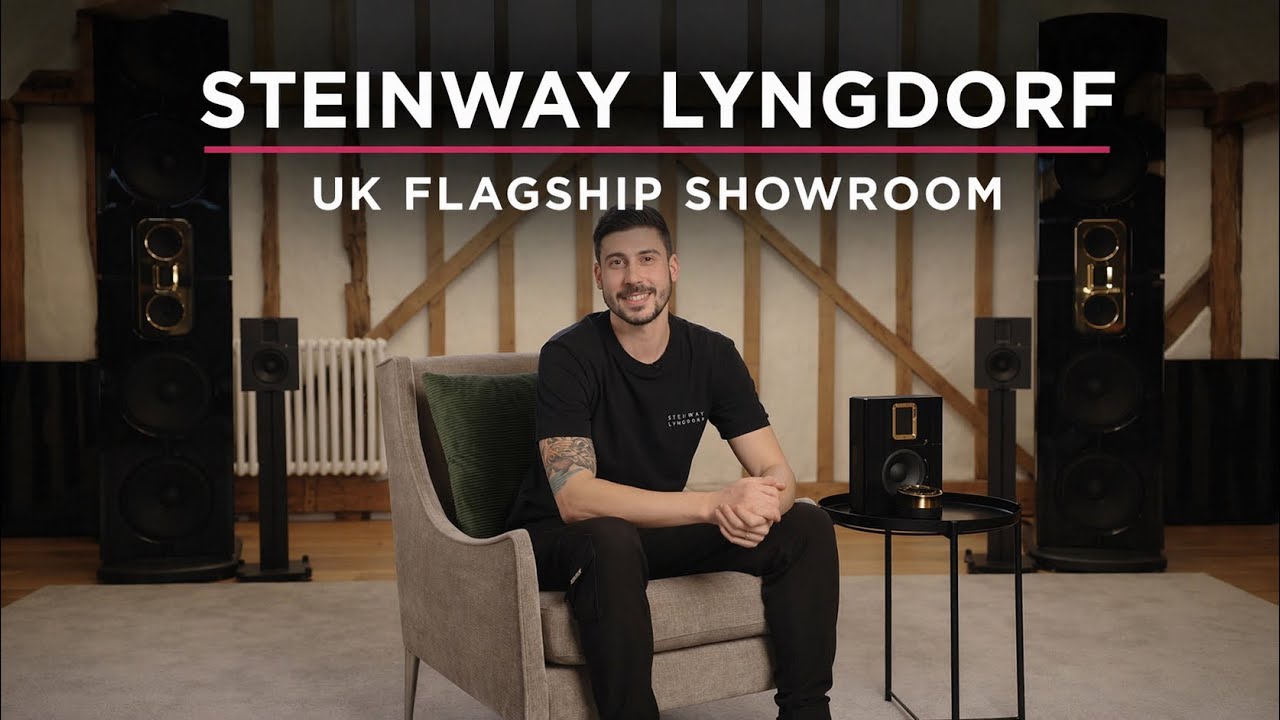
What happens when working musicians — a singer-songwriter and his producer — sit down in front of Steinway & Sons speakers for the first time and listen to their own music? Atif invited Orkaboy and Nimbus (Suraj) to the Zebra Home Cinema demo space to find out. Their reaction captured something that audiophile reviews rarely do: what it actually feels like to hear your own art played back through a reference-grade system.
The Setup: Artists in the Listening Room
The session took place at Atif's home cinema, centred on a Steinway & Sons Model O speaker system — one of the world's most exclusive loudspeaker designs, inspired by the acoustic architecture of a Steinway concert grand piano.
The two visitors:
- ▪Orkaboy — singer-songwriter, alt-rock with 80s and 90s influences. Also, as he notes with characteristic British understatement, "a junior doctor in the NHS, which is my hobby." Music is the purpose.
- ▪Nimbus (Suraj) — music producer and sound engineer based in Birmingham. Works across live sound, studio production, DJ sets, and band engineering. "Anything to do with music — if I can get involved, I will."
They listened to their own recently released single, Free Like You, alongside Hans Zimmer live recordings and classical piano music — including Beethoven's Moonlight Sonata.
First Impressions: "It's Very Intimate"
Orkaboy's reaction to hearing his own song through the Steinway system was visceral:
"I had a bit of imposter syndrome feeling watching that video. I listened to myself on that thing and thought — that's me. That's kind of weird."
But beyond the strangeness of the moment, his description of the sonic experience was precise:
"You could hear the little intricacies in certain bits. And when we listened to the live Hans Zimmer, it felt like I was sat in the audience, with all the crowd around. Very immersive. Very intimate. You can feel it in the floor, you can feel it in the air."
His core observation — the one that gets to why this kind of system matters — was about what most people never experience:
"They should come and hear their music the way it's supposed to be heard. In the air. Not just in your earphones. Sound is supposed to travel through the air so you can feel it around you, in your bones."
A Producer Hears Things He'd Never Heard Before
Nimbus arrived with professional expectations. As an engineer who spends his days in a calibrated studio environment, he knows his reference points. He expected the Steinway system to roll off the high frequencies more than his monitors — that's a common assumption about "warm" speaker designs. He was wrong.
"I was expecting it to sort of roll off a lot more top. But the tops are nice and soft. And that was across all genres of music."
The moment that stopped him was Moonlight Sonata:
"When we played just a piano song — close your eyes. It does what it says on the tin. Which is such a rarity. It actually sounds just like a piano."
More importantly, the session changed how he heard his own work:
"I heard three things I didn't hear in our songs today — and I've heard these songs a million times. I said to Atif at the start: I want to hear the problems in my mix, because it's exposing things. It's really interesting. As engineers, we sit in our studios all day and we know how our room sounds. But sometimes it's important to get a fresh perspective."
His conclusion for fellow producers: "Engineers and anyone creating music — it's very important to experience what you think you know in a very different way. It'll teach you something."
The Steinway Lyngdorf Model O: What Makes It Different
The Steinway & Sons speaker system is manufactured by Steinway Lyngdorf, a collaboration between the legendary piano maker and Danish audio engineer Peter Lyngdorf. The Model O is the entry point in a range that extends through the Model B and Model D — all named after Steinway grand piano sizes.
| Feature | Detail |
|---|---|
| Brand Heritage | Steinway & Sons (piano maker since 1853) + Peter Lyngdorf (audio engineer) |
| Design Philosophy | Acoustic architecture inspired by a concert grand piano |
| Distribution | Custom-install only — not available in retail stores |
| Aesthetic | Piano-black gloss finish with gold detailing |
| Technology | Room Perfect room correction (Lyngdorf proprietary) |
| Typical Application | Dedicated home cinema, high-end media room, listening room |
As Nimbus noted: "Visually, it's got to have that piano black. It's not going to be a Steinway if it doesn't have that. Visually they look amazing."
Why Bring Artists Into the Listening Room?
This session illustrates something important about how the best home cinema systems reveal music differently. The audiophile world obsesses over specs and measurements. But what Orkaboy and Nimbus experienced was the human proof: that a system engineered to this standard doesn't just play music louder or cleaner — it creates the sensation of presence.
For Orkaboy, it was the feeling of being inside a live performance. For Nimbus, it was hearing production details in his own work that years of studio listening hadn't revealed. Both responses point to the same thing: genuine resolution and spatial accuracy don't just improve the listening experience — they change your relationship with the music.
Key Takeaways
- ▪Birmingham-based singer-songwriter Orkaboy and producer Nimbus visited Atif's home cinema to listen to their own music through the Steinway & Sons Model O speaker system
- ▪Orkaboy described the experience as "very intimate" — feeling the sound in the floor, the air, and physically around the body
- ▪Nimbus, as a professional audio engineer, was surprised by the extended high frequency response and heard production details in his own songs he'd never noticed before
- ▪The Moonlight Sonata moment: "Close your eyes. It does what it says on the tin. It actually sounds just like a piano."
- ▪Steinway Lyngdorf speakers are custom-install only — unavailable in retail — combining Steinway's acoustic heritage with Peter Lyngdorf's room correction technology
- ▪The session demonstrates why experiencing a reference-grade system with your own music is a fundamentally different test to any spec sheet
Frequently Asked Questions
What are Steinway Lyngdorf speakers?
Steinway Lyngdorf is a collaboration between Steinway & Sons (the renowned piano manufacturer) and Danish audio pioneer Peter Lyngdorf. Their speaker range — including the Model O, Model B, and Model D — are designed to reproduce music with the acoustic realism of a live piano performance. They are custom-install-only products, not available through standard retail channels, and are among the most exclusive loudspeaker systems in the world.
Why do Steinway speakers sound like a piano?
The Steinway Lyngdorf speaker philosophy draws on Steinway's 170+ years of acoustic engineering in piano design. The enclosures, driver configurations, and proprietary Room Perfect room correction technology are all engineered to reproduce sound with the same naturalness and spatial accuracy as a well-tuned concert grand — particularly in the midrange and harmonic overtones where most speakers fall short.
What did the music producers think of the Steinway speakers?
Producer Nimbus (Suraj) noted that the high-frequency response was softer than expected — not rolled off, but natural — and that when listening to piano music such as Moonlight Sonata, the system genuinely sounded like a real piano. He also heard new details in his own mixes that studio monitoring had never revealed. Singer-songwriter Orkaboy described the experience as "intimate" and "immersive," feeling the sound physically in the floor and air.
Can you visit the Zebra Home Cinema demo space to hear Steinway speakers?
Yes. Atif at Zebra Home Cinema offers private listening sessions at his home demonstration space where you can experience the Steinway Lyngdorf system for yourself — including with your own music. Contact Zebra Home Cinema to arrange a consultation and demo.
Are Steinway Lyngdorf speakers worth the investment?
For anyone building a serious home cinema or listening room, Steinway Lyngdorf represents a tier of performance and craftsmanship that is simply unavailable elsewhere. As Nimbus discovered, professional audio engineers who have spent years with calibrated studio monitors still hear new things in their own music through this system. The combination of acoustic precision, spatial realism, and Room Perfect correction makes it a transformative listening experience — not just an upgrade.