A Basement Transformed
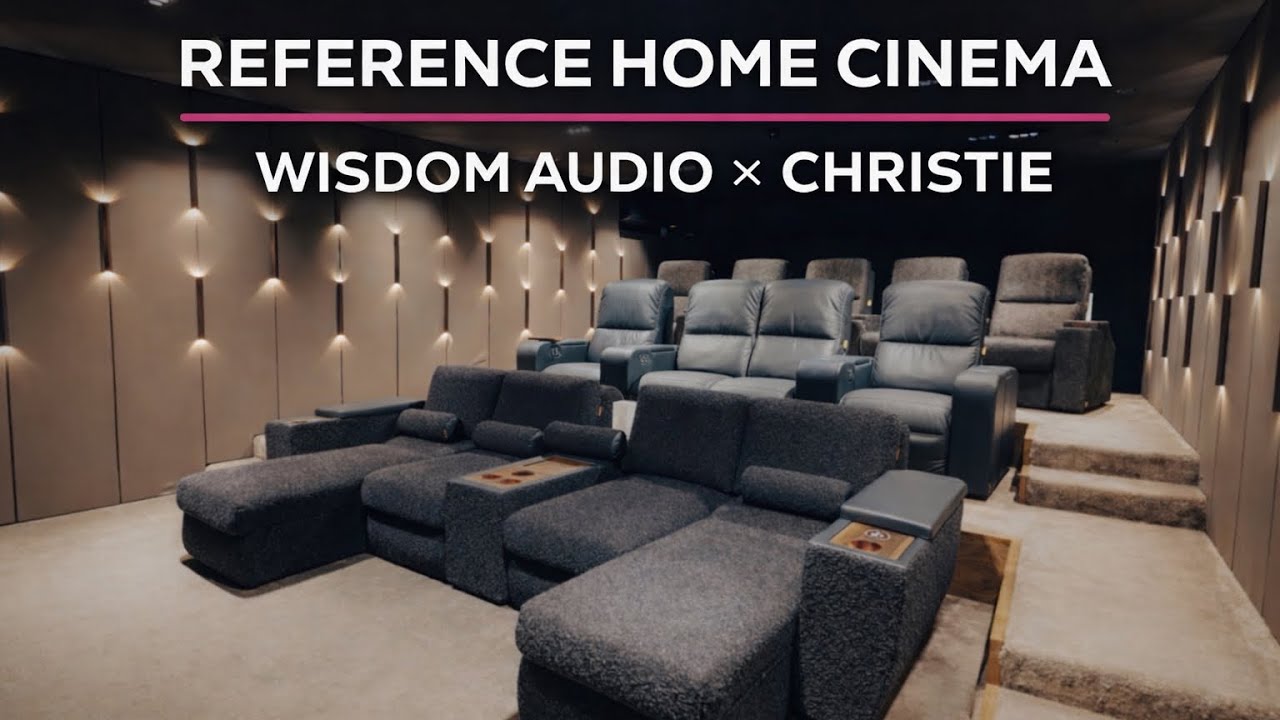
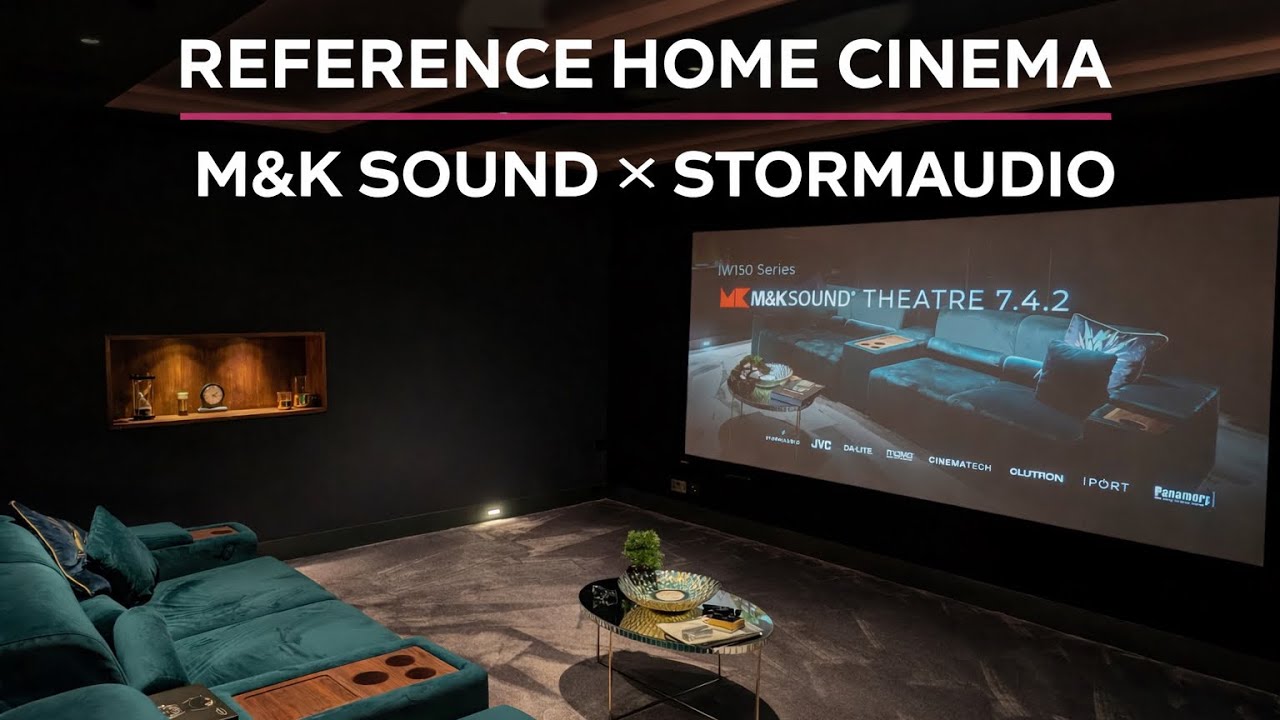
Not every great home cinema starts as a blank canvas. This project was a refurbishment — an existing basement cinema reworked by Zebra Home Cinema to deliver reference performance with a completely new aesthetic. The result is a two-tiered, full Dolby Atmos space with M&K Sound throughout, a JVC projector paired with Lumagen video processing, and a Control4 automation system that turns the entire experience on with a single touch.
The bespoke interior was designed by X Interiors, whose custom navy seating — sprayed to match the decor exactly — sets the visual tone from the moment you walk in.
System Specification
| Component | Specification | Notes |
|---|---|---|
| Front LCR | M&K Sound in-wall speakers × 3 | Behind motorised screen curtain |
| Subwoofers | M&K Sound X10 dual 10-inch × 2 | Push-pull technology, one exposed for demo |
| Surround speakers | M&K Sound IW85 in-wall × 2 pairs | Paintable magnetic grilles, sprayed navy |
| Rear centre | M&K Sound in-wall × 2 pairs | |
| Atmos height | In-ceiling × 2 pairs (front + rear) | Full overhead layer |
| Projector | JVC N5 | 4K e-shift, reference black levels |
| Video processor | Lumagen video scaler | Frame rate correction, per-pixel processing |
| AV processor | Anthem (ARC Genesis) | Separated from power amplification |
| Power amplifier | Yamaha | Separate chassis |
| Automation | Control4 + Neo remote | Lighting, AV, air conditioning |
| Seating | Custom, 2-tiered | X Interiors, navy fabric, LED-lit platform |
| Screen | Motorised curtain reveal |
The M&K Sound System: Why Push-Pull Matters
The X10 subwoofers powering this room use M&K's push-pull driver configuration: one 10-inch driver facing forward, a second identical driver mounted directly beneath it facing down. As one pushes air outward, the other simultaneously pulls — the mechanical symmetry cancels the even-order distortion that a single driver produces.
Atif left one of the X10 units exposed during this tour specifically to demonstrate the configuration. It's a design principle that explains why M&K's bass sounds accurate rather than loud: distortion is being actively cancelled at the physical level, before any signal processing is applied.
The surround speakers are the IW85 in-wall model — compact, full-range satellites mounted at the main listening position (both sides) and rear centre positions. The IW85 comes with magnetic, paintable grilles, which X Interiors had sprayed in the same dark navy used across the room. Invisible until you know they're there.
The Lumagen Video Processor: Years Ahead
The JVC N5 projector is one of the finest choices available for a dedicated basement cinema — its D-ILA imaging system produces black levels that DLP projectors cannot match, and the contrast ratio delivers the genuinely filmic image quality that separates a reference installation from a good domestic display.
But paired with a Lumagen video scaler, the image quality improves further still.
"The Lumagen really is very advanced — years ahead of any other video processing technology. In terms of how it processes the individual pixels and even corrects the frame rates depending on the source, whether you're using Sky or Apple or any of these video sources — in combination with a good quality projector, you can achieve outstanding images."
The Lumagen processes at the pixel level, correcting frame rates to match source material (eliminating motion judder from 24fps film), handling aspect ratio masking, and calibrating every zone of the image. It handles the computation, so the projector's full imaging capability is devoted to displaying the result rather than compensating for source quality.
Control4: One Button, Every System
The automation in this room is the element that transforms a collection of excellent components into a seamless experience. Control4 connects lighting, projector, screen, air conditioning, and audio into a single system, accessible from the wall panel or the Neo remote.
Pressing "Cinema Mode" dims every light to the configured level. The screen curtain opens. The projector fires up (with an audible click and whir that signals the system waking). Within seconds, the image appears. Pressing "Lights On" reverses the sequence and brings the room back to full brightness.
"And within a few seconds, we should get the picture coming up... simply, you'll be selecting cinema mode. And this is for cinema."
The LED-lit second-tier platform — which separates the two rows of seating — is also Control4-managed, adjustable in colour and brightness as part of any scene. It's a small detail that makes the room feel purposefully designed rather than assembled.
Construction Quality: The Most Important Thing You Can't See
One of the most important observations in this project concerns the decorative fabric panels on the walls. They look acoustic. They're not.
"None of the fabric panels that you've seen have any particularly acoustic quality whatsoever. They're not being used to treat the room as such. What is important in a room like this is the overall construction. Anything that rattles will rattle, particularly when the subwoofers kick in."
This is a critical point for anyone planning a basement cinema. Low-frequency energy — the sub-bass from a film's action sequence — physically moves everything in a room. Panels that aren't solidly fixed will buzz. Screen walls that aren't properly braced will resonate. Coffers, soffits, and any built-in element can become a noise source.
The solution is construction quality: every element screwed, nailed, and fixed with no tolerance for movement. No acoustic panel absorbs a rattle produced by loose joinery.
Key Takeaways
- ▪Two-tier seating works in basements — the extra height brings the rear row above the front row's sightlines without requiring a very tall ceiling
- ▪Push-pull subwoofers deliver accuracy, not just volume — the cancellation of even-order distortion is audible
- ▪Lumagen + JVC is the reference pairing — the projector handles display, the Lumagen handles all processing
- ▪Separate processor and power amp outperforms integrated AV receivers — worth budgeting for
- ▪Construction quality is the acoustic foundation — no amount of treatment fixes a rattling room
FAQ: Basement Home Cinema Conversions
What makes a basement ideal for a home cinema?
Basements offer acoustic isolation from the rest of the house, freedom from external light, and structural independence that means high sound pressure levels don't disturb other rooms. The contained geometry also simplifies acoustic control. The main challenges are managing concrete reflection surfaces and ensuring the room doesn't feel claustrophobic.
What is the Anthem ARC Genesis room correction system?
ARC Genesis is Anthem's proprietary room correction technology, used in their AV processors and receivers. It measures acoustic performance across multiple listening positions and applies mathematically derived corrections to equalise frequency response, speaker timing, and channel levels. It is widely regarded as one of the most accurate room correction systems available at its price point.
Why is the Lumagen video processor paired with a JVC projector?
JVC's D-ILA projectors are exceptional at contrast and black levels but benefit significantly from pre-processing the signal before it reaches the display. The Lumagen Radiance Pro handles per-pixel calibration, frame rate matching, aspect ratio masking, and dynamic tone mapping — tasks that would otherwise be done by the projector's internal scaler at lower quality. The combination produces better images than either component alone.
What is Control4 and why use it in a home cinema?
Control4 is a smart home automation platform that integrates all systems in a space — lighting, AV, climate, security — into a single interface. In a home cinema, it allows the entire room experience to be configured with one button press: projector on, screen open, lights dimmed, audio ready. It also provides remote monitoring and programming support from the integrator.
How do I prevent rattles in a home cinema with powerful subwoofers?
The solution is construction quality rather than acoustic treatment. All panels, built-ins, and fixtures should be solidly fixed with no movement tolerance. Screen walls need to be properly braced. Coffers and soffits must be built without loose elements. If you can physically move any panel in the room by pushing it, it will rattle when the subwoofers play at reference levels. Address this during construction — retrofitting is far harder.
Frequently Asked Questions
What makes a basement a good location for a home cinema?
Basements are usually below grade — meaning they're naturally darker, quieter, and acoustically more controllable than rooms higher in the house. The structural mass of below-grade walls helps with both sound containment and isolation from external noise, which is why dedicated cinemas are disproportionately built in basements when the option is available.
What has to be fixed in a basement before a cinema can go in?
Damp-proofing, ventilation, ceiling height (often constrained), electrical capacity, and acoustic treatment of the existing walls. The most common upgrades are membrane tanking for damp control, a controlled mechanical ventilation system, and either a suspended acoustic ceiling or a ceiling raise where the structure allows.
What's the typical budget for a refurbished basement cinema?
£80,000–£250,000 depending on the size of the room, the equipment specification, and the structural condition of the starting space. Refurbished basements with existing damp-proofing and adequate ceiling height land at the lower end; full structural rework with ceiling raises and acoustic isolation pushes the budget higher.
Why are basement cinemas the most popular dedicated room location?
Three reasons: existing structural mass aids sound isolation, no shared sightlines with other rooms means no compromises on screen size or projector throw, and the natural darkness of below-grade rooms supports proper black-level performance from projection without the need for blackout treatment.