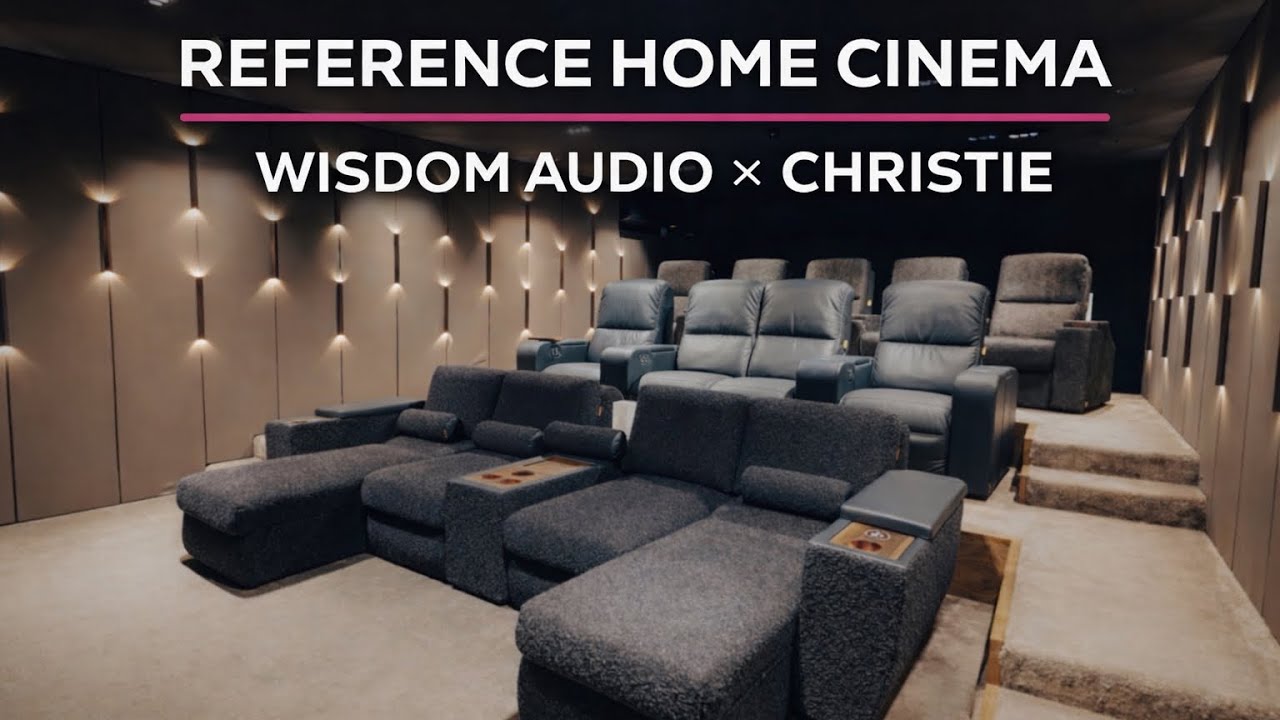
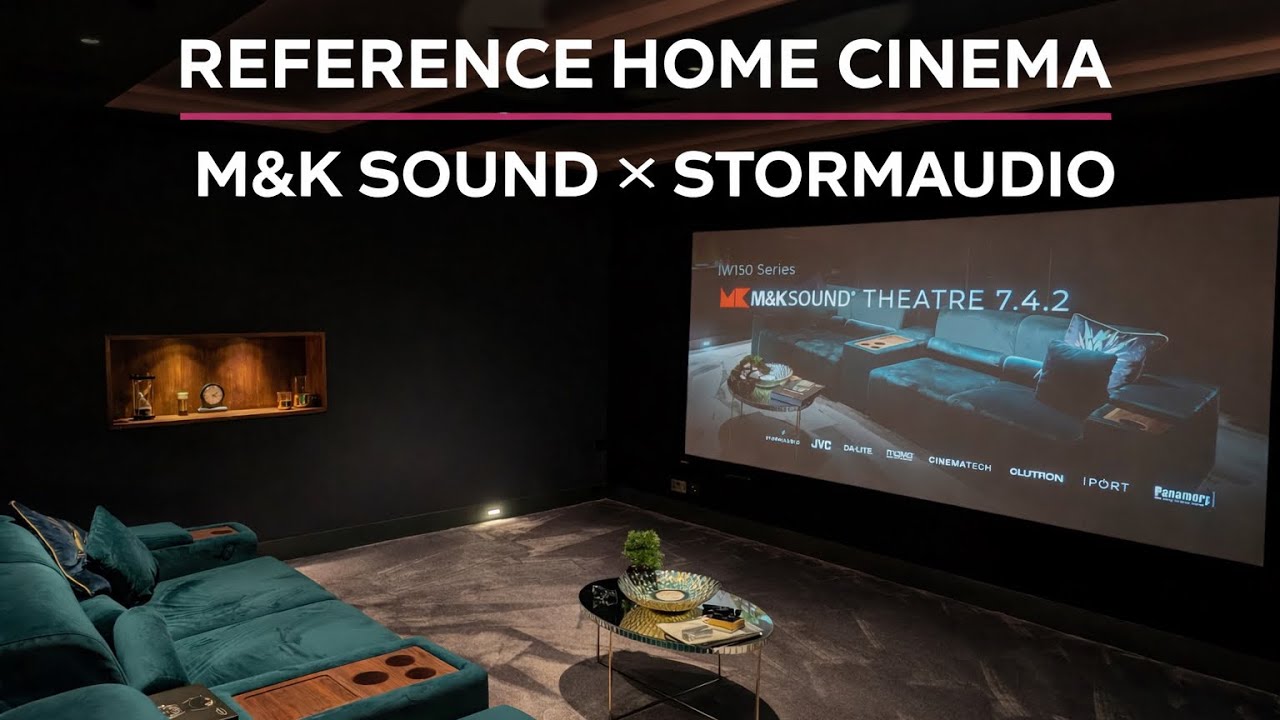
In the basement of a three-storey Cotswolds property, down a staircase, through a door — and suddenly you're somewhere else entirely. Bespoke upholstered fabric panels line every wall, a fibre-optic star ceiling fills the room with something that could be the Milky Way, and the entire speaker system has disappeared into the architecture. This is what a truly finished home cinema looks like.
Concealed Architecture: Hidden Doors, Hidden Storage
The first thing you notice is the absence of clutter. There are no visible subwoofers, no rack equipment in the room, no exposed speaker cabinets. The walls are a continuous surface of upholstered fabric panels — and most of them are doors.
Each upholstered panel conceals storage or services. Behind the fabric: DVDs, disc storage, underfloor heating pipe access, equipment routes. The client's brief was clear — no in-room boxes. Everything was to be either in-wall, in-ceiling, or concealed behind the fabric panels. The result is a room that reads as a luxury interior first and a cinema second.
This approach requires planning at the very earliest stage of the project. By the time walls are being plastered, the decision to use concealed panels has to be embedded in the structural specification — cable routes, speaker mounting positions, subwoofer alcoves, and storage cavities are all built in during the construction phase, not retrofitted.
The Speaker System: Miller & Kreisel In-Wall and In-Ceiling
The loudspeaker specification is built around Miller & Kreisel (M&K) — an American brand with a long history in professional monitoring and home cinema applications. Every speaker in this system is either in-wall or in-ceiling, with no visible cabinet in the room.
| Channel | Speaker | Position |
|---|---|---|
| Left, Centre, Right | M&K in-wall (behind screen) | Front wall, acoustically transparent screen |
| Subwoofers | M&K IW28S in-wall | Front corner + rear corner |
| Surrounds | M&K IW950 in-wall | Side wall positions |
| Rear surrounds | M&K on-wall | Rear wall |
| Height channels | M&K in-ceiling (× 4) | Ceiling, for Dolby Atmos |
Subwoofer placement strategy. The IW28S subwoofers are placed in diagonally opposite corners — front left corner and one rear corner. Corner placement exploits the room's geometry to reinforce bass output (the walls act as an acoustic horn), and using opposite corners rather than both front corners helps smooth the bass frequency response across different seating positions. When the room calculation is done correctly, bass from the seating position feels even and non-directional — you feel it, but you can't locate where it's coming from. That's the goal.
The Screen: Floor-to-Ceiling 16:9 for IMAX Enhanced
The projection screen fills the front wall from floor to ceiling — a 16:9 aspect ratio specification that makes maximum use of the available wall height. While a 2.35:1 scope screen can produce a more cinematic appearance for widescreen films, the floor-to-ceiling 16:9 delivers full-height images for content filmed in the IMAX format or IMAX Enhanced releases on Disney+.
IMAX Enhanced content on Disney+ streams at up to 1.90:1 — taller than standard 16:9 (1.78:1) but not quite as tall as 1:1 IMAX. On a floor-to-ceiling 16:9 screen, this content fills the frame almost entirely, creating a genuinely immersive image. Films like Avengers: Endgame and Black Panther on Disney+ IMAX Enhanced deliver sequences where the full frame opens to IMAX dimensions — on a screen of this size, the effect is dramatic.
The Fibre Optic Star Ceiling: Starscape Technology
The ceiling treatment is a fibre-optic star field by Starscape — one of the leading UK manufacturers of residential and commercial star ceiling systems. The Starscape approach uses pre-threaded fibre panels, with the illuminator unit housed outside the cinema room (typically in a plant room or cupboard) and individual optical fibres distributed across the ceiling.
The result is an effect that transforms the ceiling from a flat surface into a sky. For a dedicated cinema room in a basement — where the ceiling would otherwise be a close, oppressive surface — a star ceiling creates perceived depth and a sense of being in an open space. The practical benefits for cinema viewing are real: your peripheral vision encounters what reads as a dark sky rather than a hard ceiling surface, reducing the visual confinement that can make basements feel claustrophobic.
Starscape installations come pre-threaded in complete panels, making installation significantly simpler than threading individual fibres through a ceiling board. Zebra delivers complete turnkey installations that include the upholstered wall panels, star ceiling, carpets, and all AV elements.
The Electronics: Lyngdorf MP-40 and Room Correction
The audio processing is handled by a Lyngdorf MP-40 — a high-end immersive audio processor with Lyngdorf's proprietary RoomPerfect room correction system integrated. The MP-40 drives an 11-channel power amplifier that handles all of the in-wall and in-ceiling speakers.
The Lyngdorf was chosen specifically for its RoomPerfect system. After the speaker installation, room acoustics create response anomalies — early reflections from the panels, resonance modes between parallel walls, frequency response peaks and dips at the listening position. The upholstered fabric panels and carpet reduce high-frequency reflections significantly, but the room still requires calibration to sound accurate at the seating position.
RoomPerfect measures the room from multiple microphone positions and computes a correction profile that compensates for the room's acoustic signature. The result — on a system like this, with quality loudspeakers correctly positioned — is a calibrated baseline that tracks the director's mix intent rather than the room's acoustic character.
Front Row Seating: Navy Fabric, Four Motors
The seating is by Front Row Seating, specified in a navy fabric. Each seat has four independent motors: back recline, headrest angle, footrest extension, and lumbar. The result is a seat that adjusts to any position from fully upright to virtually flat, with every element independently controllable.
Four-motor seating is the correct specification for a dedicated cinema that will be used for both active viewing (where you want some back support) and long-form content like films (where full recline is preferred). Two-motor seats that only adjust the back and footrest together can't achieve the range of positions that makes a recliner truly comfortable across a full two-hour film.
Key Takeaways
- ▪A fully concealed cinema system — in-wall speakers, hidden subwoofers, concealed storage panels — requires planning from the structural phase, not as a retrofit
- ▪M&K IW28S in-wall subwoofers in diagonally opposite corners distribute bass smoothly across the seating area
- ▪A floor-to-ceiling 16:9 screen maximises the impact of IMAX Enhanced content on Disney+ and similar services
- ▪Starscape fibre-optic star ceilings transform basement cinema ceilings from an oppressive surface to an open, atmospheric sky
- ▪Lyngdorf MP-40 with RoomPerfect provides the room correction necessary to achieve accurate frequency response at the seating position in a treated room
- ▪Four-motor seating provides true flexibility across every viewing position from upright to full recline
Frequently Asked Questions
How does a fibre optic star ceiling work?
A fibre optic star ceiling uses thousands of individual optical fibres, each 0.75–1.5mm in diameter, distributed across a ceiling panel or directly through a plastered ceiling surface. The fibres are connected to a central illuminator unit (typically LED or fibre-compatible light engine) that provides the light source. The fibres carry the light from the illuminator to their tips in the ceiling, where they appear as individual points of light. Twinkle effects are created by spinning a colour wheel or filter in front of the illuminator to vary the light intensity at different fibres.
Why are subwoofers placed in the corners of a cinema room?
Corner placement loads the subwoofer against the three converging room boundaries (floor, two walls), which reinforces low-frequency output — the same output can be achieved with less amplifier power, or conversely, more output is available from the same amplifier. Using diagonally opposite corners (front corner and rear corner) rather than both front corners also smooths the bass frequency response across the seating area, reducing the severe bass peaks and nulls that occur with asymmetric or single-point subwoofer placement.
What is the Lyngdorf MP-40 and what makes it suitable for a reference cinema?
The MP-40 is Lyngdorf's flagship immersive audio processor, supporting Dolby Atmos, DTS:X, and Auro-3D formats. It includes RoomPerfect room correction — Lyngdorf's proprietary multi-point measurement system that corrects for room acoustic anomalies. In a home cinema, this integration means the calibration is part of the signal processing chain rather than a separate add-on, simplifying the system architecture and ensuring the room correction is applied optimally.
Is it better to have in-wall speakers or separate speaker cabinets for a home cinema?
For a dedicated room where aesthetics are important, in-wall speakers allow a fully integrated appearance with no visible cabinets. The acoustic performance of quality in-wall speakers (such as M&K's IW series) is comparable to equivalent-quality free-standing cabinets when correctly installed with proper wall backer construction. The limitation of in-wall systems is that they're more difficult to upgrade — the installation is permanent. Separate cabinets allow easier driver or cabinet substitution as technology improves.
How many Atmos height channels do I need for a home cinema?
Dolby Atmos home cinema recommends a minimum of two height channels (for a basic 5.1.2 configuration) up to four or more for immersive installations. For a room of typical residential cinema size (up to approximately 40 m²), a 7.1.4 configuration — seven main channels, one LFE subwoofer, four height channels — is the standard reference target. More height channels improve the spatial accuracy of height-panned effects and allow more precise overhead localisation of Atmos objects.