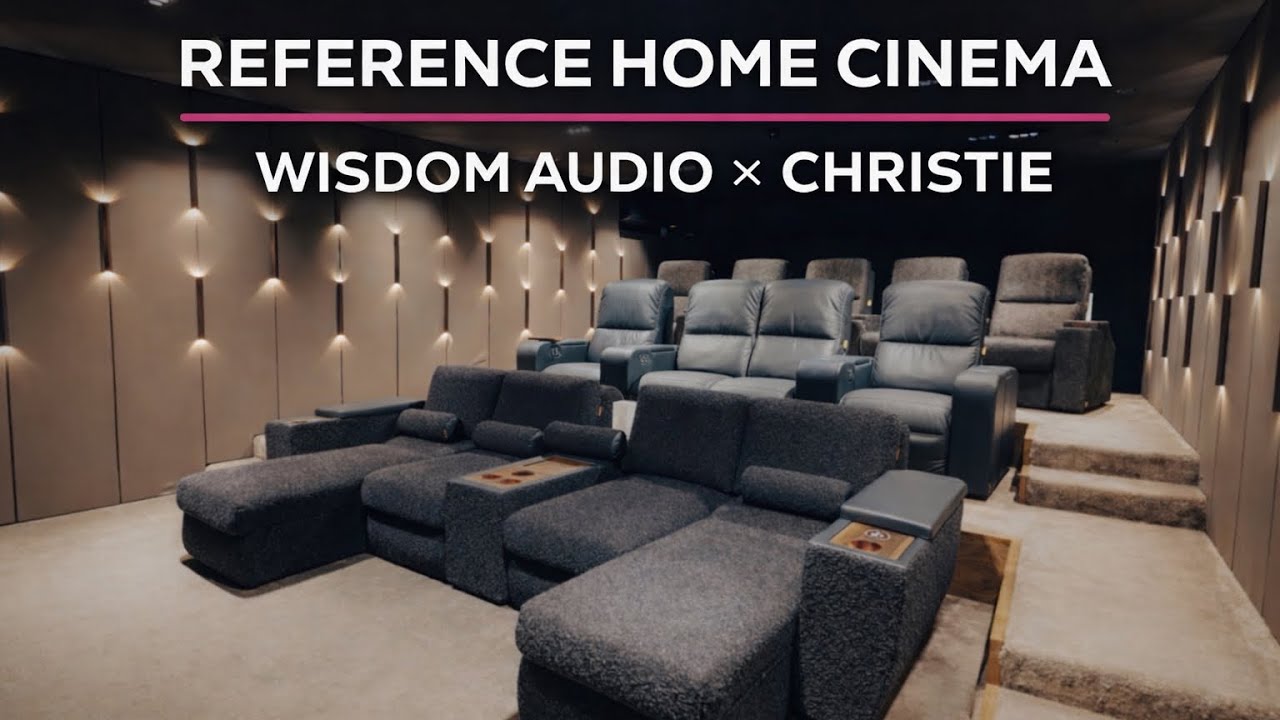
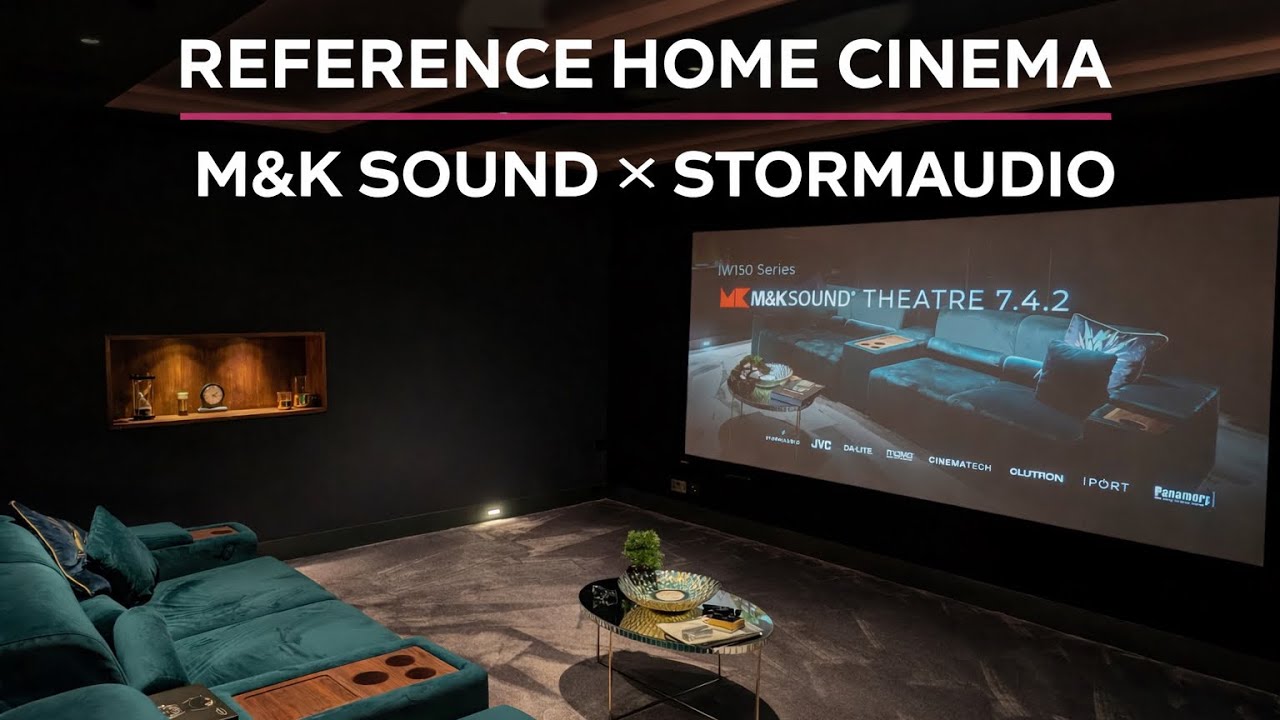
The client had told his integrator, flatly, that he never wanted a cinema room in his new-build home. A few months after it was finished, that same client was sitting on the front row, smiling at a 168-inch screen, and telling anyone who visited that it had become his favourite room in the house.
This is a reference-level home cinema project completed by Virtus Integration for Zebra Home Cinema. Cain Pritchett — 25 years in the industry and the owner of Virtus — walked through the finished room, and the client, Talbier, followed up with his own perspective on what it's like to actually live with a properly specified cinema.
The Brief — Reference-Level, Latest-Generation Everything
Virtus Integration builds home cinemas from the shell up. Roughly 80% of the company's work is dedicated cinema installations, and the brief on this project was a familiar shape for them: the client wanted reference level, with the latest generation of every major component in the signal chain.
The client had done his own research. He arrived well-informed on projector specifications, processing options, and speaker platforms — the kind of client who sends you data sheets rather than mood boards. Virtus spent significant time in pre-specification conversations before a single cable was routed, aligning on exactly which flagship products would go where.
The resulting specification is tight, consistent, and unashamed about its ambition:
| Role | Product | Notes |
|---|---|---|
| Front L/C/R | M&K IW150 | In-wall |
| Surrounds and rears | M&K IW150T | Matching tripole format |
| Atmos / heights | 4× M&K IW50A | In-ceiling |
| Subwoofers | 4× M&K CS15 | Distributed low-end |
| Processor / amplification | Storm Audio ISR Fusion | All-in-one with Dirac ART |
| Projector | JVC NZ700 | Latest-generation laser |
| Screen | Screen Research 168-inch | 16:9 HDTV format |
| Cabling | SCP throughout | Speaker, sub, projector, network |
A 7.4.4 channel count — seven bed-level speakers, four subwoofers, four overheads — is the configuration that current immersive-audio mixing is most consistently authored around. Specifying four subwoofers rather than two is a deliberate call: four distributed subs reduce modal variance across a multi-row cinema significantly more than two large subs in a corner pair.
The M&K 7.4.4 System — Why Installers Keep Returning to M&K
Cain has been specifying M&K for almost 20 years. Pressed on why M&K keeps winning the speaker brief on reference-level installations, he gave two reasons — one performance, one industrial.
Neutrality. M&K's house sound is characterised by linear frequency response and tight bass. It doesn't colour the programme. For content authored in a Dolby-certified studio (most Atmos theatrical content is), a neutral speaker system faithfully reproduces what the mixer committed to the stem — rather than editorialising it.
Industry adoption. M&K is one of a small number of speakers specified into commercial mixing stages and reference-grade cinema rooms. That matters for a client paying reference-level money, because it means the speakers in their home are, at minimum, capable of reproducing what was heard in the room the film was mixed in.
"I've always liked the sound of M&K. I like the neutrality. I like the bass. And the other side is that we know M&K is a chosen speaker in the industry. So it's not just chosen by us — others also choose it as a default."
The tripole configuration used for surrounds and rears is a specific engineering choice. A tripole speaker radiates across multiple axes rather than from a single point, creating a more diffuse and enveloping surround field. For an immersive audio format like Dolby Atmos, where the audience is meant to sit inside the sound rather than in front of it, tripoles widen the usable "sweet area" beyond a single seat.
Storm Audio ISR Fusion — The First All-in-One at Reference Level
The Storm Audio ISR Fusion is the processor-amplifier-receiver at the heart of this room, and it's a first-time install for Virtus. Historically, reference-grade installs have separated processing and amplification into discrete rack components. The ISR Fusion is Storm Audio's bet that all of that can collapse into a single chassis without performance compromise — including Dirac Live ART (Active Room Treatment) for room correction and bass management.
"For an all-in-one solution, it is incredible. The Dirac integration is really good. The Dirac bass management is fantastic — really impressed with that. I think it's an amazing receiver."
The bass-management implementation in particular is worth noting. In a cinema with four subwoofers, the quality of the integration algorithm — how the processor distributes low-frequency energy, time-aligns it, and manages room modes — has an outsized effect on the final result. Dirac ART handles this with a genuinely active approach rather than the passive EQ that older systems rely on.
Virtus completed a significant portion of the ISR Fusion setup remotely, supported directly by distributor Habitech. For a first-time installation of a new flagship, remote access to dealer-level expertise significantly de-risks commissioning.
JVC NZ700 + 168-inch Screen Research — The Picture Side
The display side matches the audio brief for ambition. A JVC DLA-NZ700 laser projector feeds a Screen Research 168-inch 16:9 HDTV-format screen.
The NZ700 is JVC's current-generation D-ILA laser projector, a class leader for native contrast and black-level performance in a dedicated dark room. Cain singled out:
- ▪The NZ700's colour reproduction at the specified brightness
- ▪How quiet the cooling system is in operation
- ▪Its ability to drive the 168-inch screen size without losing perceived punch
The client had specified the largest possible screen for his room, which produces a very particular front-row sensation.
"When you sit on the front row in here, it feels a little overpowering. But it makes them smile. So that's what we've got in here."
A 168-inch screen at a normal front-row viewing distance approaches — and in some geometries exceeds — IMAX-like subtended visual field. It's a personal-preference decision that not every client wants, but for a reference-level brief with a primary front-row seat, it delivers unmistakably theatrical scale.
The Room Was Designed Around the Cinema, Not the Other Way Around
Here's the architectural detail that matters most, from Talbier, the client.
"Originally with the architect, we built the whole of this upstairs — it was designed around this whole cinema room. We had specific dimensions, so we designed the whole upstairs around that."
This is the opposite of how most home cinemas get built. Usually, a client tells an architect to give them a "media room" as one of many rooms in a layout, and the integrator later attempts to retrofit reference performance into a space whose dimensions and geometry were decided for other reasons. The result is compromises — too much width, too much length, ceiling heights that don't support immersive overheads, structural columns in the worst possible positions.
When a cinema's dimensions drive the upstairs floor plan — rather than being fitted inside whatever's left over — the acoustic and sight-line geometry can be optimised from the first architectural sketch. Speaker placement is clean. Projector throw is clean. The seating tier is clean. Cabling routes are clean.
For any client building a new home and considering a dedicated cinema, this is the single piece of advice that most affects the final result: specify the cinema first, then design the house around it.
The Habitech Supply Chain — Why Dealers Matter
Cain has worked with Habitech as his distributor for 15 years. His framing of why that relationship matters is direct.
"Habitech support's always brilliant — right from the sales side to delivery. Scheduling has been great. I kind of have an expectation of what Habitech does, and they just always meet it. In a way, it's become the norm."
On a reference-level build with first-time installations of multiple flagship products — a new projector generation, a new all-in-one receiver — the distributor becomes an extension of the installer's team. Remote commissioning support, access to firmware, fast replacement if a unit DOAs on delivery, and, crucially, a stake in the client's long-term satisfaction: these are the things that separate a dealer-led industry from a box-shifter model.
Cain was explicit that the ISR Fusion setup, in particular, benefited from Habitech's remote support — an advantage available only when there's a real channel between manufacturer, distributor, and installer.
Key Takeaways
- ▪This is a 7.4.4 M&K system — IW150 fronts, IW150T tripole surrounds, IW50A overheads, and 4× CS15 subwoofers — chosen for M&K's neutrality and widespread specification in reference mixing rooms.
- ▪The processor is a Storm Audio ISR Fusion with Dirac Live ART for room correction. This is the installer's first deployment of the ISR Fusion — an all-in-one replacement for discrete processor + amplifier stacks at reference level.
- ▪The picture chain pairs a JVC NZ700 laser projector with a 168-inch Screen Research 16:9 screen — the largest screen the room's geometry would support.
- ▪The house itself was designed around the cinema. The upstairs floor plan was drawn from the cinema's specified dimensions outwards, rather than fitting the cinema into the leftover space. This architectural sequencing is the single biggest predictor of a clean reference-level result.
- ▪Tripole surrounds (M&K IW150T) widen the surround "sweet area" beyond a single seat — a meaningful choice for a multi-row cinema or for a front-row that's frequently occupied by more than one person.
- ▪Distributor-grade support matters on first-generation flagship installs. Habitech provided remote commissioning assistance on the ISR Fusion — the kind of backing that separates a professional supply chain from a transactional one.
Frequently Asked Questions
What speakers are used in this home cinema?
A 7.4.4 M&K system: M&K IW150 front left/centre/right in-wall speakers, M&K IW150T tripoles as surrounds and rears, four M&K IW50A in-ceiling speakers for Dolby Atmos overheads, and four M&K CS15 subwoofers.
What is the Storm Audio ISR Fusion?
The ISR Fusion is Storm Audio's all-in-one immersive audio receiver — processor, amplification, and Dirac Live ART room correction in a single chassis, aimed at replacing the traditional separates stack for reference-level rooms. In this installation, it's driving the full 7.4.4 channel count and handling bass management across four subwoofers.
What is Dirac Live ART and why does it matter?
Dirac Live Active Room Treatment is an advanced room-correction technology that uses the subwoofers themselves — time-aligned with the main speakers — to actively cancel unwanted room resonances. Unlike passive EQ, ART treats the room rather than only adjusting the signal, which produces materially better low-frequency clarity in cinemas with multiple subs.
Why specify four subwoofers instead of two in a home cinema?
Distributed bass. Four subwoofers placed around a cinema room average out the nulls and peaks produced by standing waves much more effectively than two subs, resulting in more consistent bass response from seat to seat. For any multi-row or multi-seat cinema targeting reference performance, four is the modern default.
What projector is used for this 168-inch screen?
A JVC DLA-NZ700 — the current-generation JVC D-ILA laser projector. It drives a Screen Research 168-inch 16:9 HDTV-format screen, with performance characterised (by the installer) by excellent colour reproduction, strong perceived contrast, and unusually quiet operation.
Why is M&K a common choice for reference home cinemas?
M&K speakers are used in Dolby-certified mixing stages and professional reference rooms. Specifying them in a domestic cinema aligns the client's playback system with the environment the content was mixed in. M&K is also valued for its neutral voicing, tight bass, and tripole surround formats that widen the enveloping sound field for immersive formats.
Why design a house around a cinema room?
Because the cinema's acoustic, sight-line, and cabling geometry are the most demanding set of dimensional constraints in a home. If the cinema is specified first and the rest of the layout flows around it, every other room tolerates slightly less-than-ideal geometry far better than a compromised cinema does. The result is a cinema that performs at reference level without the architectural workarounds that fitting-in-the-leftover-space always produces.