The Journey from Loft to Luxury Cinema
Hayley and Marco's project didn't start as a cinema. It started as a conversation about what to do with a loft.
The couple, based in Northamptonshire with two young boys, had been thinking about converting their loft into a play space — somewhere the kids could have friends over, space they'd grow into as teenagers. The cinema element was Marco's idea. Hayley thought it was excessive.
"It was actually my husband's idea, which I thought was quite excessive at the time. But I'm pleased he convinced me — it's been a great space which works for our family."
From that first conversation to the finished room took the best part of three years — the project ran through COVID lockdown, through a building programme, and through a long process of refining the specification. By the time Atif and his team finally installed the system, the result left him lost for words.
"When my expectations are surpassed, it just puts a massive smile on my face. It's all about the family experience — and they're having a whale of a time."
The Brief: Built Around a Semi-Detached Reality
The project came with real constraints. Hayley and Marco live in a semi-detached house — the kind of home where a basement cinema isn't feasible and the loft is the only option. The existing structure had to stay: an enclosure for the wood burner in the lounge below determined how far back the room could extend, which in turn determined the maximum screen size.
That chain of constraints — house type, existing structure, loft dimensions — is exactly the kind of challenge that benefits from specialist involvement before the building work begins. The room was designed around what was achievable within those parameters, not what the spec sheet assumed.
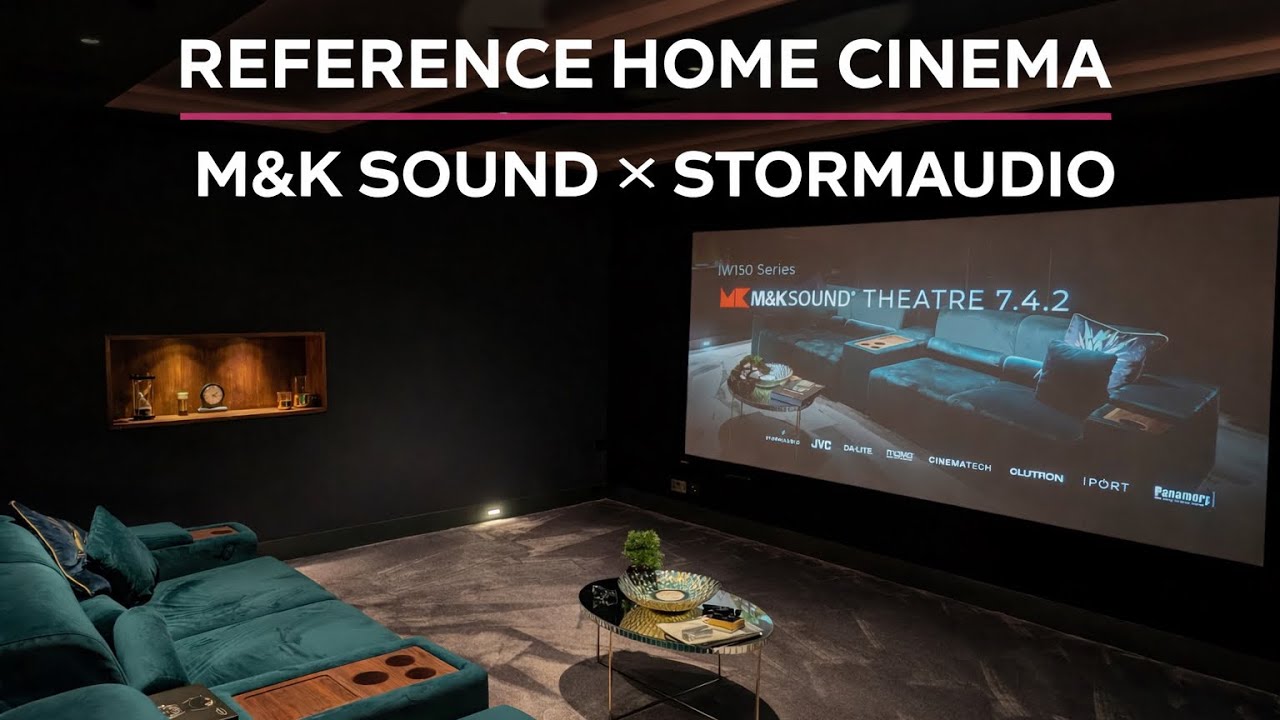
The result: a CinemaScope screen, full surround sound with ceiling Atmos speakers, a bar area with fridges, an arcade machine with retro gaming, air conditioning, and a motorised screen that opens for film and retracts to reveal the room for other uses.
Project Features
| Feature | Detail |
|---|---|
| Screen | CinemaScope, motorised (open/retract) |
| Audio | Surround + ceiling Atmos speakers |
| Side speakers | Pair, integrated into room |
| Ceiling speakers | Pair (Atmos height layer) |
| Gaming | PlayStation + retro arcade machine (Street Fighter) |
| Bar area | Fridge, accessories, accent lighting |
| Air conditioning | Heating and cooling (essential in loft space) |
| Lighting | LED accent + cinema mode dimming |
| Wall covering | Shimmer material — visible in light, disappears in dark |
The Detail That Makes a Room
Walking into the finished space for the first time, Atif was immediately struck by the specification choices the clients had made. The wall covering was an unexpected detail.
"Great choice of wall covering — in the light, you can see a slight shimmer to it. But once all the lights are down and the blinds are closed, it doesn't detract from the visuals. And where you've got the accent lighting, where the fridges are, you can just about see what you're doing."
This is the kind of specification decision that separates rooms that look good in photographs from rooms that feel right to inhabit. The shimmer material catches accent light in social mode; it disappears when the cinema is in use. It's a material that works for both functions of the room.
The demarcation between the carpet area (cinema seating) and the bar area (hard floor) was another design choice that drew comment.
"Love the demarcation between the carpet and the bar area. Absolutely superb."
From "Excessive" to Indispensable
Hayley's view shifted the moment the room was finished. The family's actual use of the space answered every question about whether it was worth it:
"A lot of the time it gets dominated by my ten-year-old son gaming, speaking to his friends. We can sort of get various different uses out of it. Or we can just go up there in an evening and watch a film."
The five-year-old watches Garfield and Star Wars. The ten-year-old uses it for gaming. Hayley and Marco use it for evening films together, and for family gatherings. The room is busy — not preserved.
On the question of commercial cinema:
"I think now it'd have to be something I really wanted to watch to go and pay to go to a cinema. A lot of people might look at something like this and think it's excessive — but actually for a lifestyle thing, for us it's nice because we've got it now. As a family we can in the evening come together and watch that together."
The Word-of-Mouth Effect
Guests who've seen the room have started asking for the same thing. The Northamptonshire client network is now generating referrals.
"People when they actually see it, I think they realise that it is a lot more achievable than what people think. We've had people around who've been really impressed — to the point where they've said, 'How did you get this done? We want the details.'"
This pattern — neighbours and friends visiting, seeing the room, then contacting Zebra — is how the best home cinema projects multiply. The finished room is its own best advertisement.
Key Takeaways
- ▪Start with what your house can accommodate, not what you'd ideally build — the best brief works within real constraints
- ▪A loft cinema needs air conditioning — loft spaces heat and cool dramatically; climate control is not optional
- ▪The motorised screen makes the room multi-purpose — cinema when you want it, play space when you don't
- ▪Wall covering matters for dual-use rooms — materials that work in both ambient and dark cinema modes are worth specifying
- ▪The family will use it differently than you planned — leave room for gaming, social use, and casual viewing
FAQ: Family Loft Home Cinema Conversions
Is a loft cinema suitable for a family with young children?
Yes — and often it's a better choice than a basement cinema for families, because it keeps the children in the house and audible. The acoustic isolation provided by a converted loft means the family above doesn't disturb the rest of the house, and children watching films or gaming are contained in a safe, comfortable space. Air conditioning and proper ventilation are essential in loft spaces.
Can a loft cinema in a semi-detached house disturb neighbours?
With proper acoustic isolation — decoupled walls, acoustic underlay, solid construction — the sound transmission to adjoining properties can be managed to acceptable levels for normal domestic use. Reference-level bass at high volumes is the hardest parameter to control. Most family use operates well below that threshold.
What is a CinemaScope screen in a home cinema?
CinemaScope (2.35:1 or 2.40:1 aspect ratio) refers to the ultra-widescreen format used in major Hollywood productions. A 2.35:1 screen fills a wider field of view than a standard 16:9 display and matches the native format of most films. With a motorised screen and auto-masking, it can also display 16:9 content correctly without wasted screen area.
Does a home cinema reduce the need to visit commercial cinemas?
For many home cinema owners, yes. When the picture quality, sound quality, and seating comfort of the home installation match or exceed what's available locally at a multiplex, the decision to go out is reserved for genuinely special releases — large-scale IMAX films, opening nights, social occasions. The convenience of watching in your own space, on your own schedule, in your own seat, is a significant quality-of-life change.
What is the typical timeline for a loft cinema conversion project?
From first consultation to completed installation, a full loft cinema project typically takes six months to a year, accounting for design refinement, building work, and installation sequencing. Projects that begin before the loft conversion itself is underway achieve the best results — pre-wiring during the build is far easier than retrofitting cable routes after construction is complete.
Frequently Asked Questions
What's it like to have a loft converted into a home cinema?
The client experience is dominated by two phases: the structural build (which feels like any major loft conversion — noise, dust, displacement) and the equipment commissioning (which feels like a precision instrument being tuned). Most clients say the second phase is the surprising one — the moment a calibrated room comes alive is dramatically different from anything they expected from a domestic AV install.
How long does a loft cinema conversion take?
Four to seven months end-to-end is typical for a UK loft cinema, depending on whether the loft already has a usable shell or needs roof and structural work first. The cinema-specific finishing (acoustic panels, projector mount, screen, cabling, calibration) usually adds four to six weeks on top of the structural conversion timeline.
What surprises clients during a loft cinema build?
Most commonly: the impact of acoustic treatment (clients underestimate how much it changes the sound), the time required for proper calibration (a full picture and audio pass takes a day or more), and how invisible a well-integrated system can be — speakers, screens, and projectors disappearing into the architecture rather than dominating the room.
What budget should I plan for a loft cinema conversion?
A fully-treated, dedicated loft cinema in the UK typically runs £80,000–£200,000 inclusive of structural work, acoustic treatment, equipment, seating, and integration. The structural conversion is usually 30–40% of total cost; equipment, seating, and integration take the rest.
Would clients do it again?
In the projects Zebra has completed, the answer is nearly universally yes — but with hindsight changes. The two most common second-time decisions are: invest more in acoustic treatment up front, and specify the seating personally rather than choosing on data sheets alone.